
Virtually every opera ever composed since the art form was invented 420+ years ago failed to make the international performance repertory – those operas that well-regarded opera companies have chosen to perform periodically.
Over the past two decades, since the creation of this website, I have posted performance reviews of the world premieres or world premiere runs (an early repeat performance taking place a few days after a world premiere) of 28 new operas.
This review is of the third performance of “The Righteous”, an opera composed by Gregory Spears to a libretto by the United States’ 22nd Poet Laureate, Tracy K. Smith. This is the second collaboration between Spears and Smith, following 2022’s “Castor and Patience”, which premiered at the Cincinnati Opera. That opera followed Spears’ most often performed opera to date, “Fellow Travelers” with a libretto by Greg Pierce.
“The Righteous” centers around political activities in three time periods, 1979, 1986 and 1990. The opera differs from other operatic endeavors in that there is very little onstage action, but long arias, each describing in song a character’s viewpoints on whatever matters to him or her at a given moment.
The opera’s cast is comprised of 11 named characters and six minor characters. Five of the named characters share their names (or a name similar to theirs) with members of Saul’s family that appear in the Old Testament Book of 1 Samuel. These five are Governor Paul Ward (King Saul), Paul’s son Jonathan, Jonathan’s friend David, David’s first wife Michele (Michal) and Paul’s wife Marilyn (Ahinoam), the mother of Jonathan and Michal. CM, Paul’s campaign manager, is closely associated with Paul’s family. Jacob, a preacher from the black community, is another character.
Four of the characters are assoiated with the family of David’s second wife, Sheila. These are Sheila’s daughter Shannon and Sheila’s divorced husband (and Shannon’s father), Eli. Shannon’s friend Deirdre also in the opera.
Michael Mayes’ David
[Photo: Michael Mayes as David; edited image, based on a Curtis Brown photograph, courtesy of the Santa Fe Opera.]

After the chorus of Santa Fe Apprentices sing an opening prayer, Governor Paul (Greer Grimsley), his campaign manager CM (Brenton Ryan), Paul’s son Jonathan (Anthony Roth Costanzo) and Jonathan’s close friend David (Michael Mayes) are hunting in the mountains. To set that scene, the back walls of the Santa Fe Opera stage open to reveal the evening sky and to highlight the nearby mountain ranges that surround the opera house.
IIn the opera, David is a minister. Mayes’ David explored his relationship with his Lord, singing with a beautifully expressive, secure legato. As the opera progresses, circumstances will cause David to leave his ministry to pursue a political career, providing several opportunites for David to reflect on the intersection of religious faith and political activity. Over time, David will become increasingly conservative politically.
[Photo: as its minister, David (Michael Mayes, left) preaches to his church’s congregation; edited image, based on a Curtis Brown photograph, courtesy of the Santa Fe Opera.]
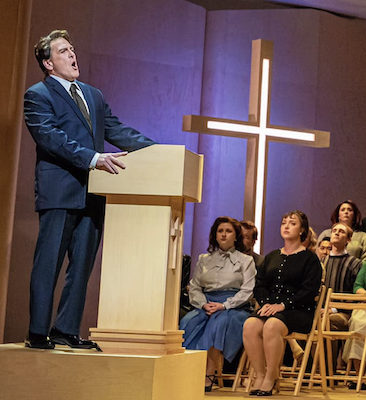
This was my third opportunity to hear Mayes, who is a rising star operatic baritone. Previously, I reported on his Count di Luna, which suggested an ability to master the Verdi baritone repertory. [See Review: “Il Trovatore”- Impressive debuts for Meade, Muehle, Mayes and Sourouzian – Seattle Opera, January 13, 2019,]
Anthony Roth Costanzo’s Jonathan
Anthony Roth Costanzo lent his vocally brilliant countertenor and dramatic skill to creating a sympathetic portrait of the senator’s son.
It seems obvious that Jonathan’s friendship with David is meant to be an important element in the opera’s story, although one of the libretto’s curious features is its failure to provide more information on their friendship’s history. In an opera whose characters’ describe their inner thoughts and emotions at length, the evolution and nature of David’s and Jonathan’s relationship is surprisingly inarticulate, and seems at odds with the implied “Saul’s family” association with the First Book of Samuel.
Over the past two millennia, the story of King Saul, and of a passionate relationship between his son Jonathan and the warrior David has caught the imaginations of both Biblical scholars and literary artists. In “The Righteous” there are clearly strong feelings between the two that Jonathan wishes were manifest and which David feels must be suppressed.
David expresses his desire for what seems to be a “marriage of convenience” to Jonathan’s sister Michele. When David becomes a politician, Jonathan presses David to take a position in support of a sympathetic response to the AIDS health crises. At opera’s end, Jonathan hugs David in what seems to be a gesture of regret that feelings for one another could not be openly expressed.
[Photo: Jonathan (Anthony Roth Costanzo, left) and David (Michael Mayes, right) enjoy a moment in each others’ company; edited image, based on a Curtis Brown photograph, courtesy of the Santa Fe Opera.]
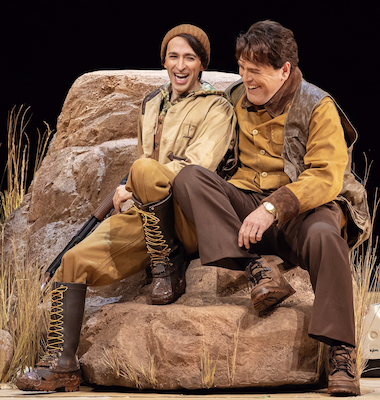
Contrast this with a treatment of similar subject matter in Handel’s dramatic oratorio “Saul”, which director Barrie Kosky presented as impactful opera [Review: A Visually, Vocally Stunning “Saul” at Houston Grand Opera – October 25, 2019]. In Kosky’s staging, the David-Jonathan relationship is presented as overtly physical, without the need for changing a word of the libretto Handel used that was written nearly three centuries ago,
This was the second operatic world premiere run of an opera in which Costanzo and Mayes appeared together, following a Jake Heggie work from nine years ago [World Premiere Review: Heggie’s “Great Scott” is a Great New Opera, Hilarious, Endearing, Sophisticated, Profound – The Dallas Opera, October 30, 2015. ]
See also my interview with Costanzo at: Rising Stars: An Interview with Anthony Roth Costanzo.
[Photo Jonathan (Anthony Roth Costanzo) visits the church; edited image, based on a Curtis Brown photograph, courtesy of the Santa Fe Opera.]
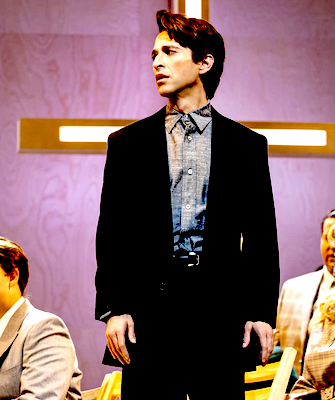
For a previous world premiere performance at Santa Fe Opera , see Review: Anthony Roth Costanzo, Jarrett Ott and Kathryn Henry Lead Strong Cast for Corigliano’s New “Lord of Cries” – Santa Fe Opera, July 21, 2021.
See also Review: Houston Grand Opera’s Resilient “Julius Caesar” Showcases Anthony Roth Costanzo and Stellar Cast – October 27, 2017 and Review: An Engaging Cast, Handel’s Seductive Music, and Christopher Alden’s Surreal Staging Enliven San Francisco Opera’s “Partenope” – San Francisco Opera, October 15, 2014.
Greer Grimsley’s Paul
[Photo: Greer Grimsley as Paul; edited image, based on a Curtis Brown photograph, courtesy of the Santa Fe Opera.]
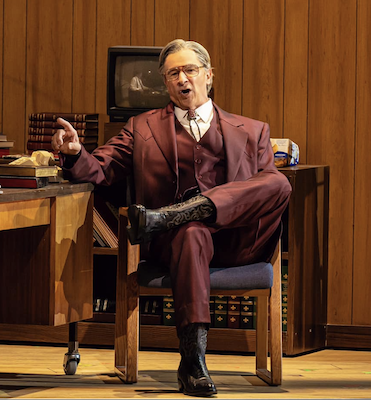
Louisiana baritone Greer Grimsley gave a vocally solid, dramatically persuasive performance as Paul, an oil magnate who was elected United States senator. A fatal heart attack in first act opens the way for his son’s friend David to pursue and win Paul’s Senate seat.
have admired Grimsley’s performances in a wide range of dramatic baritone roles, including the Dutchman [Review: Grimsley, Lindstrom Launch a Sonically Lavish, Visually Dazzling “Flying Dutchman” – San Francisco Opera, October 22, 2013], Don Pizarro [Review: A Finely Crafted “Fidelio” from Stephen Wadsworth – Santa Fe Opera, July 31, 2014], Sweeney Todd [Review: Greer Grimsley Stars in Christopher Alden’s Staging of “Sweeney Todd” – Glimmerglass Festival, August 4, 2016] and Wotan [Review: Francesca Zambello’s Iconic “Walküre” – San Francisco Opera, June 20, 2018]
See also Ambassador for Opera: An Interview with Bass-Baritone Greer Grimsley.
Jannifer Johnson Cano’s Michele
[Photo: Jennifer Johnson Cano as Micheole; edited image, based on a a Curtis Brown photograph, courtesy of the Santa Fe opera.]
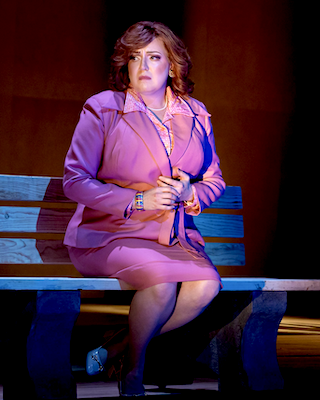
This was my first opportunity to hear Missouri-born mezzo-soprano Jennifer Johnson Cano, who performed the role of the minister David’s wife Michele.
As the daughter of Senator Paul Ward, Cano’s Michele was a politically useful spouse, although one that could not trust her husband’s wandering eye. Ultimately, she divorces David, but develops a friendship with his second wife, Sheila.
Cano, whose voice has an attractive timbre, proved a formidable presence in the role.
Wendy Bryn Harmer’s Marilyn
[Photo: Wendy Bryn Harmer; edited image, based on a Curtis Brown photograph, courtesy of the Santa Fe Opera.]
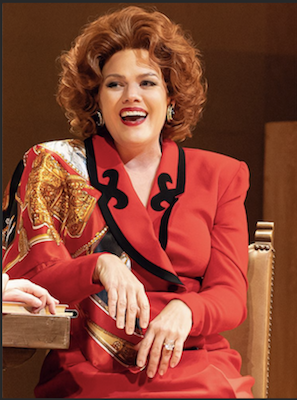
California-born soprano Wendy Bryn Harmer was a lively presence in the role of Marilyn, Paul’s wife, later widow, and the mother of Michele and Jonathan.
Demonstrating vocal power and superb technique, Harmer excelled as family matriarch and politician’s wife.
I have praised Harmer’s work in the operatic endeavors of such diverse composers as Wagner [Review: A Richly Rewarding, Re-imagined “Rheingold” – Seattle Opera, August 4, 2013], Johann Strauss [Review: A Feisty, Funny “Fledermaus” – Houston Grand Opera, November 2, 2013] and Prokofiev [Review: Opera Philadelphia’s Richly Melodic, Laugh-filled “Love for Three Oranges” – September 20, 2019]. See also: Rising Stars: An Interview with Wendy Bryn Harmer
Brenton Ryan’s CM
[Photo: Brenton Ryan as CM; edited image, based on a Curtis Brown photograph, courtesy of the Santa Fe Opera.]
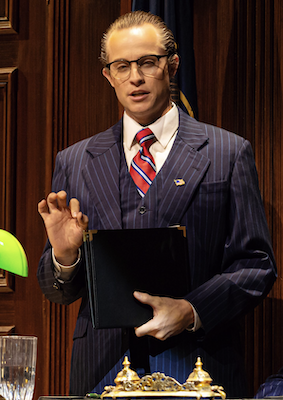
Appearing in the role of Paul’s campaign manager, CM, is Missouri tenor Brenton Ryan, who was a vocally solid, authoriatitive presence. This was the second world premiere run I reviewed in whicn Ryan performed, following a new John Adams opera [See World Premiere Run Review: Adams’ “Antony and Cleopatra” – San Francisco Opera, September 18, 2022.]
Over the past decade, I have seen Ryan excel in a diverse repertory of “character tenor” roles, including Countess Almaviva’s and Cherubino’s love child, Leon [Review: Los Angeles Opera Launches Ambitious New Production of “Ghosts of Versailles” – February 7, 2015], the Novice [Review: An Indomitable “Billy Budd”, San Francisco Opera, September 7, 2019] and Monsieur Triquet [Review: Robert Carsen’s Production of “Eugene Onegin”, Admirably Performed – San Francisco Opera, October 9, 2022].
Nicholas Newton’s Jacob
[Photo: Nicholas Newton as Jacob; edited image, based on a Curtis Brown photograph, courtesy of the Santa Fe Opera.]

The role of the preacher Jacob was performed with distinction by California bass Nicholas Newton. The artist, who is appearing in the current Santa Fe Opera season as Leporello in “Don Giovanni” [Review: Stephen Barlow Creates an Elegant New “Don Giovanni” Production – Santa Fe Opera, June 29, 2024] had been a Santa Fe Opera Apprentice two years prior, in which he was cast as Don Basilio in a rollicking production of “Barber of Seville” [Review: A Hilarious “Barbiere di Siviglia” from Hopkins, Swanson, Fons and Burdette – Santa Fe Opera, August 6, 2022].
The character of Jacob adds little to the opera’s plot, but allows a commentary by composer Spears and librettist Smith on the negative impact of Nancy Reagan’s “War on Drugs” on minority communities.
Elena Villalón’s Sheila
[Photo: Elena Villalón as Sheila; edited image, based on a Curtis Brown photograph; courtesy of the Santa Fe Opera.]
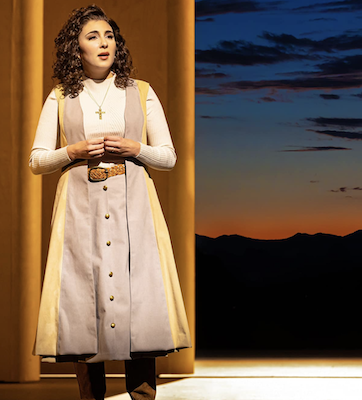
Texas lyric coloratura soprano Elena Villalón sang brilliantly in the role of Sheila, who, when the opera begins, is married to Eli.
This was my fourth opportunity to review a Villalón performance, all taking place in Houston or Santa Fe , following performances of Ines [Review: Jamie Barton, a Phenomenon in “La Favorite” – Houston Grand Opera, January 24, 2020], Amy [ Streamed World Premiere Review: Joel Thompson’s and Andrea Davis Pinkney’s “The Snowy Day” – A Child-friendly Opera for the Winter Holidays, Houston Grand Opera, December 9, 2021] and Nannetta [Review: Quinn Kelsey Delights in Sir David McVicar’s New “Falstaff” Production – Santa Fe Opera, August 4, 2022.]
Villalón’s Sheila takes a job at David’s church. In time, Sheila becomes David’s second wife.
Andrew Turner’s Eli and Jasmine Saunders’ Shannon
[Photo: Andrew Turner (left) is Eli and Jasmine Saunders is Eli’s daughter Sahnnon; edited image, based on a Curtis Brow photograph, courtesy of the Santa Fe Opera.]
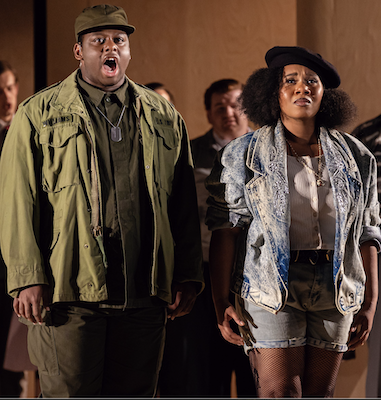
Washington tenor Andrew Turner was cast as Eli, Sheila’s first husband. Their daughter, Shannon, was played by Santa Fe Opera Apprentice Jasmine Saunders.
Turner had appeared at Santa Fe Opera two season’s earlier in the small role of the Arresting Agent in Ruo’s and Huang’s “M. Butterfly”.
Natasha Isabella Gesto’s Deirdre and Other Cast Members
[Photo: Soprano Natasha Isabella Gesto as Deirdre; edited image, based on a Curtis Brown photograph, courtesy of the Santa FeOpera.]
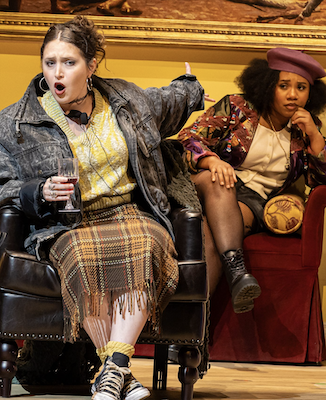
Australian soprano Natasha Isabella Gesto’s vocal performance as Shannon’s university friend Deirdre was dramatically effective.
I had seen Gesto two days earlier in the tiny role of the Dressmaker in the first act of Richard Strauss’ “Der Rosenkavlier”. In “The Righteous” It is Deirdre that vehementily disagrees with then Governor David’s political positions.
Three Women were performed by California soprano Isabel Anthony, California mezzo-soprano Ashlyn Brown, and Canadian mezzo-soprano Tessa Fackelmann.
Three Deacons were performed by Kansas baritone Cole Bellamy, Pennsylvania bass-baritone Luke Harnish and New York tenor Matthew Goodheart.
Maestro Jordan De Souza and the Santa Fe Opera Orchestsra and Chorus
[Photo:: Maestro Jordan de Souza; edited image based on a publicity photograph from jordandesouza.com.]

In his Santa Fe Opera debut, Maestro Jordan De Souza, led the Santa Fe Opera Orchestra in a fine reading of Gregory Spears’ intricate musical score. The Chorus, comprised of Santa Fe Opera Apprentices under the leadership of Utah Chorus Master Susanne Sheston, added excitement to the performance.
Director Kevin Newbury’s Production and Mimi Lien’s Scenic Design
It would seem a challenge to stage an opera with relatively little action and long arias discussing the political and social issues of an 11 year period.of late 20th century America. Maryland director Kevin Newbury met that challenge with the use of movable sets created by New York’s Tony-winning Mimi Lien, allowing for fast moving scene changes.
Over the past 11 years, I reviewed three world premiere productions created by Newbury,. In 2013 he produced a new opera by Adamo in San Francisco [Review: Warm Reception for Adamo’s “Mary Magdalene” – San Francisco Opera, June 19, 2013] and another by Morrison in Santa Fe [World Premiere Review: “Oscar” at Santa Fe Opera, July 27, 2013.] In 2017, at Santa Fe Opera, he directed the most successful of these three operas [World Premiere Review: Ovations for the (R)evolution of Steve Jobs – Santa Fe Opera, July 22, 2017.]
Newbury’s versatility as a director is demonstrated by his inventive productions for standard repertory operas by Bellini [Review: Sondra Radvanovsky’s Stunning Season Opening “Norma” – San Francisco Opera, September 5, 2014] and Gounod [Review: Benjamin Bernheim Leads Superb “Faust” Cast – Lyric Opera of Chicago, March 12, 2018.]
Final Thoughts
“The Righteous” differs in structure not only from the other 27 world premiere operas I have reviewed previously, but also from every other opera of which I have knowledge. The opera has the feel of a series of essays on contemporary subject matter composed to be sung.
The basic premise, that tensions can arise between the articles of one’s faith and current political issues, suggests dramatic possibilities far beyond what is actually realized, but this did not seem to be a priority of the works’ creators. Neither did the idea of further exploring the “David-Jonathan” relationship that the naming of the characters seems to imply. Perhaps the work will gain its fanbase over time, but its survival as a contemporary repertory opera seems unlikely.