
The San Francisco Opera’s music director, South Korean Maestra Eun Sun Kim, has committed to conducting one Verdi and one Wagner opera each San Francisco Opera season. This provides the company with an opportunity to give special attention to works of the two 19th century operatic geniuses. Verdi’s mid-19th century opera “Rigoletto” is the third Verdi opera to be chosen by Maestra Kim for this special recognition.
Attention has been given to the opera’s dramatic flow, by an artist with a longstanding relationship with the company, Argentina-born California director Jose Maria Condemi. Given a director who appreciates the dramatic power of Francesco Maria Piave’s libretto (such as Condemi) new insights can be derived from this repertory standard.
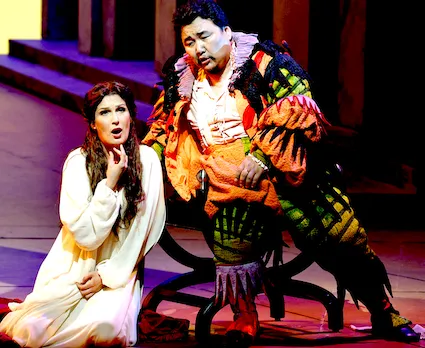
Amartuvshin Enkhbat’s Rigoletto
[Photo: Amartuvshin Enkhbat as Rigoletto; edited imagek based on a Cory Weaver photograph, courtesy of the San Francisco Opera.]

Mongolian dramatic baritone Amartuvshin Enkhbat returned to the San Francisco Opera, having previously sung in last season’s Verdi opera. [See Review: Michael Fabiano, Lianna Haroutounian Lead a Beautifully Performed, Intelligently Directed “Ballo in Maschera” – San Francisco Opera, September 15, 2024.]
I had praised Enkhbat’s “sonorous” 2024 San Francisco Opera performance as Renato in Verdi’s “Ballo in Maschera”. Although Renato is a dramatically and vocally challenging role, the role of Rigoletto provides a much greater opportunty to display the vocal power and dramatic persuasiveness that Enkhbat posseses.
I was pleased especially with Enkhbat’s affecting performance of Rigoletto’s reply to Gilda’s inquiries about her mother. Rigoletto sings the passage ‘Deh non parlare al misero del suo perduto bene’, describing his heartfelt remembrances of his deceased wife, which leads to the beautifully sung duet with Adela Zaharia’s Gilda.
A supreme test of both the vocal and dramatic power of a baritone singing Rigoletto is the famous aria “Cortigiani”, in which he implores the Mantuan courtiers to let him know what has happened to his daughter, Gilda. Enkhbat’s impactful performance of the aria confirmed Enkhbat’s vocal and dramatic skills, and was followed by a sustained audience ovation.
Adela Zaharia’s Gilda
[Photo: Adela Zaharia as GIlda; edited image, based on a Cory Weaver photograph, courtesy of the San Francisco Opera.]

In the operatic standard repertory, there is perhaps no more striking example of the consequences of a person living under the control of an overprotective guardian than Rigoletto’s daughter Gilda.
Romanian soprano Adela Zaharia possesses a beautiful lyric coloratura voice, and the role of Gilda abounds in opportunities to display the full range of Zaharia’s vocal powers. One aria, “Caro nome” is in the first rank as an exhibition of a soprano’s coloratura skills. Zaharia’s performance of that aria was stunning, for which the audience awarded her a sustained, fully deserved, ovation.
This was my third opportunity to attend a Zaharia performance.
Gilda was the American debut role for Zaharia at the Los Angeles Opera [See my performance review Review: Spectacular Los Angeles Opera Debuts in “Rigoletto” for Michael Fabiano, Adela Zaharia – May 27, 2018]. Four years later, she made her San Francisco Opera debut as Donna Anna [Review: Dupuis and Pisaroni Lead International Cast for Michael Cavanagh’s New “Don Giovanni” Production – San Francisco Opera, June 12, 2022.]
I regard Zaharia as one of the most talented lyric sopranos currently performing in opera.
Yongzhao Yu’s Duke of Mantua
[Photo: the Duke of Mantua (Yongzhao Yu) enjoys a visit to Sparafucile’s Inn; edited image, based on a Cory Weaver photograph, courtesy of the San Francisco Opera.]

The opera’s first scene introduces us to the Duke of Mantua, performed by Chinese tenor Yongzhao Yu in his San Francisco Opera debut role.
Surrounded by flirting women of the Mantuan court, Yu’s Duke performed the opening balleta ‘Questa o quella’, with a pleasing light lyric tenor voice.
Few characters in opera engender such complex reactions from the opera’s other characters as the Duke of Mantua. Yu plays the character with an affability that, as staged by director Condemi, brings these conflicting perceptions into sharp relief.
Monterone and Rigoletto both have reasons to despise the Duke. Before the opera begins, the Duke has seduced Monterone’s daughter. Monterone denounces the Duke and curses Rigoletto when he mocks Monterone on the Duke’s behalf. Midway through the opera, Rigoletto discovers that the Duke has defiled his daughter Gilda. Rigoletto plots to revenge his daughter by paying to have the Duke killed.
Both the virginal (at opera’s beginning) Gilda and Maddalena (the sister and accomplice of the assassin Sparafucile) succumb to the Duke’s charms. Maddalena convinces her brother to save the Duke’s life by killing an innocent person. Gilda sacrifices her life to prevent the Duke’s death
[Photo: the Duke (Yongzhao Yu, left) and Gilda (Adela Zaharia, right) kiss; edited image, based on a Cory Weaver photograph, courtesy of the San Francisco Opera]

Verdi’s music gives us a hint of another element to the situation. Perhaps the Duke himself fantasizes he is in love. Psychologists might confirm or dispute the possibilities, but I can imagine the Duke believing himself to be an impoverished student, the Gualtier Malde of Gilda’s aria ‘Caro nome’.
Consider the romantic music Verdi composed for the Duke’s duet with Gilda, especially the ‘cantabile’ beginning ‘”E’il sol dell’anima, la vita e amore’. Could it have been any sweeter if the duke was really an impoverished student? Consider also the passion in the ‘vivacissimo’ passage ‘Addio, addio, speranza ed anima’ that Gilda and the Duke sing, when the Duke needs to depart quickly.
Piave’s libretto provides further support for a thesis that the Duke has genuine feelings for Gilda in the text of the Duke’s solo aria at the beginning of the third act [Act 2 Scene 1 in the San Francisco Opera production). This is Ruth and Thomas Martin’s translation of the Duke’s soulful aria “Parmi veder le lagrime”: “Torn from him who adores you, despairing, weeping in terror. Dearest, you must have suffered alone in sudden terror. . .” Then to the aria’s next phrase – in Italian ‘dell’amor nostro memore, il suo Gualtier chiaro’ which the Martins translate as “You seem to hear me calling you, your own Gualtier Malde”.
Even after his courtiers arrive to tell the Duke that they have kidnapped Gilda, the Duke exclaims ‘Possente amor mi chiamo, . . . Il serto mio darei per consolar quel cor’ which the Martins translate “With all my heart I love her ,. . . I’d throw my crown away to lighten her despair”
These passages suggest that in the days prior to the scene between Rigoletto’s apartment, that the Duke has become attracted to Gilda in church, interacted with her, followed her as she left for home to determine where she lived, and then became the poor student Malde to court her. Later, finding her aparment deserted, he returned to his palace continuing to act as (or believe himself to be) the student Malde.
I suspect that some persons find Gilda’s behavior after her kidnapping mystifying, but perhaps she continues to have feelings for the idea of Malde, even after she has learned he is in reality the Duke.
Those sympathetic with the positions of Monterone and Rigoletto (and likely many in the 21st century opera audiences) would consider the Duke to be a self-absorbed, dangerous force around women, who deliberately grooms vulnerable girls like Gilda for nefarious purposes.
For the first and last scenes Yu, personifying the Duke’s general love for women, ardently performs the big tenor numbers, “Questa o quella”, “La donna e mobile’ and the opening theme of the “Rigoletto Quartet”. In the second and third scenes, he displays his love for one woman, Gilda, with whom – it is possible to believe – he has fallen in love.
Peixin Chen’s Sparafucile
[Photo: Peixin Chen as Sparafucile; edited image, based on a Cory Weaver photograph, courtesy ofthe San Francisco Opera.]

Texas tenor Peixin Chen, in his San Francisco Opera debut role, was an imposing Sparafucile.
Just as I was present for another Zaharia Gilda in a different opera house, this was my second opporutnity to experience a Chen Sparafucile, seven years after his performance of the role in Santa Fe [Review: Quinn Kelsey, Georgia Jarman – Powerful Performances in Lee Blakeley’s New Santa Fe Opera “Rigoletto” – July 4, 2015.]
Chen’s powerful bass voice was authoratative. Chen’s Sparafucile serves a unique function in society. He imposes capital punishment in a private judicial system. (Interestingly, his price for killing a nobleman, twenty scudi, is the amount of gold crowns that Nemorino receives for enlisting in Belcore’s company in Donizetti’s “L’Elisir d’Amore”)
Sparafucile is always present in the streets surrounding Rigoletto’s apartment. In Condemi’s staging of the finale to the second scene (when the Duke’s courtiers are kidnappng Gilda), Sparafucile is spotlighted, standing in an alcove, observing.
Over the past decade, I have seen Chen perform roles large and small, including such important and varied roles as Mozart’s Doctor Bartolo [Review: Boogie Nights at Mozart’s “Marriage of Figaro” – Houston Grand Opera, January 30, 2016] and Bellini’s Oroveso [Review: Beautifully Sung “Norma” at HGO Resilience Theater – Houston Grand Opera, April 29, 2018 ]
J’Nai Bridges’ Maddalena
[Photo: J’Nai Bridges as Maddalena; edited image, based on a Cory Weaver photograph, courtesy of the San Francisco Opera.]

One of the most rewarding comprimario roles for a mezzo-soprano is that of Sparafucile’s sister, Maddalena. Although she sings only in the final act, it is an act filled with two of Verdi’s most popular compositions, the Duke’s ‘La Donna e mobile’ and the Quartet in which Maddalena joins the Duke, Rigoletto and Gilda.
Director Condemi gives Washington State mezzo-soprano J’Nai Bridges additional stage time, having her appear in the first scene between Rigoletto and Sparafucile, as the latter introduces her as the woman who lures men he has contracted to kill.
Bridges brought star quality to the role, beautifully performing Maddalena’s familiar music.
I have praised Bridges’ performances in the title role of Francesca Zambello’s production of “Carmen” [Review: Francesca Zambello’s Theatrically Compelling “Carmen” – San Francisco Opera, June 5, 2019], and as Bersi in Sir David McVicar’s production of “Andrea Chenier: [Review: Yonghoon Lee is an Eloquent Andrea Chénier in McVicar’s Cinematic Staging – San Francisco Opera, September 9, 2016].
In addition, Bridges created the role of Dame Shirley in a new John Adams’ opera [World Premiere Review: Adams’ “Girls of the Golden West”, San Francisco Opera, November 21, 2017.]
Aleksey Bogdanov’s Count Monterone
[Photo: Aleksey Bogdanov (center) as Count Monterone; edited image, based on a Cory Weaver photograph, courtesy of the San Francisco Opera.]

Ukrainian baritone Aleksey Bogdanov (now listed as a San Francisco, CalIfornia resident) performed the role of the Count Monterone. It is Monterone’s curse, chillingly sung by Bogdanov, that propels the opera’s action.
I have praised Bogdanov performances over the past 15 years.
At the Washington National Opera, I commended Bogdanov for his appearances as a Gravedigger [Review: Michael Chioldi, Micaela Oeste Enrich Washington National Opera’s Theatrically Absorbing “Hamlet” – May 22, 2010] and as Masetto [ Review: Ildar Abdrazakov is Don Giovanni in the Pascoe Production’s Revival – Washington National Opera, October 7, 2012]..
At the Sarasota Opera Bogdanov sang the role of Sebastiano [Review: Sarasota Opera’s Triumphant “Tiefland” Stars Kara Shay Thomson, Ben Gulley – March 18, 2018]
Other Cast Members
The named Mantuan courtiers were portrayed by Delaware baritone Olivier Zerouall as Marullo; South Carolina tenor Samuel White as Matteo Borsa and South Korean bass-baritone Jongwon Han as Count Ceprano. Missouri soprano Caroline Corrales was Countess Ceprano. Australian mezzo-soprano Stella Hancock was Gilda’s housekeeper, Giovanna. California soprano Eliza Sunshine was the Duchess of Malta’s page. (Each of these cast members are current or graduate Adler Fellows, the San Francico Opera’s year round Young Artists’ program).
Minnesota baritone William Lee Bryan, a member of the San Francisco Opera regular chorus, was an Usher.
Maestra Eun Sun Kim and the San Francisco Opera Orchestra and Chorus
[Photo: Maestra Eun Sun Kim; edited image, based on a Cody Pickens photograph, courtesy of the San Francisco Opera.]

Maestra Eun Sun Kim conducted well-played performances of the San Francisco Opera Orchestra and well-sung performances of the San Francisco Opera Chorus, the latter under the direction of Pennsylvania Chorus Master John Keene.
Beginning with the 2023-24 San Francisco Opera season, Maestra Kim has paired a Verdi and Wagner opera each season to conduct personally. This is the third Verdi opera to be selected for the annual pairing following “Il Trovatore” [Review: Chacon-Cruz, Angel Blue, Semenchuk and Petean in Rousing, Richly Dramatic Performance of “Il Trovatore” – San Francisco Opera, September 17, 2023] and the “Un Ballo in Maschera”, cited above, in which Enkhbat appeared.
Including Maestra Kim’s recent conducting of “Traviata” [Review: “La Traviata” Delightful New Production, Well-Received Debuts by Yende, Tetelman and Piazzola – San Francisco Opera, November 22, 2022], her association with the mid-19th century trio of Verdi blockbusters {“Rigoletto”/”Trovatore”/”Traviata”) demonstrates her superb grasp of Verdi’s central place in the Italian repertory.
Jose Maria Condemi’s Direction
[Photo: Director Jose Maria Condemi; edited image, based on a publicity photograph, courtesy of the San Francisco Opera.]

The production’s director was Argentina-born California director Jose Maria Condemi. Over the past 20 years I have followed his masterful work, as director of new productions, revival director and associate director.
Much of Condemi’s philosophical approach to directing, he has enunciated in my posted interviews with him, posted in my 2010 interview Rising Stars: An Interview with Stage Director José Maria Condemi. In that interview Condemi stated “Stage directors always like to have a free rein and new productions. But I find this other approach – utilizing existing sets and costumes for different purposes than originally conceived – to be challenging and, to me, equally exciting.” He followed this with a two-part 2015 interview The Art of Staging Opera – A Conversation with José Maria Condemi Part 1 and The Art of Staging Opera – A Conversation with José Maria Condemi Part 2.
My reviews of operas with Condemi-associated productions mounted by the San Francisco Opera span two decades, and include the revivals of productions created by John Cox [Review: Warhorse Warriors – John Cox’ ‘Cosi Fan Tutte’ at San Francisco Opera, July 2, 2005]. Frank Corsaro, [Review: Racette Ravishing, Relyea Riveting in San Francisco “Faust” – June 5, 2010] and Jose Cura [Review: San Francisco Opera Season Opening “Cavalleria Rusticana/Pagliacci” Part I – Nicely Sung, Brilliantly Staged, September 7, 2018 and Review: Thrilling Performances in San Francisco Opera Season Opening “Cavalleria Rusticana/Pagliacci” Part II, September 7, 2018
[Photo: Gilda (Adela Zaharia, left) describes what she has just experienced in the Duke of Mantua’s private chambers to her angry father, Rigoletto (Amartuvshin Enkhbat, right); edited image, based on a Cory Weaver photograph, courtesy of the San Francisco Opera. ]
To witness Condemi’s works elsewhere I have traveled to Chicago [Review: Licitra, Radvanovsky Gleam in Lyric Opera’s Glorious New “Ernani” – Chicago, November 5, 2009], San Diego [Review: Costello, Pérez, Grimsley and Mulligan Brilliant in Spectacularly Staged “Faust” – San Diego Opera, April 23, 2011], Seattle [Review: William Burden Triumphs in Gluck’s “Orphée et Eurydice” – Seattle Opera, February 29, 2012], Cincinnati [Review: Ailyn Pérez and Stephen Costello Star in Cincinnati Opera’s “La Traviata” – July 26, 2012], Salt Lake City [Review: A Florid, Flowing “Florencia” in Salt Lake City – Utah Opera, January 19, 2013], and Houston [Review: Liudmyla Monastyrska, Issachah Savage Lead Strong “Aida” Cast – Houston Grand Opera, November 1, 2013
Michael Yeargan’s Scenic Design
[Photo: In the Duke of Mantua’s court, Rigoletto (Amituvshin Enkhbat, kneeling in front of central column, begs the courtier Marullo (Oliver Zerouall, standing center left) to help him find his daughter; edited image, based on a Cory Weaver photograph courtesy of the San Francisco Opera.]

Michael Yeargan’s scenic design for San Francisco Opera’s production of Verdi’s “Rigoletto” was first performed in 1997. The production was strongly influenced by 20th century artist Giorgio de Chirico’s paintings, whose towering, strikingly lit arches and angular surfaces gave a perspective that seems both familiar and surreal. For my report on another production influenced by Giorgio de Chirico’s paintings, see Review: A Well-Sung “Tosca” Starring Leah Hawkins, Joshua Guerrero, Reginald Smith, Jr. and Blake Denson – Santa Fe Opera, June 30, 2023].
Yeargan’s “Rigoletto” production is notable for a structure that represents, in the second scene, Rigoletto’s apartment and in the final scene, Sparafucile’s inn. It is wheeled onto center stage from stage left, at the appropriate times.
California designer Constance Hoffman created the costumes. Irish choreographer Colm Seery created the dances and crowd movement.
Recommendation
I strongly recommend the cast and musical performance of San Francisco Opera’s 2025 mounting of “Rigoletto”, both for the veteran opera goer and the person new to opera.