The last production of San Francisco Opera’s 2024-25 season to open was Mozart’s “Idomeneo” The earliest of Mozart’s seven most important operas, it dates from 1781 when Mozart was not quite 25 years old.
Matthew Polenzani’s Idomeneo
The opera takes place in the aftermath of the Trojan War on the Island of Crete. The Kingdom of Crete was allied with the winning Greeks in defeating the Trojans. The opera’s title character, Idomeneo, in Greek mythology, commanded a fleet of 80 ships, was a trusted adviser to the Mycenean King Agamemnon and was invited by Agamennon’s brother Menelaus (King of Sparta) to join the warriors inside the Trojan Horse that led to Troy’s defeat.
[Photo: Matthew Polenzani as Idomeneo; edited image, based on a Cory Weaver photograph, courtesy of the San Francisco Opera.]

The opera begins after Idomeneo has had a near death experience in a storm-battered ship. During the storm, the god Neptune extracts an oath from Idomeneo that if Neptune saves him and his crew, Idomeneo will sacrifice the first person he meets ashore. The first person Idomeneo meets is the leader of a search party, his son Idamante.
Cast as Idomeneo was Illinois tenor Matthew Polenzani, whom I had seen perform the role seven years prior.[Review: Matthew Polenzani Stars in Jean-Pierre Ponnelle “World Treasure” Production of Mozart’s “Idomeneo” – Lyric Opera, Chicago, November 2, 2018].
A Mozart specialist, I previously had seen him also as Tamino [Conlon’s Magical Revival of Mozart’s “Flute” at Los Angeles Opera – January 10, 2009], Belmonte [Cornelius Meister’s Admirable “Abduction”: San Francisco Opera – October 11, 2009] and Tito [Polenzani and DiDonato Triumph as McVicar Illumines “La Clemenza di Tito” – Lyric Opera of Chicago, March 11, 2014].
In Idomeneo’s big aria “Fuor del mar”, he expresses his dismay that Neptune would have saved him just to create for him a new dilemma. The aria, the opera’s most famous, is considered a feat for a tenor to sing uncut, but Polenzani sang it in its entirety with distinction.
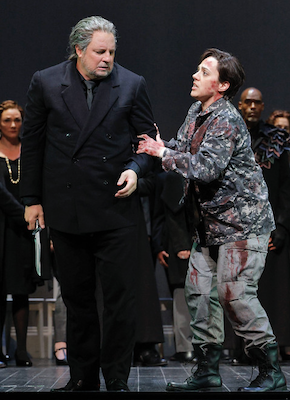
Daniela Mack’s Idamante
San Francisco Opera’s 2008 revival of “Idomeneo” had special significance for the company, as it marked the first major role for the Adler Fellow, Daniela Mack. As the cover for another artist, Mack took over the role of Idamante for the final three of the six scheduled 2008 performances.
[Photo: Idamante (Daniela Mack, right) seeks an action from his father, Idomeneo (Matthew Polenzani, left); edited image, based on a Cory Weaver photograph, courtesy of the San Francisco Opera.}
I was scheduled to review the fourth 2008 performance, and, I believe, was the only reviewer present. My performance review is posted here: Review: An “Idomeneo” Surprise in San Francisco – Daniela Mack’s Princely Idamante, October 26, 2008. This performance proved to be a career-enhancing event. Mack subsequently went on to star in such important roles as Rosina [Review: Daniela Mack, Alek Shrader, Audun Iversen and Maurizio Muraro Sparkle in San Francisco Opera “Barber of Seville” – November 14, 2013], Isabella [Review: Santa Fe Opera’s Delightful “Italian Girl in Algiers” – July 25, 2018] and Frida Kahlo [Review: Daniela Mack, San Francisco Opera Chorus Shine in “El Último Sueño de Frida y Diego”, San Francisco Opera, June 17, 2023].
When San Francisco Opera decided to import Lindy Hume’s Opera Australia production, it was without question that Mack would be invited to reprise the role of Idamante. She projected a believable heir to the Cretan throne. See my interview at: Rising Stars: An Interview with Daniela Mack
I found Idamante’s big aria “Il padre adorato” to be emotionally satisfying, despite Mack’s vocal performance being not quite what one expects from this fine artist. I was not surprised that San Francisco Opera’s General Manager Matthew Shilvock stepped before the curtain at the beginning of the third act, to announce that Mack was suffering from an indisposition, but would soldier on through the remainder of the performance. (Three days later Mack withdrew part-way through her second performance and three days after that missed the third performance, but returned to sing the fourth and last performances in the subsequent week.)
Ying Fang’s Ilia
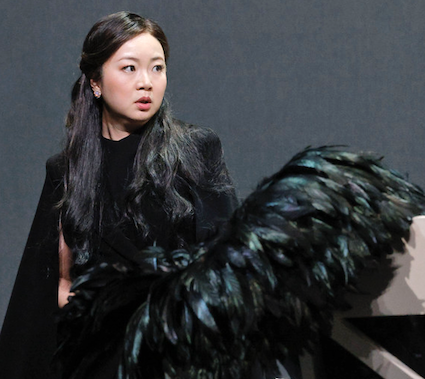
The performance was the occasion for Chinese soprano Ying Fang’s San Francisco Opera debut as Ilia. The daughter of the Trojan King Priam and Queen Hecuba, Ilia was brought to Crete as a slave. Mozart invested the role of Ilia with beautifully crafted arias for each of the opera’s three acts.
[Photo: Ying Fang as Ilia; edited image, based on a Cory Weaver photograph, courtesy of the San Francisco Opera.]
In my reviews of previous Fang performances, I had praised Fang’s Mozartian skills as Susanna [Review: A Clockwork “Marriage of Figaro” Delights – Santa Fe Opera, July 23, 2021] and her charming, vocally impressive Sophie von Faninal [Review: A Spectacular “Der Rosenkavalier” – Santa Fe Opera, July 24, 2024.]
Fang’s impactfully sung solo aria “Padre, germani, addio”, the first aria of the opera, makes clear both her hatred of the Greeks and their Cretan allies and her repressed feelings for Idamante, whose reciprocal feelings for Ilia will become evident.
Ilia’s second act aria “Se il padre perdei” and her third act aria “Zeffiretti lusinghieri” are two of Mozart’s most sublime melodic creations, the first expressing Ilia’s acceptance of the Cretan monarchy’s peaceful overtures towards herself and her Trojan countrymen. In the third aria, Ilia confesses that she loves Idamante. Fang’s expressive lyric soprano was enlisted for superb performances of each of these emotional arias.
Elza van den Heever’s Elettra
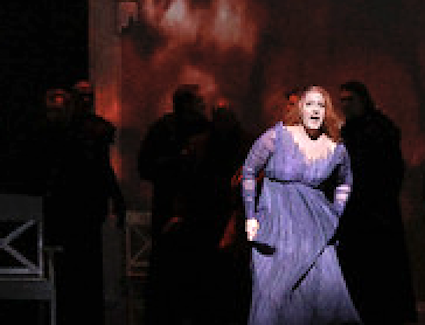
South African soprano Elza van den Heever performed the role of Elettra, Ilia’s rival for Idamante’s hand. Just as Ilia is the daughter of a Trojan power couple, Elettra is the daughter of Mycenean Greek King Agamemnon and Queen Clytemnestra.
[Phoro: Elza van den Heever; edited image, based on a Cory Weaver photograph, courtesy of the San Francisco Opera.]
Like Fang’s Ilia, Van den Heever’s Elettra has an aria for each of the three acts. The three arias encompass the vocal fireworks of Act 1’s “Tutte nel cor vi sento furie del cupo averno” and Act 3’s “D’Oreste, D’Ajace” and Act 2’s seductively amorous “Idol mio”. Van den Heever was in excellent voice, negotiating the complexities of the three challenging arias.
Van den Heever spent two years (2003 and 2004) in San Francisco Opera’s Merola young artist’s program and an additional three years (2005-2007) as an Adler Fellow. (For my early career interviews with Van den Heever, see: Rising Stars: An Interview with Elza van den Heever, Part 1 and Rising Stars: an Interview with Elza van den Heever, Part 2]. Her most recent role at San Francisco Opera before her Elettra was that of Beethoven’s Leonore [See Review: Beethoven’s “Fidelio”, An Excellent Cast for Matthew Ozawa’s Powerful Production – San Francisco Opera, October 17, 2021.]
Alek Shrader’s Arbace and Other Cast Members
[Photo: Alek Shrader as Arbace; edited image, based on a Cory Weaver photograph, courtesy of the San Francisco Opera.]

Oklahoma lyric tenor Alek Shrader reprised his 2008 role as Idomeneo’s counsellor, Arbace. Casting a gifted tenor in the ‘comprimario’ role of a problem-solving functionary is luxury casting. Although his performance was competently performed, this is not a role he needs to retain in his repertory.
Shrader’s presence continues a series of San Francisco Opera performances paired with his wife, Daniela Mack. Shrader’s and Mack’s joint San Francisco Opera appearances have included their 2013 appearances as Rosina and Count Almaviva cited above, and their 2014 and 2024 appearances as Rosmira and Emilio [Review: A Brilliant Production and Strong Performance of Handel’s “Partenope” – San Francisco Opera, June 23, 2024],
See also my interviews and conversations with Shrader at Rising Stars: An Interview with Alek Shrader and “Opera Acting Without Music” – A Conversation with Alek Shrader“.
South Carolina tenor Samuel White was the High Priest of Neptune and Trojan Man #1. Delaware baritone Olivier Zeroljali was Trojan Man #2. South Korean bass-baritone Jongwon Han was the Voice of the Oracle. Illinois soprano Georgina Adams was the Cretan Woman #1 and Utah soprano Mary Hoskins was Cretan Woman #2.
Interfamily Greek and Trojan Geopolitics
[Photo: Elettra (Elza van den Heever, right) attempts to overpower Ilia (Ying Fang, left); edited image, based on a Cory Weaver photograph, courtesy of the San Francisco Opera.]
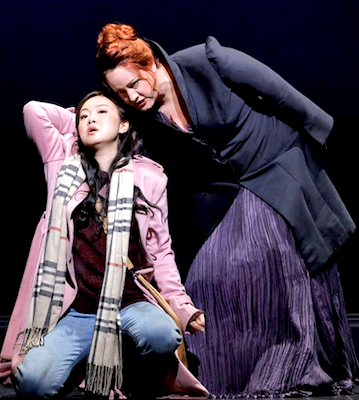
Mozart’s opera takes place in a relatively brief moment in the histories, as recorded in Greek mythology, of three powerful human families – the descendants of Mycenae’s King Agamemnon (Elettra), of Troy’s King Priam (Ilia) and Crete’s King Minos (Idomeneo and Idamante)
Elettra’s arguments in favor of an Idamante-Elettra marriage do have weight. Elettra is from a winning family (albeit, a violent and murderous one) and Ilia’s family is from the losing side. In addition, Idomeneo had pledged Idamante’s hand to Elettra.
The opera arguably contains two only partially joined stories. The main story is similar to one that Giuseppe Verdi chose for an opera that premiered a century later in Cairo, Egypt. The daughter of a king, recently victorious in a war, intends to marry the army’s leader, but her would-be husband has fallen in love with a slave, who is the daughter of the enemy king.
That Verdi’s opera ends with the entombment of the lovers instead of the celebration of their nuptials is the result of a second story line – the god Neptune has agreed to save the Cretan King in return for a horrific sacrifice of another’s life.
[Photo: King Idomeneo (Matthew Polenzani, standing center, with arms outstretched) welcomes all to the marriage of his son Idamante (Daniela Mack, seated right) to Ilia (Ying Fang, seated left); edited image, based on a Cory Weaver photograph, courtesy of the San Francisco Opera.]
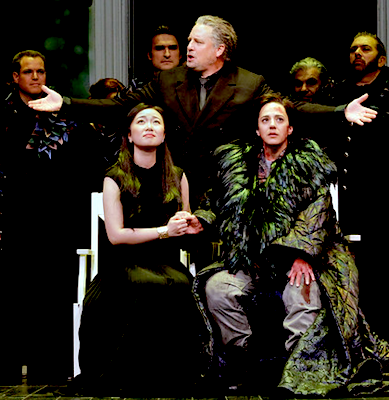
The third act quartet ‘Andrò ramingo e solo,’ beautifully sung by Polenzani’s Idomeneo, Mack’s Idamante, Van den Heever’s Elettra and Fang’s Ilia, was the opportunity to express the thoughts and emotions of each of the four principals.
Then, in what seems a ‘deus ex machina’ moment, Neptune releases the king from the required sacrifice if the king abdicates his throne in favor of his son and his son then weds his father’s former enemy’s daughter.
Maestra Eun Sun Kim and the San Francisco Opera Orchestra and Chorus
South Korean Maestra Eun Sun Kim, San Francisco Opera’s fourth Music Director in its history, conducted the San Francisco Opera Orchestra and Chorus in an elegant performance on one of Mozart’s operatic masterpieces.
The San Francisco Opera, under the leadership of Pennsylvania Chorus Master John Keene was especially effective in the rousing chorus ‘Godiam la pace, trionfi amore’ in which Trojans and Cretans sing praises of Idamante’s decision to free and pardon all of the Trojan captives, including Ilia.
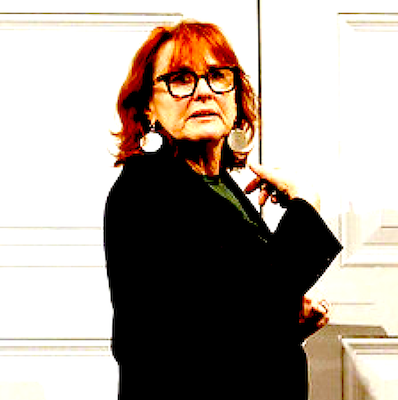
Director Lindy Hume’s Production
Australian director Lindy Hume created a production that told the story in a visually effective setting, while creating a scenic design that minimized the costs of disassembling and reassembling opera productions that alternate in an opera season’s repertory.
The basic set for her “Idomeneo” is an off-white structure at the back of the stage, made of a material that maximizes the effectiveness of projected images. The set was created originally by Texas Designer Michael Yeargan for another opera, but with projections designed for each opera, could be available for either (or even different operas).
Although this is Hume’s San Francisco Opera debut, I praised an imaginative production of hers elsewhere a dozen years ago [Review: A Feisty, Funny “Fledermaus” – Houston Grand Opera, November 2, 2013].
Australian projection designer David Bergman created projections that represent the rocky landscapes and turbulent seascapes of Crete. (All of the projections were actually scenes from the Australian island of Tasmania and its surrounding sea.)
Others contributing to the production were Australian Set Design Consultant Richard Roberts and Australian Cinematographer Catherine Pettiman. The costumes were created by Australian Deisigner Anna Cordingley. The lighting was originally created by Designer Verity Hampson, its revival by Justin A. Partier. Dance Master Colm Seery choreographed Idomeneo’s storm sequence and the movements of the Cretan crowds.
[Photo: Director Lindy Hume; edited image, based on a Cory Weaver photograph, courtesy of the San Francisco Opera.]