
The Santa Fe Opera imported an elegant production of Richard Strauss’ “Der Rosenkavalier” that premiered in 2021 at England’s Garsington Opera.
“Rosenkavalier” can be considered as three intertwined stories, skillfully integrated by the Austrian team of composer Richard Strauss and librettist Hugo von Hoftmanstahl.
The first story is that of the Marschallin, who begins the opera in a passionate affair with the 17-year old adolescent, Count Octavian Rofrano. As her story progresses. the Maschallin recognizes the waning days of her youth and embraces reality. The second story is Octavian falling in love with the young Sophie. The third story is the “comedy” surrounding the comeuppance of the boorish and narcissistic Baron Ochs.
Rachel Willis-Sørensen’s Marschallin
“Rosenkavalier’s long first act provides one of opera’s great roles for a dramatic soprano. It is during the first act that we see the Marschallin transform from a woman with an appetite for a young lover, to a woman realizing that she is aging. Before the first act ends, the Marschallin is “feeling the frailty of earthly things”. Her mood changes from exuberant ecstasy to melancholic reflection.
[Photo: Rachel Willis-Sørensen as the Marschallin; edited image, based on a Curtis Brown photograph, courtesy of the Santa Fe Opera.]
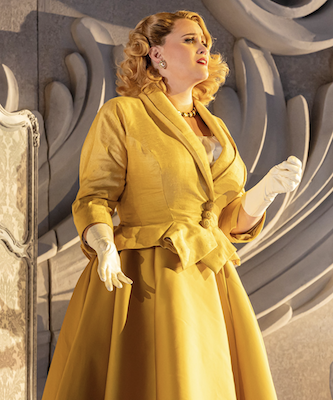
Willis-Sørensen enlisted her gleaming soprano and acting instinct to create a superb portrayal of the Marschallin’s transformation. By the third act, Willis-Sørensen’s Marschallin appears totally comfortable in her role as a member of the older generation. She counsels her young lover to set his sights on a woman of his own age. The conclusion of Willis-Sorensen’s consummate performance.Is the arrestingly beautiful final trio, in which the Marschallin acts as a matchmaker to Octavian and Sophie.
[Photo: the Marschallin (Rachel Willis-Sørensen) dressed in the gown she wears for the opera’s final trio; edited image, based on a Curtis Brown photograph, courtesy of the Santa Fe Opera.]
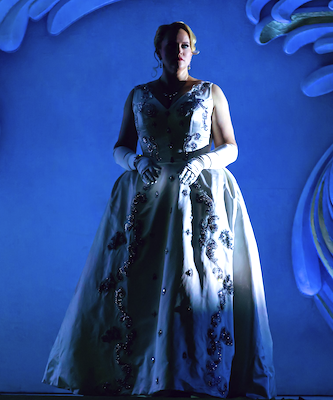
A decade ago, Willis-Sørensen won first prize in Placido Domingo’s Operalia contest, also winning the zarzuela contest and the Birgit Nilsson prize for the Wagner/Richard Strauss repertory.
The artist’s vocal power and flexibility is evident in the range of roles she pursues. This was my fourth opporutnity to witness Willis-Sørensen’s approaches to iconic operatic roles. She met the lyric coloratura demands of Fiordiligi [Review: Classy Cast in Classic “Cosi fan Tutte” – Houston Grand Opera, October 31, 2014], conveyed Wagner’s melodious portrayal of the youthful Eva [Review: McVicar’s Magical, Masterful “Meistersinger” – San Francisco Opera, November 18, 2015] and showed the expressive spinto voice required for Rusalka [Review: “Rusalka”- Beautiful Singing, Insightful Drama – An Opera “Not to be Missed” – San Francisco Opera, June 16, 2019].
Paula Murrihy’s Count Octavian Rofrano and Ying Fang’s Sophie von Faninal
Complementing Willis-Sørensen’s vocal beauty were the equally appealing voices of Irish mezzo-soprano Paula Murrihy as Octavian and Chinese soprano Ying Fang as Sophie.
Murrihy, performing the opera’s title role, was central to all three of “Rosenkavalier’s” stories. (1) Octavian’s passionate affair with the Marschallin, (2) the enchantment of Octavian’s presentation of the silver rose to Sophie, leading ultimately to a committed love relationship with her, and (3) Octavian’s central role in promoting comedic situations that effectively humiliate the Baron Ochs and devastate the Baron’s opportunity to marry into the wealthy von Faninal family. Murrihy proved adept as both lover and as the Baron’s nemesis.
[Photo: Paula Murrihy as Count Octavian Rofrano; edited image, based on a Curtis Brown photograph, courtesy of the Santa Fe Opera.]
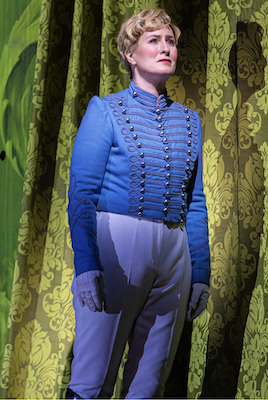
Although this was my fourth performance attended in which Murrihy sang, it was the first time I saw her perform in an opera composed anytime in the past 289 years. The roles in which I saw her previously were the Messenger in a 1607 Monteverdi opera [Review: Luke Sutliff, Replacing Injured Rolando Villazón, Triumphs in Opening Night of Monteverdi’s “Orfeo” – Santa Fe Opera, July 29, 2023], Dido in a 1689 Purcell opera [Review: Barrie Kosky’s Spirited “Dido and Aeneas” Arrives at Los Angeles Opera – October 25, 2014] and Ruggiero in a 1735 Handel opera [Review: Santa Fe Opera’s “Alcina”: Beautifully Sung Enchantment – July 29, 2017].
Soprano Ying Fang was a feisty Sophie. Returning to the Santa Fe Opera after her memorable Susanna of three years prior [Review: A Clockwork “Marriage of Figaro” Delights – Santa Fe Opera, July 23, 2021], Fang created yet another indelible portrait of an ardent young woman.
[Photo: Ying Fang as Sophie; edited image, based on a Curtis Brown photograph, courtesy of the Santa Fe Opera.]
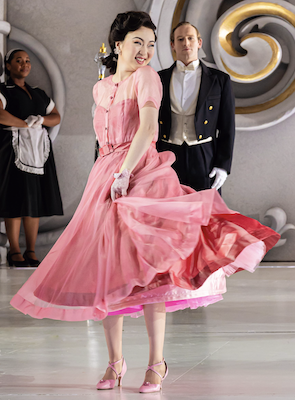
One of the highlights of any “Rosenkavalier” performance is the excitement of the Faninal household anticipating the arrival of the Cavalier of the Rose. The climax of the scene and the high point of the opera is the first appearance of the handsomely dressed Count Octavian, carrying the silver rose he will present to Sophie.
Although Sophie is as nouveau riche as her father, Herr von Faninal, she was not about to endure mortification from the aged Ochs, “feeling safe in the arms” of the young Cavalier of the Rose.
[Photo: Sophie (Ying Fang, left) stands to accept the silver rose carried by the Rose Cavalier, Count Octavian (Paula Murrihy, right); edited image, based on a Curtis Brown photograph, courtesy of the Santa Fe Opera.]
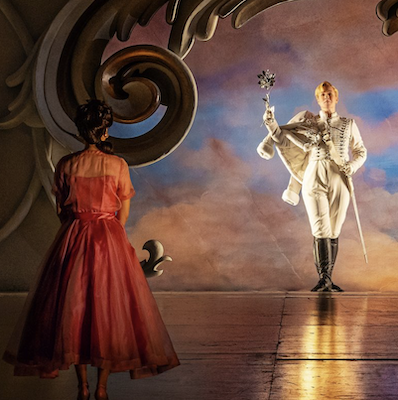
Although there was obvious attraction between Sophie and Octavian from the moment Sophie receives the rose, Octavian was still conflicted by his feelings for the Marschallin. That conflict was not resolved until the opera’s denouement when the Marschallin appears and persuades Octaviian to turn his attention to Sophie. The Marschallin, accompanied by Herr von Faninal, leaves Sophie and Octavian to express their love for one another.
[Photo: the Marschallin (Rachel Willis-Sørensen, right) encourages Octavian (Paula Murrihy, center) to let Sophie (Ying Fang, left) know what he feels for her in his heart; edited image, based on a Curtis Brown photograph, courtesy of the Santa Fe Opera.]
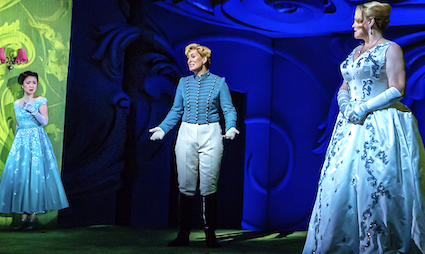
The subsequent final duet between Octavian and Sophie was beautifully sung by Murrihy and Fang.
[Photo: Octavian (Paula Murrihy, left) and Sophie (Ying Fang, right) are finally free to pursue their love affair and future marriage; edited image, based on a Curtis Brown photograph, courtesy of the Santa Fe Opera.]
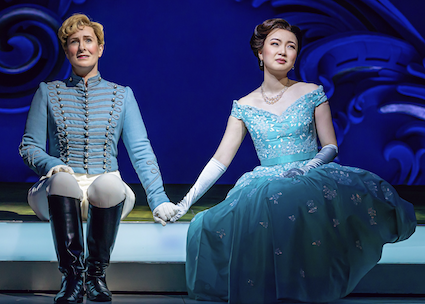
The music accompanying the Presentation of the Rose, Sophie and Octavian’s trio with the Marscahllin, and the final duet between Sophie and Octavian are each high points of post-Wagnerian German opera.
Matthew Rose’s Baron Ochs and Zachary Nelson’s Herr von Faninal
English bass Matthew Rose, donning a bright red wig, proved to be a roguish Baron Ochs, an engaging performance vocally and histrionically. Rose displayed superb comic timing as his condescending, self-centered character lurched from one outrageous act to another. Ochs’ cluelessness about his impact on others, especially the father and daughter von Faninals whom he set out to impress with a Rose Cavalier, makes for a spirited operatic comedy.
[Photo: the Baron Ochs (Matthew Rose, left) becomes distracted by the maid Mariande, unaware that Mariandel is Count Octavian in disguise (Paula Murrihy, right); edited image, based on a Curtis Brown photograph, courtesy of the Santa Fe Opera.
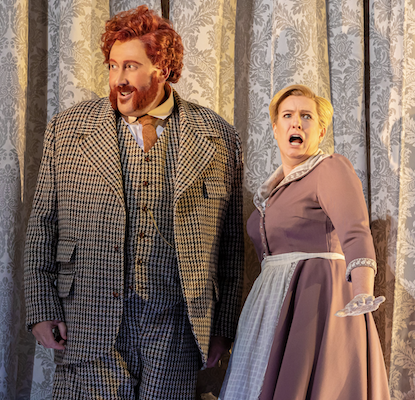
Ochs’ aggrandized self-image makes him extremely vulnerable to the traps set by the wily Octavian, assisted by the intriguers Annina and Valzacchi. The Garsington Opera team has created a very funny scenic design for Ochs’ “date night” with the person Ochs thought was the Marschallin’s female servant, but instead was the disguised Octavian..
Confronted with supposed abandoned wives and red-headed kids yelling “papa, papa”, Ochs finds himself with no plausible explanation for his behavior, when father and daughter von Faninals arrive to witness his humiliation.
[Photo: Baron Ochs (Matthew Rose, center) is surrounded by kids who claim him as their father; edited image, based on a Curtis Brown photograph, courtesy of the Santa Fe Opera.]
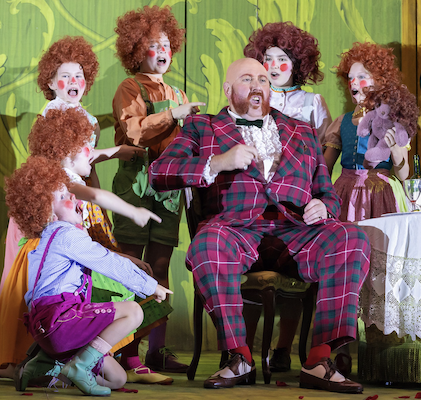
I first came to appreciate Matthew Rose’s comic abilities a decade and a half ago, when he sang Leporello in this venue. [See Review: The Man Who Loved Women, Lucas Meachem’s Empathetic Don Giovanni – Santa Fe Opera, July 31, 2009.]
The role of Herr von Faninal was authoritatively presented in a vocally impactful, physical performance by Zachary Nelson, a graduate of Philadelphia’s prestigious Academy of the Vocal Arts. Faninal has invested his prestige and committed his fortune to his duaghter’s marriage to the oafish Ochs.
[Photo: Ying Fang (left0 Is Sophie and Zachary Nelson, right, is Herr von Faninal; wdited image, based on a Curtis Brown photograph, courtesy of the Santa Fe Opera.]
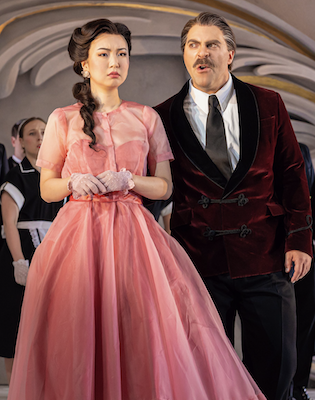
The course of the opera gives Nelson’s Faninal the opportunity to rage at those persons (including his daughter) that might upset the carefully negotiated marriage. Nelson’s character has more to rage at when he finds that the compromised Ochs is apparently engaging in immoral activities.
[Photo: Herr von Faninal (Zachary Nelson) is outraged at the spectacle of his would-be son-in-law besieged by women claiming to be his wife and children claiming him as his father; edited image, based on a Curtis Brown photograph, courtesy of the Santa Fe Opera.]
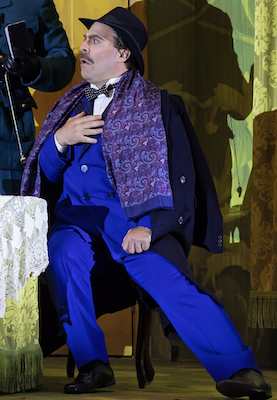
I have reported on seven previous Nelson performances, six of them at Santa Fe Opera. These latter appearances include such diverse roles as Golaud [Review: Passionately Sung, “Pelléas et Mélisande” in Netia Jones’ Attractive, Introspective Production – Santa Fe Opera, July 28, 2023 ], Marcello [Review: A Magnificent Mimi Leads a Youthful “Boheme” Cast – Santa Fe Opera, June 28, 2019] and Doctor Malatesta [Review: Ovations for Laurent Pelly’s Daffy “Don Pasquale” – Santa Fe Opera, June 28, 2014]..
Megan Marino’s Annina and Gerhard Siegel’s Valzacchi
South Carolina mezzo-soprano Megan Marino made a strong impression as the mischievous operative-for-hire Annina. Marino added star power and vocal heft to this supporting role.
[Photo: Megan Marino as Annina; edited image, based on a Curtis Brown photograph, courtesy of the Santa Fe Opera.]
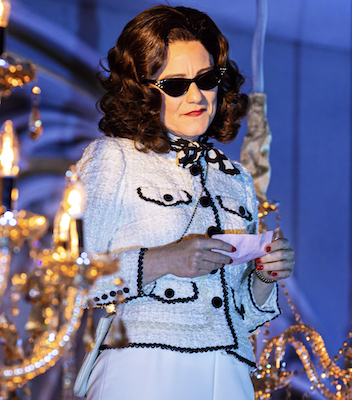
Marino previously had impressed me in the principal roles of Nanetta [Review: World Class Performances and Rollicking Fun in The Dallas Opera “Falstaff” – April 28, 2019] and as Cherubino in the Santa Fe Opera’s 2022 “Marriage of Figaro” performance cited above.
Annina’s partner in intrigue, Valzacchi, was played by German tenor Gerhard Siegel, making his Santa Fe Opera debut. Siegel is noted for portraying major German character tenor roles, including Mime in Wagner’s “RIng of the Nibelungs” and Herod in Richard Strauss’ “Salome”. His eye-catching performance of Valzacchi proved an excellent introduction to Siegel’s vocal and dramatic talents.
[Photo: Gerhard Siegel as Valzacchi; edited image, based on a Curtis Brown photograph, courtesy of the Santa Fe Opera.]
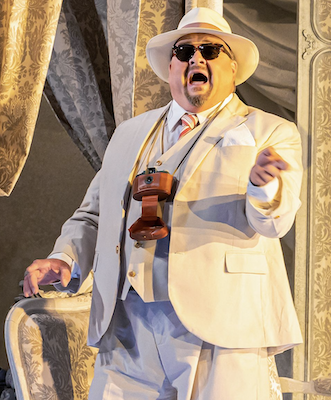
David Portillo’s Italian Tenor, Scott Connor’s Police Commissar and Other Cast Members
Earlier this season, lyric tenor David Portillo’s Don Ottavio confirmed him as an expert Mozartian [Review: Stephen Barlow Creates an Elegant New “Don Giovanni” Production – Santa Fe Opera, June 29, 2024]. For this production, he sang the role of the Italian Tenor. Portillo skillfully performed the Italian Tenor’s challenging aria Di rigori armato il seno, proving Portillo’s ability to project a full-voiced Italianate sound.
[Photo: the Italian Tenor (David Portillo, left) performs for the Marschallin (Rachel Willis-Sørensen, seated right) as arranged by her Major-Domo (Wayd Odie, center); edited image, based on a Curtis Brown photograph, courtesy of the Santa Fe Opera.]
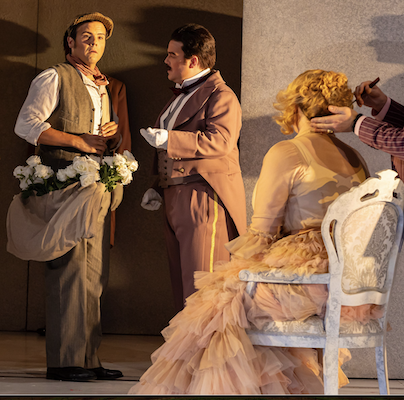
Kansas bass Scott Conner, as the officious Police Commissar, continued his string of impressive appearances in operatic comic roles. These have included such recent delights as his Pistola [Review: Quinn Kelsey Delights in Sir David McVicar’s New “Falstaff” Production – Santa Fe Opera, August 4, 2022], his King of Clubs [Review: Opera Philadelphia’s Richly Melodic, Laugh-filled “Love for Three Oranges” – September 20, 2019] and his Mustafa [Review: Santa Fe Opera’s Delightful “Italian Girl in Algiers” – July 25, 2018].
[Photo: the Police Commissar (Scott Conner) brings law and order to the evening’s events; edited image, based on a Curtis Brown photograph, courtesy of the Santa Fe Opera.]
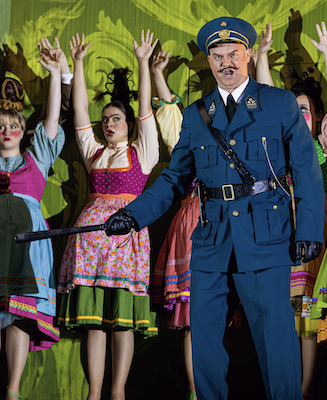
The Marschallin’s Four Lackeys were played by New York tenor Matthew Goodheart, Missouri baritone Randell McGee, Virginia tenor David Bogaev and Oklahoma baritone Bernardo Medeiros. The Marschallin’s Major-Domo was Nebraska tenor Wayd Odie.
The invitees into the Marschallin’s bedroom included New Jersey soprano Anneliese Klenetsky as The Noble Widow. The Three Noble Orphans were California soprano Isabel Anthony, California mezzo-soprano Ashlyn Brown and New York mezzo-soprano Christina Grohowski. The Dressmaker was Australian soprano Natasha Isabella Gesto. The Animal Trainer was North Dakota tenor Nathan Bowles (also a Waiter in Act 3). The Notary was Kansas bass-baritone Keith Kline. Baron Ochs’ son Leopold was played by Maryland dancer Nicholas Sipes.
Appearing in the Faninal household were Wisconsin soprano Kathryn Henry as Marianne Leitmetzerin and Texas tenor Ryan Bryce Johnson as the Major-Domo. In the third act, Spencer Hamlin was the Innkeeper. The waiters, besides Bowles, were Florida tenor Garrett Evers, New Mexico bass-baritone Tzi Bat Asherah and Indiana bass Drew Comer. Maryland bass-baritone Dylan Gregg was Boots.
New Mexico child actor Maximilian Moore plays the non-textual role of Cupid, who appears in diverse scenes of the opera, including the Marschallin’s bedroom, the von Faninal estate for the Presentation of the Rose and the opera’s final notes.
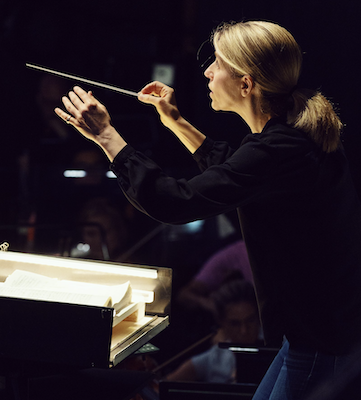
Maestra Karina Canellakis and the Santa Fe Opera Orchestra and Chorus
Leading the Santa Fe Opera Orchestra Orchestra and Chorus in a masterful performance of Strauss’ opera was New York Maestra Karina Canellakis. Supervising the chorus, comprised of Santa Fe Opera Apprentices, was Utah Chorus Master Susanne Sheston.
[Photo: Maestra Karina Canellakis conducts the Santa Fe Opera Orchestra; edited image, based on a Curtis Brown photograph, courtesy of the Santa Fe Opera.]
Director Bruno Ravella and Scenic and Costume Designer Gary McCann
The production was staged by Moroccan-born English director Bruno Ravella. Although the composer-librettist team set the story of “Rosenkavalier” in the Vienna of 1745, each of the storylines described above – a woman’s resignation to the passage of time, a young couple falling in love, a boorish sociopath being outwitted by the concerted action of those who oppose his designs – fit well into many time periods, including those much closer to the current day.
The opera’s action, directed by Ravella, is always clearly and effectively presented.
[Phoro: Director Bruno ravella; edited image, based on a publicity photograph.]
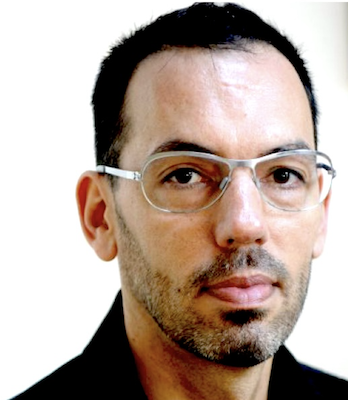
The production’s sets and costumes were created by Northern Ireland designer Gary McCann. The “timelessness” of the opera’s stories is exemplified by McCann’s mix of classical era spatial interiors with mid-20th century costumes.
[Photo: Designer Gary McCann; edited image, based on a publicity photograph.]

Recommendation: I enthusastically recommend the Santa Fe Opera’s mounting of Ravella-McCann production of “Der Rosenkavalier” both to the veteran opera-goer and the person new to opera.