
This review continues my discussion of the San Francisco Opera’s 2025 revival of John Caird’s production of Puccini’s “La Boheme” posted at Review: A Superbly Performed “Boheme”, Starring Pene Pati, Karen Chia-Ling Ho, Andrea Carroll and Lucas Meachem – San Francisco Opera, June 15, 2025..
This review discusses the performances of three alternate cast members – Nicole Car (Mimi), Evan LeRoy Johnson (Rodolfo) and Brittany Renee (Musetta). It also makes note of cast members who perform in all performances of the run, but who were not identified in the previous review.
Nicole Car’s Mimi
Australian soprano Nicole Car performed the role of Mimi. From her first act entrance into the Bohemian’s apartment, Car was an engaging presence, performing her first act aria ‘Mi chiamano Mimi’ beautifully.
[Photo: Nicole Car as Mimi; edted mage, based on a Matthew Washburn photograph, courtesy of the San Francisco Opera]

This was Car’s second San Francisco Opera role, following her company debut as Donna Elvira [Review: Dupuis and Pisaroni Lead International Cast for Michael Cavanagh’s New “Don Giovanni” Production – San Francisco Opera, June 12, 2022.] She previously proved to be a technically precise and elegantly refined Mozartian. In this performance she displayed her command of the emotional content of Puccini’s soaring melodies.
Any first rate Mimi (and Car certainly qualifies as one) will win our hearts in the first and final scenes (Mimi’s first meeting of Rodolfo, and her death in the Bohemians’ apartment). In the opera’s second act Puccini focuses on the Bohemian ensemble, and their reactions to Musetta’s high jinks and the Parisian crowds.
It is in the third act in which Puccini allows the soprano more opportunity to showcase her vocal and acting talents. She sings duets with both the principal baritone, Marcello (in this performance, Lucas Meachem), and the tenor lead, Rodolfo (in this performance, Evan LeRoy Johnson).
The melodic content of the duet that Car and Meachem sing begins with Mimi’s question as to whether Rodolfo is inside with Marcello. Learning that he is, Mimi asserts that she cannot come inside, to which Marcello asks why. That exchange of simple phrases between Mimi and Marcello — “C’e Rodolfo?” “Si” “Non posse, entrar, no, no” “Perche?” — is invested with one of Puccini’s breathtakingly beautiful melodies, throughout which Mimi imparts the information that Rodolfo is consumed by jealously, and, as a result he and she have separated.
[Photo: Mimi (Nicole Car, left) joins Rodolfo (Evan LeRoy Johnson, right) for a Christmas evening in Paris; edited image, based on a Matthew Washburn photograph, courtesy of the San Francisco Opera.]
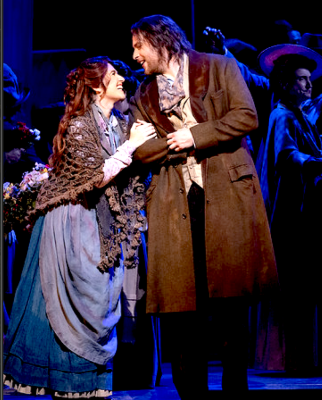
Car’s Mimi figures prominently in two other duets – the first is sung by Rodolfo and Marcello. From her hiding spot, Mimi overhears Rodolfo reveal to Marcello that Mimi is deathly ill
When Mimi is discovered, her duet with Rodolfo ensues. In that duet, Mimi and Rodolfo agree to stay together until the Spring.
These dramatic encounters with Meachem’s Marcello and Johnson’s Rodolfo provided excellent opportunities for Car to demonstrate her vocal and histrionic skills.
Evan LeRoy Johnson’s Rodolfo
Minnesota tenor Evan LeRoy Johnson sang the role of Rodolfo in this, the first of three scheduled performances for the alternate cast.
[Photo: Rodolfo (Evan LeRoy Johnson) conmunicates with his fellow Bohemians in the street below; edited image, based on a Matthew Washburn photograph, courtesy of the San Francisco Opera.]

Johnson’s San Francisco Opera debut took place in 2022 as Vladimir Lensky in Tchaikovsky’s “Eugene Onegin”. In my performance review, I praised Johnson’s vocal performance, especially noting his memorable singing of Lensky’s great aria that takes place in the moments before the character’s death. I regarded Johnson’s appearance as one of the most important new voices heard at the War Memorial Opera House this decade.
As Rodolfo, Johnson met my expectations for this iconic role. He responded to Spanish Maestro Ramón Tebar’s passionate conducting with emotionally rich singing in both his first act aria ‘Chegelida manina’ and his duets with Car’s Mimi. In his interactions with his fellow Bohemians, he showed the comic timing that is a prerequisite of a well-rounded Rodolfo performance.
Brittany Renee’s Musetta, Dale Travis’ Benoit and Alcindoro and Other Cast Members
Performing the role of Musetta with vocal brilliance was Minnesota soprano Brittany Renee, returning to San Francisco Opera after her successful debut in Gliddens’ and Abels’ contemporary opera, “Omar” [Review: Ovations for “Omar”, Giddens’ and Abels’ Remarkable Opera – San Francisco Opera, November 5, 2023.] Renee brought an irrespressible spirit to the character of Musetta, the dominant presence in “Boheme’s” second act.
[Photo: Musetta (Brittany Renee, left) entertains her wealthy suitor, Alcindoro (Dale Travis, right); edited image, based on a Matthew Washburn photograph, courtesy of the San Francisco Opera.]
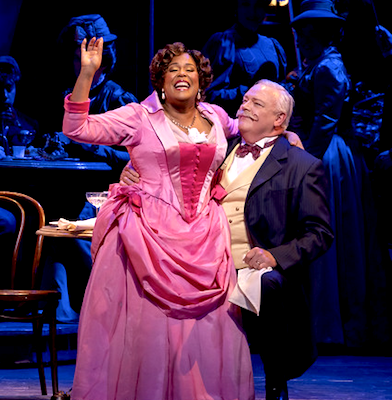
Few (if any) artists, in the history of the San Francisco Opera, have performed as many roles as New Jersey bass-baritone Dale Travis, who made his company debut 37 years ago. Travis appeared in all performance of “Boheme’s” run as both the Bohemians’ beleaguered landlord Benoit in Act 1 and as Musetta’s moneybags companion Alcindoro in Act 2. Travis, a character actor with experience in multiple productions of “La Boheme” over several decades, is an expert on every line and gesture of each of his roles. Travis performed both roles masterfully.
The role of the toy-seller Parpignol was sung by Missouri tenor Chester Pidduck. Maryland tenor C. Michael Belle was a Prune Vendor. California baritone Nikolas Nackley was a Customhouse Officer. California baritone Andrew Thomas Pardini was a Customhouse Sergeant.
John Caird’s Production
John Caird’s production, a joint project of the San Francisco Opera, Houston Grand Opera and Canadian Opera Company, was performed previously by the San Francisco Opera in 2014 and 2016.
[Photo: Designer David Farley’s set designs for the final scene of “La Boheme”; edited image, based on a Cory Weaver photograph, courtesy of the San Francisco Opera.]

The production is memorable for the facility of David Farley’s scenic design. Farley’s sets rotate after the first and third acts, permitting the first and second acts to change from the Bohemians’ apartment to an outside scene. After an intermission, the third and final acts change seamlessly from an outside setting back to the Bohemians’ apartment without the need for the curtains to close and the opera’s action to be paused
Final Thoughts
In June 2025 the San Francisco Opera presented nine performances of “La Boheme”, in which the roles of Mimi, Rodolfo and Musetta were divided between two alternate casts, both under the baton of Maestro Ramón Tebar. Having reviewed each cast, I can attest that each cast was vocally and histrionically praiseworthy. Whichever cast an audience member experienced, they saw and heard a stunningly effective performance.