
In a three and a half month period in mid-2024, the San Francisco Opera presented two contemporary operas from two Nordic countries – Finland and Denmark. One performance was the late composer Kiaja Saariaho’s 2019 opera “Innocence [American Premiere Review: Saariaho’s and Oksanen’s “Innocence”- a Milestone in the Dramatic Possibilities of Operatic Performance – San Francisco Opera, June 1, 2024]. The other was the U. S. West Coast Premiere of Poul Ruders’ 2000 opera “The Handmaid’s Tale”, whose libretto by Paul Bentley is based on Margaret Attwood’s popular novel of the same name.
Both “Innocence” and “Handmaid’s Tale” operas were disturbingly relevant to current societal issues – “Innocence” on the impact of a school shooting by a bullied student on a student’s family and community. The other, “The Handmaid’s Tale”, presented a vision of the ultimate consequences of a jurisdiction seeking to control the child-bearing functions of the women who live within it.
Arrwood’a image of the handmaid became a symbol of protest against goverments that denied or eliminated women’s rights. Discussions began between the Royal Danish Opera of Copenhagen, Denmark, site of the 2000 world premiere of Ruders’ opera and the San Francisco Opera to create a new production with major revisions in the opera. That new production was seen in Copenhagen in 2022, with original plans to perform the new production in San Francsico soon after.
“The Handmaid’s Tale’s” premise is that a fundamentalist group seizes control of a democratic government (in Attwood’s novel the United States) and establishes a theocratic Republic of Gilead. That sovereign entity takes control of the sexual lives of all its citizens, with special attention to the reproductive history of each of Gilead’s population of women, every aspect of whose lives the Republic intends to control. The production’s ominous relevance to present day issues is discussed in a section towards the end of this review. That section cites the Margaret Attwood novel on which the opera is based, the American judicial system’s tackling of a Constitutionally-implied “right to privacy”, and the composition of the American electorate.
Although performance repertory decisions are made years ahead by opera companies, the impact of the Covid pandemic resulted in San Francisco Opera rescheduling “Tale” for Fall 2024. The production, therefore, came to be performed during the period of a consequential American presidential election campaign, in which national policy towards women’s reproductive rights were issues dividing the presidential candidates.
Irene Roberts’ Offred
[Photo: Irene Roberts was Offred in John Fulljames’ production of “The Handmaid’s Tale”; edited image, based on a Cory Weaver photograph, courtesy of the San Francisco Opera.]

The lead role in the opera is that of Offred, who the Republic of Gilead has designated to be the handmaid “of Fred”. The role of Offred, who rarely leaves the stage, was performed by California mezzo-soprano Irene Roberts. Singing her fifth principal role at San Francisco Opera, Roberts again proved to be an artist of consummate vocal and acting skills. Roberts, on the basis of this performance alone, could teach a master class in how to display the emotional content of Bentley’s intense libretto while performing Ruders’ complex music.
Roberts was impressive in each of her four previous assignments at San Franisco Opera performances under four major directors. In 2013, Roberts performed the role of Giulietta in French director Laurent Pelly’s “Tales of Hoffmann” [Review: Matthew Polenzani Triumphs in Pelly’s Take on “Tales of Hoffmann” – San Francisco Opera, June 5, 2013]. In 2016, she created the role of Bao Chai in Taiwanese director Stan Lai’s world premiere staging of Sheng’s and Hwang’s “The Dream of the Red Chamber”. Later that season she performed the title role in Spanish director Calixto Bielto’s production of Bizet’s “Carmen” [Review: Roberts, Jagde and Dehn in “Carmen” – San Francisco Opera, May 29, 2016]. In 2021 she appeared as Dorabella in Canadian director Michael Cavanagh’s lively production of Mozart’s “Cosi fan Tutte” [Review: “Cosi fan Tutte” – Nicely Sung, Imaginatively Staged – San Francisco Opera, November 21, 2021].
Christopher Oglesby’s Luke, Simone McIntosh’s Ofred’s Double and Sarah Cambidge’s Aunt Lydia
[Photo: Offred (Irene Roberts, hidden in shadows at left of photo, observes a happier time when she (right, portrayed by Simone McIntosh as the younger Offred), and her husband Luke (Christopher Oglesby, center) were together; edited image, based on a Cory Weaver photograph, courtesy of the San Francisco Opera.]
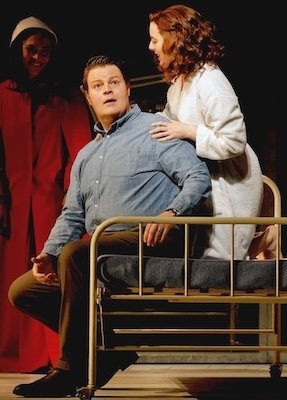
To explain the sinister mission of the Republic of Gilead, I will select some incidents of the opera’s crushingly complicated plot in chronological order of the important events, rather than the order in which they take place in the opera.
The first is the arrest of a happily married woman, who tried to escape the newly established republic with her husband, Luke, and their daughter. Attempting to evade Gilead’s family-destroying dictates is a criminal offense. As punishment, the woman, the newly-renamed Offred, is assigned to a “Red Centre” for training as a handmaid under the supervision of the Centre’s ruling Aunty, Lydia.
Georgia tenor Christopher Oglesby, an alumnus of San Francisco Opera’s Merola program and of a 2019-2020 Adler Fellowship, sympathetically portrayed Luke, to whom Offred was married when Gilead functionaries apprehended them trying to escape.
Over the past five seasons Oglesby has been a stalwart performer of various character roles including Jacquino [Review: Beethoven’s “Fidelio”, An Excellent Cast for Matthew Ozawa’s Powerful Production – San Francisco Opera, October 17, 2021 ] and Edmondo [Review: A Passionate “Manon Lescaut” Led by Luisotti, Haroutounian and Jagde – San Francisco Opera, November 8, 2019.]
French mezzo-soprano Simone McIntosh performed the role of the pre-Gilead Offred.
[Photo: Sarah Cambidge as Aunt Lydia; edited image, based on a Cory Weaver photograph, courtesy of the San Francisco Opera.]

Canadian soprano Sarah Cambidge created an arresting portrait of Aunt Lydia, the matronly leader of one of the Red Centres that trains new handmaids for their child-bearing duties.
Cambidge’s previous San Francisco Opera performance highlights included her career-advancing appearance as the Foreign Princess in Dvorak’s beloved opera [Review: “Rusalka”- Beautiful Singing, Insightful Drama – An Opera “Not to be Missed” – San Francisco Opera, June 16, 2019].
John Relyea’s Commander, Lindsay Ammann’s Serena Jo and Brenton Ryan’s Nick
[Photo: The Commander (John Relyea, right) expresses his interest in successfully impregnating Offred; edited image, based on a Cory Weaver photograph, courtesy of the San Francisco Opera.]
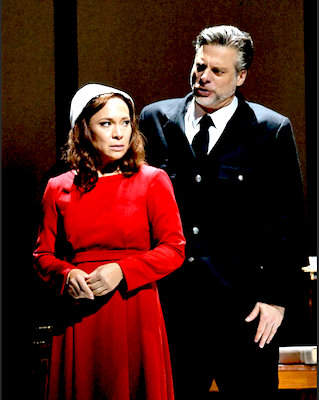
Offred, who was not impregnated during either of her first two postings, has one final chance to produce a child. She is assigned to the household of a Commander, performed by Canadian bass John Relyea. Having first joined the San Francisco Opera in the 1975 Merola Young Artists program,
Relyea spent two seasons as a San Francisco Opera Adler Fellow. Relyea, returning to the company after an absence of 14 years, was a formidable presence, possessing a sonorous bass voice and sensitivity as an actor.
I have reported previously on two of the lead roles Relyea sang with the company – Figaro [Review: San Francisco Opera “Nozze di Figaro” – July 2, 2006] and Mephistopheles [Review: Racette Ravishing, Relyea Riveting in San Francisco “Faust” – June 5, 2010].
I also reviewed his Seattle Opera appearances as Don Quichotte [Review: Masterful Massenet -John Relyea’s Don Quixote at Seattle Opera – February 26, 2011] and Attila [Review: Reveling in Early Verdi: Relyea, Garcia, Vratogna, Palombi in Montanaro’s Uncut “Attila” – Seattle Opera, January 14, 2012]. See my interviews with him at Rising Stars: An Interview With John Relyea, Part 1 and Rising Stars: An Interview with John Relyea Part 2.
The Commander is married to a former newscaster, Serena Joy. Their household employs two servants, Nick and Rita. Roberts’ Offred becomes the fifth member of that household, whose interpersonal relationships are complex, and whose activities reveal subversive attitudes toward the authoritarianism of the Republic of Gilead.
[Photo: Lindsay Ammann as Serena Joy; edited image, based on a Cory Weaver photograph courtesy of the San Francisco Opera.]
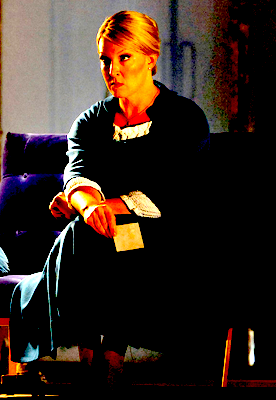
In her San Francisco Opera debut, as well as her role debut as Serena Joy, Arizona mezzo-soprano Lindsay Ammann brought a rich mezzo voice, whose strength in her lower register allows her to take on opera’s iconic contralto roles.
The character of Serena Joy, desperate for a child and distraught that her husband failed to impregnate Offred, convinces Offred to allow the household servant Nick, a role performed by Missouri tenor Brenton Ryan, to try and get the handmaid pregnant.
Of the opera’s 29 named cast members, the artist I have seen most often is Ryan, whose performances I have reviewed on 12 previous occasions over the past decade. As Nick, his well-honed acting instincts were evident, as well as his solid vocal performance.
I have praised Ryan’s performances in four roles at the Los Angeles Opera, including Leon [Review: Los Angeles Opera Launches Ambitious New Production of “Ghosts of Versailles” – February 7, 2015] and three roles at the Santa Fe Opera, including Don Basilio [Review: A Clockwork “Marriage of Figaro” Delights – Santa Fe Opera, July 23, 2021.]
[Photo: Nick (Brenton Ryan, left) has been commanded by his mistress, Serena Joy, to impregnate Offred (Irene Roberts, right), a task that he approaches with enthusiasm; edited image, based on a Cory Weaver photograph, courtesy of the San Francisco Opera.]
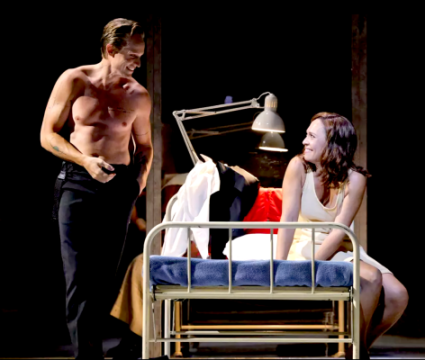
At San Francisco Opera Ryan has performed in six operas, including character roles as diverse as Janek [Review: Nadja Michael’s Arresting Performance in “Makropulos Case” – San Francisco Opera, October 14, 2016], the novice seaman [Review: An Indomitable “Billy Budd”, San Francisco Opera, September 7, 2019] and Monsieur Triquet [Review: Robert Carsen’s Production of “Eugene Onegin”, Admirably Performed – San Francisco Opera, October 9, 2022].
Rhoslyn Jones’ Ofglen, Caroline Corales’ Moira and Katrina Galka’s Ofwarren
[Photo: Offred (Irene Roberts, left) renews her acquaintance with Ofglen (Rhoslyn Jones, right); edited image, based on a Cory Weaver photograph, courtesy of the San Francisco Opera.]
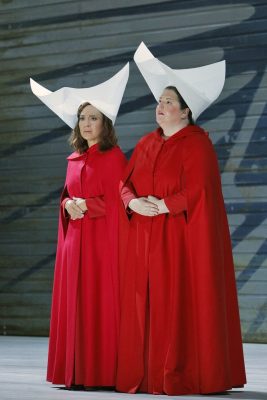
Much of the opera is concerned with the responses of women, whether or not they have been officially assigned the role of handmaids, struggling with the terrible circumstances that the Republic of Gilead has enforced upon them.
The role of the violently mutinous, ultimately suicidal handmaid Ofglen, was performed by Rhoslyn Jones, who 17 years prior was a San Francisco Opera Adler Fellow who created the role of the wife of Ulysses S. Grant in the world premiere run of a Philip Glass “docu-opera” [Review: The Remaking of San Francisco Opera, Part I – Glass’ “Appomattox”, October 14, 2007].
Current Adler Fellow, California soprano Nikola Printz, performed the role of the new Ofglen.
Wisconsin coloratura soprano Katrina Galka, in her San Francisco Opera and role debuts, perfromed the role of the ill-fated handmaid Ofwarren (formerly called Janine).
Missouri soprano and current San Francisco Opera Adler Fellow Caroline Corrales performed the role of Moira, Offred’s friend from pre-Gilead times.
[Photo: Moira (Caroline Corrales, right) is with Offred (Irene Roberts, right) in pre-Gilead days; edited image, based on a Cory Weaver photograph, courtesy of the San Francisco Opera.]
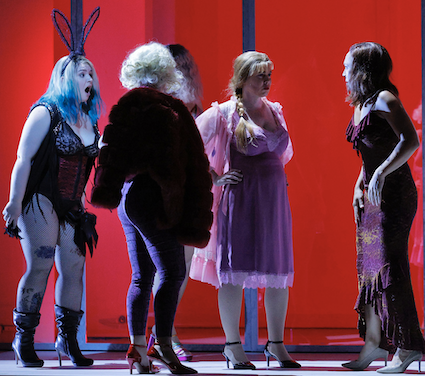
Gabrielle Beteag’s Offred’s Mother, Mathew DiBattista’s Doctor and Other Cast Members
Determined resistance to the Republic of Gilead’s laws is evident throughout most of the opera. Perhaps the most chilling call to resist Gilead’s snuffing out of the rights of women and overbearing rules on the behavior of men is expressed in a flashback to earlier times by Offred’s mother. That role was played by Georgia mezzo-soprano Gabrielle Beteag, an alumna of the San Francisco Opera Adler Fellowships.
[Photo: Offred (Irene Roberts, left) remembers the plea of her mother (Gabrielle Beteag, right) to resist the institution of the Republic of Gilead’s extreme measures governing women’s child-bearing functions and eliminating the basic rights of women; edited image, based on a Cory Weaver photograph, courtesy of the San Francisco Opera.]
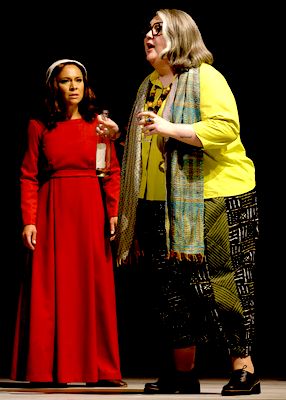
Massachusetts tenor Matthew DiBattista was The Doctor. Like all of the male principals in the opera (and almost all of the major female characters) the Doctor is quick to ignore the Republic’s strict rules on sexual behavior. Like his colleague Brenton Ryan, DiBattista is a brilliant presence in character tenor roles.
I first saw DiBattista a decade ago, performing the role of Monostatos [Review: Mizrahi’s Charming “Magic Flute” Production Opens OTSL 2014 Season – St Louis, May 24, 2014ens OTSL 2014 Season – St Louis, May 24, 2014]. I subsequently reviewed his Santa Fe Opera performances as Goro [Review: A Stunning “Madama Butterfly” Starring Kelly Kaduce – Santa Fe Opera, June 30, 2018], as Scaramuccio [Review: Santa Fe Opera’s Delectable New “Ariadne auf Naxos” – Santa Fe Opera, July 28, 2018] and as Monsieur Triquet [Review: Santa Fe Opera’s “Eugene Onegin”, Musically Appealing, Visually Striking – July 24, 2021].
California contralto Sara Couden sang the role of Nick’s wife, Rita. Wisconsin mezzo-sropano Courtney Miller was Warren’s wife. Oregon mezzo-soprano Whitney Steele was a Widow. California mezzo-soprano Silvie Jensen was Moira’s Aunt.
Members of the San Francisco Opera Regular Chorus performed several roles. California mezzo-soprano Jacque Wilson was Handmaid 1. Hawai’i mezzo-soprano Mart Raul was Handmaid 2. New Hampshire soprano Jesslyn Thomas was Handmaid 3. Other members of the San Francisco Opera Regular Chorus were South Korea soprano Crystal Kim as Echo. Tennessee mezzo-soprano Edith Dowd was Econowife. California tenor Kevin Gino was Commander X. Missouri tenor Chester Pidduck and Rhode Island bass-baritone William O’Neill were Guards. Florida bass-baritone Wilford Kelly was Eye. Washington mezzo-soprano Sarah Nadeau was a Girl, and Pennsylvania tenor Michael Jankosky was a Man.
Maestra Karen Kamensek and the San Francisco Opera Orchestra and Chorus
The orchestra was led by Illinois Maestra Karen Kamensek, making her second San Francisco Opera appearances since the first main season production of Floyd’s “Susannah” [Review: Racette, Aceto, Jovanovich in Brilliant New Production of “Susannah” – San Francisco Opera, September 6, 2014]. I had previously praised her conducting of Donizetti’s most famous comic opera [Review: Giuseppe Filianoti Leads Strong Cast for “The Elixir of Love” – San Diego Opera, February 15, 2014].
[Photo: Conductor Karen Kamensek; edited image, based on a Todd Rosenberg photograph, courtesy of the San Francisco Opera.]
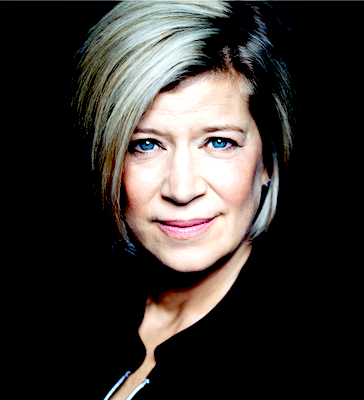
Composer Ruders’ orchestration is a much heavier sound than the works of Donizetti and Carlisle Floyd. Conducting from a outsized operatic score, Maestra Kamensek, a champion of contemporary opera, oversaw an augmented orchestra of 79 artists, including a timpanist, five percussionists, and performers on a tuba, a sampler keyboard, a digital piano and an organ, 46 strings and a variety of woodwind and brass instruments. The effect of the large orchestra was often overpowering in the responsive acoustics of the War Memorial Opera House.
Pennsylvania Chorus Master John Keene supervised the extensive choral contributions to the opera.
Margaret Attwood’s Novel and the Ongoing American Debate over a “Right to Privacy”
Twenty-six years before the publication of Attwood’s novel, a seminal case before the United States Supreme Court was decided in a landmark 7-2 decision, Griswold vs. State of Connecticut written by liberal Justice William O. Douglas. The majority opinion overturned a 19th century Connecticut law that banned the sale and use of contraceptives to prevent pregnancy. Justice Douglas determined that an inexplicit but discernible “right to privacy” could be found in the United States Constitution that prohibited any of its state governments (half of whom had similar laws) from interfering in whether its citizens chose to use pharmaceuticals to prevent an undesired pregnancy.
The dissenting justices refused to concede that any such right to privacy was contemplated by the powdered-wigged gentlemen, imbued in the philosophies of Locke and Montesquieu, who created the Consitution of the United States. Nor, they believed, was it contemplated that the United States Constitution was designed in any way to establish a woman’s freedom of control from government intrusion into her child-bearing functions. (The rhetoric of the republic’s founders spoke of “all free men” rather than “all persons”.)
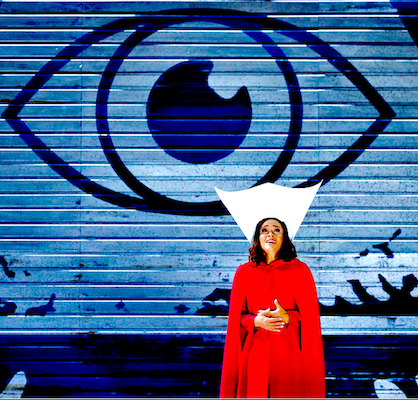
[Photo: Offred (Irene Roberts) stands before the symbol of the Republic of Gilead; edited image, based on a Cory Weaver photograph, courtesy of the San Francsico Opera.]
Douglas’ “right to privacy” was revisited on many occasions afterward (often modifying the arguments as to where in the Constitution or its amendments such “rights to privacy” existed). Privacy rights led to Supreme Court rulings on such diverse topics as laws prohibiting same-sex sexual relationships, same-sex marriages, and, in Roe vs. Wade, on the right of a woman and her medical team to terminate an unwanted or medically-compromised pregnancy.
What “The Handmaid’s Tale” deals with is not with the judicial opinions, but with the implications of a society having the authority to regulate, as in the case of Griswold, a married couple’s decisions on if and when it decides to have children.
Defenders of Connecticut in its pre-Griswold days have noted that state and local police more or less ignored enforcing the law. But in the “leaving it to the states” response to Griswold, Roe, et al. it soon became evident that many state governments determined that they had a duty to govern the most intimate decisions of individual women, their families and medical teams.
Poul Ruders and Paul Bentley’s “The Handmaid Tale” opera, in John Fulljames production, demonstrates the absurb and dangerous outcomes of state government lawmakers deciding that they need to regulate a woman’s decisions about her body.
Director John Fulljames’ Production and Chloe Lamford’s Set Design
A new production of the two and a half-decade old Ruders’ opera, was co-sposored by the Royal Danish Opera in Copenhagen, Denmark and the San Francisco Opera. The opera was extensively revised with staging by English director John Fulljames. English director Lucy Bradley was associate director.
[Photo: Director John Fulljames; edited image, based on a publicity photograph, courtesy of the San Francisco Opera.]

The sets were created by English director Chloe Lamford, whom I had praised for the sets of Saariaho’s opera “Innocence”, cited above. England’s Helen Hebert was Associate Set Designer.
The costumes, including the distinctive red handmaid robes and white headdresses were created by English designer Christina Cunningham. English designer Will Duke created the projections.
New York Sound Designer and Mixing Engineeer Rick Jacobsohn took on his second assignment with the San Francisco Opera [See also: Review: Aural Splendor Permeates Composer Mason Bates’ Revised “(R)evolution of Steve Jobs” – San Francisco Opera, September 24, 2023.]
Irish choreographer Colm Seery was the opera’s movement director.
Final Thoughts
Too many worthy operas written in the late 20th and early years of the 21st century have failed to take their place in the international performance repertory. Many of these could benefit from sympathetic review and appropriate revisions
Composer Ruders, and the Royal Danish and San Francisco Operas deserve praise for their careful revisions and new production of an important contemporary opera. In the process the production team created what might be considered a “protest opera” against outrageous contemporary policies in too many jurisdictions in our world.
That said, I would love to see this “protest opera” become a museum piece (I like museums), hoping that the issues the opera protests so eloquently are no longer relevant to the modern world.
See also my review of another Poul Ruders’ opera: World Premiere Review: Poul Ruders’ “Thirteenth Child” – Santa Fe Opera, July 27, 2019 .