
I attended the third and final San Francisco Opera performance of Verdi’s “Simon Boccanegra” in the first week of the company’s strike-shortened 2026-27 season. The new to San Francisco Claus Guth production’s season-opening performance occurred only five nights before.
As will be discussed at the end of this performance review, this was my seventh San Francisco Opera mounting of “Simon Boccanegra”. The seven seasons in which I saw the San Francisco Opera perform the opera span a period of seventy years. They began in 1954. in what was the first Italian opera I ever attended The casts of the six previous “Boccanegra” mountings include many world renowned artists of previous years.
The current production discussed here deserves its place among the illustrious performances of past years.
Amartuvshin Enkhbat’s Simon Boccanegra
[Photo: Amartuvshin Enkhbat as Simon Boccanegra; edited image, based on a Cory Weaver photograph, courtesy of the San Francisco Opera.]
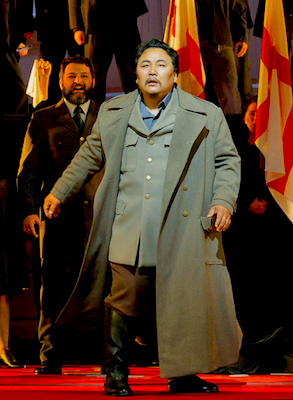
The title role was sung by Mongolian baritone Amartuvshin Enkhbat, who proved to be in fine voice throughout the performance. Enkhbat’s security in the role was most vividly demonstrated in the Doge Simon’s great aria ‘Plebe, Patrizi, Popoli’; in which he seeks reconciliation between the aristocratic and lower class factions that Simon believes are destroying the Italian city-state of Genoa.
The passionate words ending the aria proper ‘E vo gridando pace; E vo gridando amor’ [‘And I cry out peace; and I cry out love!’] lead to one of the greatest ensembles in Verdian opera. In the ensuing ‘pezzo concertato’ each of the principal characters express their thoughts of the moment.
Enkhbat’s character, the elected Doge of Genoa, is the leader of the city-state’s plebeian (lower class) factions, historically in opposition to the patrician (aristocratic) factions whose leader is his arch-rival Jacopo Fiesco Grimaldi. The opera, which spans two generations, is a tale of historical adversaries who at opera’s end are reconciled.
Enkhbat demonstrated a powerful dramatic baritone voice that has proven a good fit for Verdi’s operatic works. This is the third Enkkhbat performance I have reviewed, all principal roles in San Francisco Opera Music Director Eun Sun Kim’s “Verdi opera of the season”
Previous reviews were of his Renato [Review: Michael Fabiano, Lianna Haroutounian Lead a Beautifully Performed, Intelligently Directed “Ballo in Maschera” – San Francisco Opera, September 15, 2024] and his Rigoletto [Review: Immensely Satisfying “Rigoletto” Performance Led by Amartuvshin Enkhbat and Adela Zaharia – San Francisco Opera, September 13, 2025].
Toni Marie Palmertree’s Amelia Grimaldi/Maria Boccanegra
[Photo: Toni Marie Palmertree as Amelia Grimaldi, also known as Maria Boccanegra; edited image,, based om a Matthew Washburn photograph, courtesy of the San Francisco Opera.]
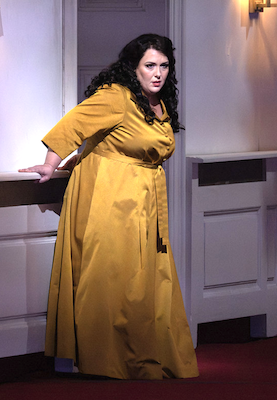
This performance was the role debut of Pennsylvania soprano Toni Marie Palmertree, performing as Maria Boccanegra, a character who had been known as Amelia Grimaldi for most of her life. (The season’s first two performances were performed by Italian soprano Eleonora Buratto.)
Palmertree sang her character’s principal aria ‘Come in quest ora bruna’ beautifully and with obvious confidence. She also impressively held the soprano line in the several ensembles in which her character participates. This performance confirms my belief that she is early in an important operatic career.
Although Palmertree has appeared at the San Francisco Opera in both the title role of Puccini’s “Madama Butterfly” and Nedda in Leoncavallo’s “Paglliacci”, to date I have seen her perform in smaller roles except for her role as Prince Calaf’s companion, Liu. [See: Review: San Francisco Opera’s “Turandot” – Sonic Splendor, Visual Delight – September 8, 2017 and A Second Look Review: San Francisco Opera’s “Turandot” – September 24, 2017,]
Christian Van Horn’s Jacopo Fiesco
[Photo: Christian Van Horn as Jacopo Fiesco; edited image, based on a Cory Weaver photograph, courtesy of the San Francisco Opera.]
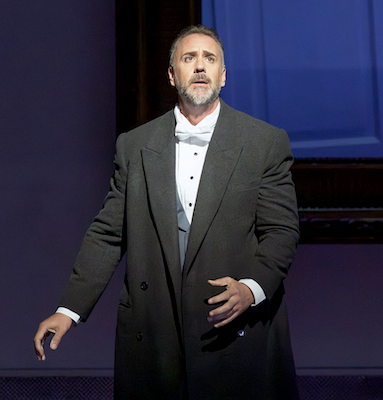
New York bass Christian Van Horn brought a sonorous low voice and incisive acting to the role of the patrician leader, Jacopo Fiesco. He intoned Fiesco’s great arias ‘A te, l’estremo addio’ (beautifully sung with distant chorus) and ‘Il lacerato spirito’ with solemnity.
Van Horn is a passionate student of the bass repertory, with a special reverence for Verdi’s works. Among his career accomplishments is the creation of an iinfluential Internet presence “The CVH Podcast”
Among Van Horn’s many roles with the San Francisco Opera are the Four Villains [Review: Matthew Polenzani Triumphs in Pelly’s Take on “Tales of Hoffmann” – San Francisco Opera, June 5, 2013] Narbal [Review: Susan Graham, Hymel, Antonacci in a Magnificent “The Trojans” from Sir David McVicar – San Francisco Opera, June 7, 2015], and Claggart [Review: An Indomitable “Billy Budd”, San Francisco Opera, September 7, 2019] ].
In other opera houses, I have praised his performances as Zaccaria [Review: Mary Elizabeth Williams’ Beautifully Sung Abigaille, Deep Casting Enrich New “Nabucco” – Seattle Opera, August 8, 2015], Oroveso [Review: The Dallas Opera’s “Norma” – Vocally Outstanding, Dramatically Persuasive, April 21, 2017], Raimondo [Review: Brenda Rae’s Stunning Lucia di Lammermoor – Santa Fe Opera, July 1, 2017] and Mephistopheles [Review: Benjamin Bernheim Leads Superb “Faust” Cast – Lyric Opera of Chicago, March 12, 2018].
Joshua Guerrero’s Gabriele Adorno
[Photo: Joshua Guerrero as Gabriele Adorno; edited image, based on a Cory Weaver photograph, courtesy of the San Francisco Opera.]
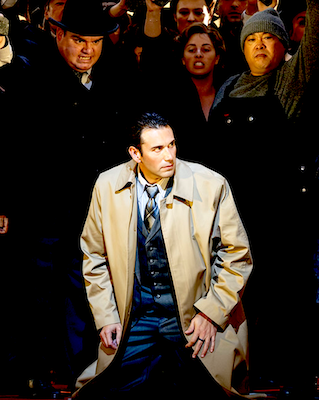
Nevada tenor Joshua Guerrero, in his San Francisco Opera debut season, sang the role of Gabriele Adorno. He demonstrated a tonally brilliant ‘spinto’ voice that was effective in Adorno’s major aria ‘Cielo pietoso rendilla’. His Adorno was a strong presence in the several ensembles in which the character appears.
This is my third time at a Joshua Guerrero performance following his Romeo, substituting for another artist [Review: A Surprise at Santa Fe Opera – Joshua Guerrero joins Pérez, Aceto in Gounod’s “Roméo et Juliette”, July 29, 2016] and his Cavaradossi [Review: A Well-Sung “Tosca” Starring Leah Hawkins, Joshua Guerrero, Reginald Smith, Jr. and Blake Denson – Santa Fe Opera, June 30, 2023].
Alexey Bogdanov’s Paolo Albiani and Other Cast Members
[Photo: Alexey Bogdanov as Paolo Albiani; edited image, based on a Cory Weaver photograph, courtesy of the San Francisco Opera.]
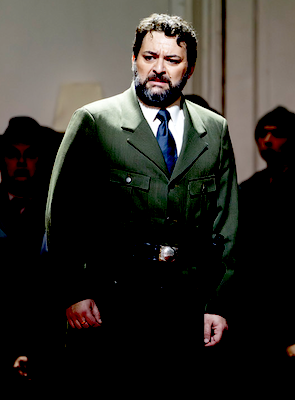
California baritone Alexey Bogdanov was a strong presence, vocally and histrionically, as the villainous Paolo, whose poisoning of Doge Simon, instead of achieving its desired results, leads to his downfall.
I have anjoyed past Bogdanov performances both in such standard repertory roles as Masetto [ Review: Ildar Abdrazakov is Don Giovanni in the Pascoe Production’s Revival – Washington National Opera, October 7, 2012 ] and Sharpless [Review: Yunah Lee Leads Impressive Cast in Glimmerglass Festival “Madama Butterfly” – July 17, 2014] and also in rarely performed roles such as Sebastiano [Review: Sarasota Opera’s Triumphant “Tiefland” Stars Kara Shay Thomson, Ben Gulley – March 18, 2018].
First-Year Adler Fellow Puerto Rico baritone Gabriel Natal-Baez was Pietro (see photograph with San Franicisco Opera Chorus below). New York tenor Christopher Jackson was the Captain of the Guard. Australia mezzo-soprano Stella Hancock was Amelia’s Servant.
Maestra Eun Sun Kim and the San Francisco Opera Orchestra and Chorus
[Photo: Maestra Eun Sun Kim conducts the San Francisco Opera Orchestra (unseen below her in the orchestra pit; during the scene that closes the opera. Onstage Simon Boccanegra (Amartuvshin Enkhbat, lying at edge of stage as Gabriele Adorno (Joshua Guerrero, left) and Maria Bocccanegra (Toni Marie Palmertree, right) kneel beside him and Jacopo Fiesco (Christian Van Horn), stands behind them; edited image, based on a Matthew Washburn photograph, courtesy of the San Francisco Opera.
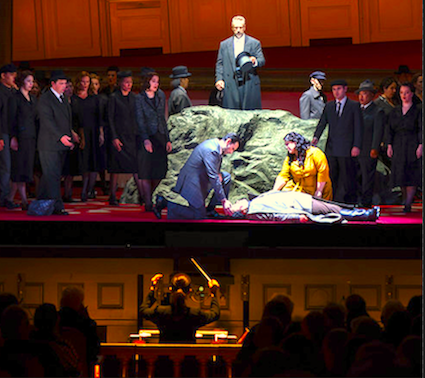
Maestra Eun Sun Kim led the San Francisco Opera Orchestra and Chorus in a world-class performance of one of Verdi’s greatest works. The San Francisco Opera Orchestra, whose contract disputes with the opera’s management, delayed the opening of the Opera for ten days (resulting in the cancellation of four scheduled performances) gave a magnificente performance.
At the begiining of this decade, Maestra Kiim had committed to performing a Verdi opera each year. In addition to mounting “Ballo” in 2024, “Rigoletto” in 2025 and this season’s “Boccanegra, (all featuring Amartubshin Enkhbat) , the list includes “La Traviata” in 2022 [Review: “La Traviata” Delightful New Production, Well-Received Debuts by Yende, Tetelman and Piazzola – San Francisco Opera, November 22, 2022] and “Il Trovatore” in 2023 [Review: Chacon-Cruz, Angel Blue, Semenchuk and Petean in Rousing, Richly Dramatic Performance of “Il Trovatore” – San Francisco Opera, September 17, 2023]
The San Francisco Opera Chorus (see photo below), under the direction of Pennsylvania Chorus Director John Keene, performed an essential rike in the performance’s great success.
Directors Claus Guth and Katherine M Carter and Production Designer Christian Schmidt
[Photo: Pietro (Gabriel Natal-Baez, center front) stands with a patrician crowd (San Francisco Opera Chorus) in ; edited image, based on a Cory Weaver photograph, courtesy of the San Francisco Opera.]
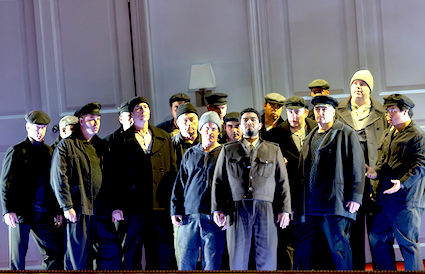
The production by German director Claus Guth originated at the Hamburg State Opera in 2006. IIt opens the opera with the main characters surrounding the poisoned body of Doge Simon, so that the ensuing scenes are presented as memories of the events that end with the same images as the opening scene.
The sets, created by German scenic designer Chirstian Schmidt consisted a dual level stage, which included a large seascape, representing Genoa’s maritime presence. From time to time the picture disappeared and activities of actors and choristers advancing the plot, were seen in place of it.
A curiosity of the production is a large rock that represents a meteor that has broken through the roof of the set. Although the rock did not disrupt the story, I was unpersuaded that it added to the opera’s presentation. The revival of the Guth production was directed bt New York director Katherine M. Carter.
For my performance review of aa previous Claus Guth production, see Review: A “Rigoletto” Surprise in Paris: Ludovic Tézier Subs in Title Role in Claus Guth’s Production with Fabiano, Peretyatko, Luisotti – May 5, 2016.
Special Note: ‘Me and Boccanegra’
I am pesonally aware that I am one of the few persons alive that has attended a performance of “Simon Boccanegra” in each of the seven seasons between 1956 and 2026 that the San Francisco Opera has presented the work.
[Photo: The Council scene from the 1975 San Francisco Opera production of “Simon Boccanegra”. Doge Simon (Ingvar Wixell, center) stands at the base of his throne while his daughter Maria (Dame Kiri Te Kanawa, in white gown) stands below him at center right); edited image, based on a Greg Peterson photograph, courtesy of the San Francisco Opera Archives.]
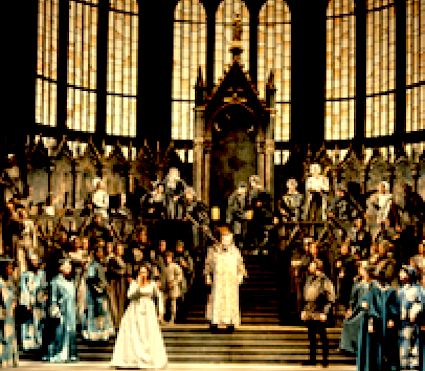
In my “Historical Perfomances” feature, I commented on performances I attended in 1956 [Historical Performances: “Simon Boccanegra” with Warren, Tebaldi and Christoff, San Francisco Opera in Los Angeles – October 20, 1956] and 1960 [Historical Performances: “Simon Boccanegra” with Tito Gobbi, Giorgio Tozzi – San Francisco Opera, October 6, 1960]. I have posted my contemporaneous performance review of its most recent mounting prior to this season [Review: Verdian Back to Basics – San Francisco Opera’s Satisfying “Simon Boccanegra”, September 21, 2008], in addition to this review from the present season.
[Photo: In the 1980 San Francisco Opera production, Maria Boccanegra (Margaret Price, left) is comforted by her father Doge Simon Boccanegra (Renato Bruson, right);; edited image, based on a Ron Scherl photograph, courtesy of the San Francisco Opera Archives.]
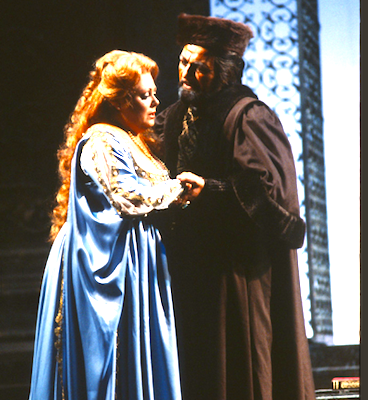
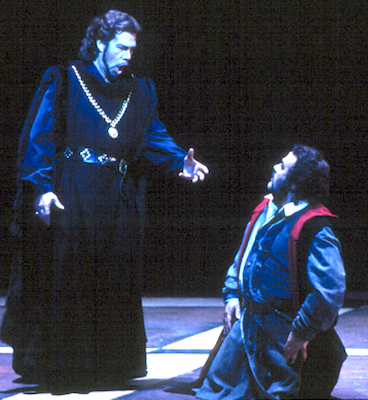
The other three mountings of the opera were performances that took place in 1975, starring Swedish baritone Ingvar Wixell, New Zealand soprano Dame Kiri Te Kanawa and Finnish bass Martti Talvela; in 1980 starring Italian baritone Renato Bruson, English soprano Margaret Price and Italian bass Cesare Siepi, and in 2001 starring Italian baritone Paolo Gavanelli, American soprano Carol Vaness and bass Samuel Ramey
[Photo: Jacopo Fiesco (Samuel Ramey, left) opens a dialogue with his traditional enemy Doge Simon Boccanegra (Paolo Gavanelli, right); edited image, based on a Ken Friedman photograph, courtesy of the San Francisco Opera Archives.]
I have a great respect for the opera. Throughout the seven decades that I have been attending “Boccanegra” performances at San Francisco Opera, the company has presented a lustrous array of great voices.
Additionally, I attended performance with important casts in both Houston [Review: Hvorostovsky, Guryakova, Berti Excel in Houston Grand Opera “Simon Boccanegra” – November 4, 2006] and Los Angeles [Review: Legend Making at Los Angeles Opera – Placido Domingo, James Conlon Lead Star-Studded “Simon Boccanegra”, February 11, 2012], each starring principal singers each of whose careers includes many San Francisco Opera seasons.
Final Thoughts
This was a memorable performance of a Verdi opera that the San Francisco Opera has presented