
For the Spring 2025 weeks of its 2024-25 season, the San Francisco Opera scheduled nine performances of Puccini’s “La Boheme”. For six of those performances the lead roles of Mimi, Rodolfo, Musetta and Marcello were to be sung by four artists designated as the “first cast”. Four other artists were scheduled to alternate those four roles and were designated as the “second cast”. The remaining cast members were to sing all nine performances. This performance review is of the fifth of six performance of the “first cast”. [Following it is a performance review of the first of three performances of the “second cast”.]
One of the notable features of “Boheme’s” “first cast” is that three “Adler Fellows” – one from each decade of the present century, sing three of the four “Bohemian roommate” roles. Lucas Meachem, the Marcello, is a 2004 and 2005 “Adler”. Pene Pati, the Rodolfo is a 2016 Adler. Samuel Kidd, the Schaunard, is completing a two-year fellowship.
Pene Pati’s Rodolfo
Although John Caird’s production was performed by the San Francisco Opera in both 2014 and 2016, the 2025 performances were staged by New York director Katherine M. Carter, who previously had staged the production’s revival in Toronto. Carter’s revival proved rich in innovative details. In this staging, for example, Rodolfo not only announces himself as a poet, but has a book of his poems to show to Mimi.
[Photo: Pene Pati as Rodolfo; edited image, based on a Cory Weaver photograph, courtesy of the San Francsico Opera.]
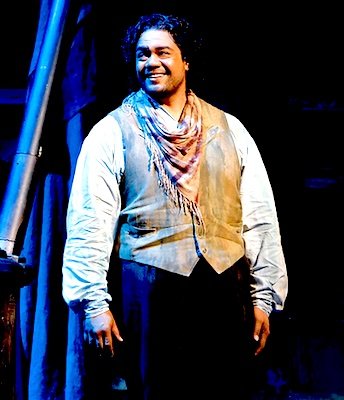
The role of Rodolfo was sung by Samoan tenor Pene Pati. who, as previously mentioned, had been a 2016 Adler Fellow.
Performing Rodolfo combines two musical styles. The first is a series of comic situations that arise from playful interchanges with Rodolfo’s three Bohemian roommates – Marcello, Schaunard and Colline. These comic scenes are in full display in the first halves of the first and fourth acts in their garrett apartment.
The role of Rodolfo’s central place in the lyric tenor repertory, however, derives from the second of the musical styles – the powerful effect of the role’s dramatic high points. These include Rodolfo introducing himself to Mimi with the aria ‘Che gelida manina’, the third act duet with Marcello (explaining his concern for Mimi’s deteriorating health) and the “breakup” duet with Mimi, which follows. The final scene in Act 4, ends with Rodolfo’s despair at Mimi’s death.
Pati proved himself to be a dramatically intense, theatrically effective Rodolfo. He was a strong comedic presence in the first act banter with his Bohemian roommates. With the entrance of Mimi, and, especially Rodolfo’s great aria, Pati exuded the passion that defines a great Puccini tenor.
[Photo: Rodolfo (Pene Pati, left) lights the candle that Mimi (Karen Chia-Ling Ho, right) carries; edited image, based on a Cory Weaver photograph, courtesy of the San Francisco Opera..]
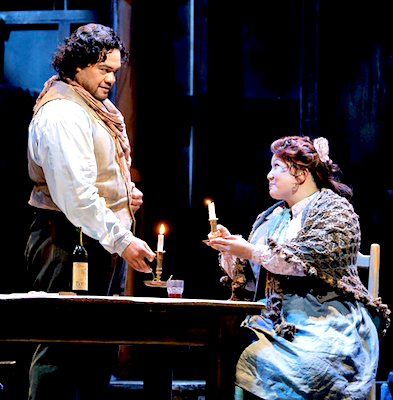
Rodolfo is the fourth major role that San Francisco Opera has entrusted to Pati. His previous assignments were Verdi’s Duke of Mantua [Review: Quinn Kelsey a World Class Verdi baritone in “Rigoletto” – San Francisco Opera, May 31, 2017], Gounod’s Roméo [Review: Pene Pati and Nadine Sierra Brilliant in Gounod’s “Roméo and Juliet” – San Francisco Opera, September 6, 2019] and Donizetti’s Nemorino [Review: Donizetti’s Delightful, ‘Must See’ “Elixir of Love” Starring Pene Pati and Slatka Zamecnikova – San Francisco Opera, November 19, 2023], the latter role under the baton of this performance’s conductor, Maestro Ramón Tebar.
Karen Chia-Ling Ho’s Mimi
Taiwanese soprano Karen Chia-Ling Ho returned to the San Francisco Opera to perform the role of Mimi. Her first aria, ‘Mi chiamano Mimi’, confirmed that she possessed the emotional depth and persuasive vocal power expected of a principal Puccini soprano.
[Photo: Karen Chia-Ling Ho as Mimi; edited image, based on a Cory Weaver photograph, courtesy of the San Francisco Opera.]
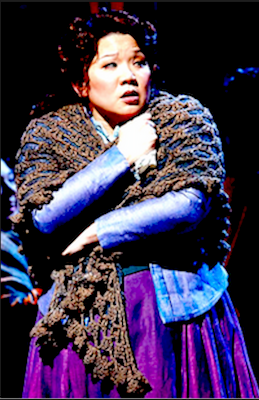
An alumna of the San Francisco Opera’s Merola program, Ho appeared as the Princess Jia in both the 2016 world premiere and the 2022 revival of Bright Sheng’s epic opera [Review: A Pleasing Revival of “Dream of the Red Chamber” at San Francisco Opera, June 14, 2022]. In her two seasons as Jia, she is remembered as an artist who wore what is surely the most elaborate costume in San Francisco Opera history. As Mimi, she will be remembered for her passionate singing and acting.
The performance’s highlights include the luxuriously melodic third act duet between Ho’s Mimi and the Marcello of Lucas Meachem, followed by her affecting duet with Pati’s Rodolfo, and the opera’s final scene in which Musetta and the Bohemians surround Mimi’s deathbed.
Andrea Carroll’s Musetta
For her San Francisco Opera debut, Maryland lyric soprano Andrea Carroll sang the role of the flirtatious Musetta. Carroll performed Puccini’s popular aria ‘Quando m’en vo’ (Musetta’s waltz) with spirit and vocal skill.
[Photo: Andrea Carroll as Musetta; edited image, based on a Cory Weaver photograph, courtesy of the San Francisco Opera.]
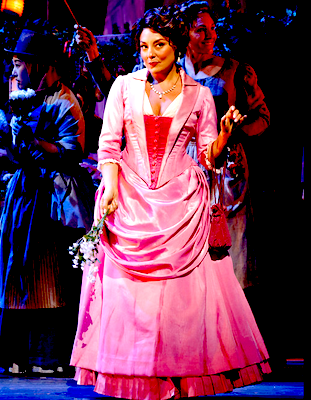
Carroll’s comic talents were evident in her portrayal of Musetta’s battles with her on-again, off-again lover Marcello, as well as the tricks she played on her money-bags date, Alcindoro. In contrast, she was dramatically intense in the final scene at Mimi’s death bed.
Carroll is a frequent performer of 21st century repertory, including world premieres [World Premiere Review: Jake Heggie’s Celestial Transformation of “It’s a Wonderful Life” – Houston Grand Opera, December 2, 2016]. In addition to the standard lyric repertory, she has participated in opera company performances of 20th century musical roles, including Rodgers’ and Hammerstein’s Julie Jordan [Review: Ryan McKinny Stars in Affectionately Mounted “Carousel” – Glimmerglass Festival, July 18, 2014 and Review: Houston Grand Opera’s Convincing Case for “Carousel” – April 22, 2016] and Bernstein’s Maria [Review: Francesca Zambello’s Spirited Mounting of Bernstein’s “West Side Story” – Houston Grand Opera, April 28, 2018.]
Lucas Meachem’s Marcello
North Carolina baritone Lucas Meachem’s San Francisco Opera debut took place 21 years ago in the first year (2004) of a two-year Adler Fellowship. Meachem, for the first time, is assuming the robust role of Marcello at the War Memorial Opera House. Oriignally announced for six performances, he now sings the role in all nine performances.
[Photo: Lucas Meachem as Marcello; edited image, based on a Cpry Weaver photograph, courtesy of the San Francisco Opera.]
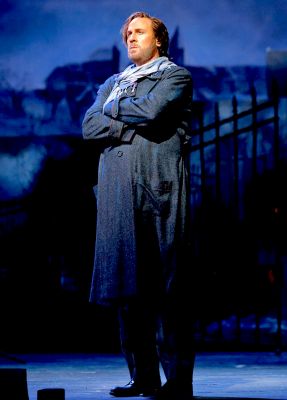
Marcello is a perfect role for Meachem, with abundant opporutnities to show his full range of operatic emotions. Meachem’s sonorous baritone was in evidence in ‘Mimi – son io’, his heartfelt third act duet with Ho’s Mimi, in which he responds to her concerns about Rodolfo’s behavior towards her.
I have often described the acoustically vibrant War Memorial Opera House as the “House of Puccini”. Meachem’s rich, refined vocal performance of Marcello, following his brilliant Sharpless two seasons ago [Review: Karah Son, Michael Fabiano Lead Brilliant Cast in Amon Miyamoto’s Fascinating Production of “Madama Butterfly” – San Francisco Opera, June 3, 2023] suggests he is right at home in what I consider to be “Puccini’s house”.
Previously at San Francisco Opera, Meachem had been associated with Mozartian roles, singing both Count Almaviva [Review: Copley Directs, Luisotti Conducts, Sparkling “Nozze” Ensemble – San Francisco Opera, October 3, 2010] and Don Giovanni [Review: Meachem, Vinco, Lead Cast of Imaginatively Staged “Don Giovanni” – San Francisco Opera, October 23, 2011]. Several Meachem appearances were in bel canto comedy roles, including Figaro [Review: Lucas Meachem, Javier Camarena and Isabel Leonard Romp in Sagi’s Sprightly New “Barber of Seville” – San Francisco Opera, November 13, 2013] and Malatesta [Review: Maurizio Muraro Leads An Appealing “Don Pasquale” Cast – San Francisco Opera, October 2, 2016].
In addition to Meachem’s accomplishments in San Francisco, I have admired his versatility in performing elsewhere in such varied roles as Chorebus [Review: A World Class Cast for Berlioz’ “Les Troyens” – Lyric Opera, Chicago, November 13, 2016], Athanaël [Review: Minnesota Opera’s Splendidly Exotic, Erotic “Thaïs” – May 12, 2018] and Onegin [Review: Santa Fe Opera’s “Eugene Onegin”, Musically Appealing, Visually Striking – July 24, 2021]. He also sang the role of Figaro in Corigliano’s “The Ghosts of Versailles”. [Review: Los Angeles Opera Launches Ambitious New Production of “Ghosts of Versailles” – February 7, 2015]. That performance’s recording earned Meachem a Grammy.
Samuel Kidd’s Schaunard
Michigan bass-baritone Samuel Kidd, a current Adler Fellow, is a tall, handsome and confident performer. Having assayed such ‘comprimario’ roles as King Marke’s Steersman [Review: ONeill and Kampe Lead a Powerfully Performed “Tristan und Isolde” – San Francisco Opera, October 27, 2024] and Corporal Morales [Streamed Performance Review: A Splendidly Sung and Well Acted “Carmen” – San Francisco Opera, November 19, 2024], his exuberant portrayal of the musician Schaunard, more that any of the roles he has sung for the company, showcases Kidd’s vocal and histrionic talents.
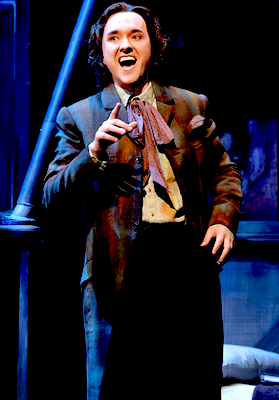
In revival director Kathleen Winter’s staging, Schaunard has much more to do than such high-jinks as is described in the libretto. Kidd’s Schaunard makes a spectacular entrance into the Bohemians’ apartment in the opera’s first scene, bringing Christmas eve foodstuffs (some carried by a young boy and girl he enlisted to help him get everything home).
Throughout the performance, Kidd’s Schaunard engages in eye-catching activities. At one point in his earliest appearance, Schaunard with his fellow Bohemians and the two kids, facing front, unexpectedly perform choreographed dance steps. At the Cafe Momus, Schaunard steals the top hat of Musetta’s date Alcindoro, wearing it again in the early moments of the final act.
Kidd’s Schaunard was intelligently conceived and acted. Even with the welcome innovations in Winter’s staging, Kidd’s Schaunard exhibits the depth of character that Puccini and his librettists have imbued in the role – the boisterousness of the interactions with the roommate’s landlord Benoit, and the four roommates dancing at the beginning of the final act, until Musetta bursts into the apartment with news that Mimi is deathly ill. In Mimi’s final moments it is the observant Schuanard that is first aware that Mimi has died.
Bogdan Talos’ Colline
Romanian bass Bogdan Talos makes his San Francisco Opera debut as Colline. Although Talos’ Colline joined his Bohemian roommates in all the adventures in which they engaged – the first act’s cunning deception of the Bohemians’ landlord, the all male dancing in the final act – Colline, the philosopher, is the most introspective of the foursome.
[Photo: Bogdan Talos as Colline, about to part ways with his “philosopher’s coat”; edited image, based on a Cory Weaver photograph, courtesy of the San Francisco Oper

Colline is unique among the cast members in having a solo aria, ‘Vecchio, Zimmara, senti’ which he sings to himself, or more specifically to his coat, which he associates with his career as a philosopher. Talos sang the aria beautifully.
Maestro Ramon Tebar and the San Francisco Opera Orchestra and Chorus
Maestro Ramón Tebar led the San Francico Opera Orchestsra and Chorus in an intensely emotional performance, in which the orchestra instrumentalists displayed a keen awareness of the pathos that Puccini wrote into his score. The chorus, which enlivened the second act scene surrounding Paris’ Cafe Momus, was directed by Chorus Master John Keene
[Photo: Maestro Ramón Tebar; edited image of a publicity photograph, from Google Images.]

I had previously praised Tebar’s conducting of bel canto works by Bellini [Review: “Sonnambula” Reawakened: Rachele Gilmore’s, Michele Angelini’s Artistry, Vocal Fireworks Enliven Bellini’s Masterpiece – Florida Grand Opera, February 9, 2013] and Donizetti [Review: Donizetti’s Delightful, ‘Must See’ “Elixir of Love” Starring Pene Pati and Slatka Zamecnikova – San Francisco Opera, November 19, 2023].
Hearing the results of his conducting “Boheme” for both the “first” and “second” cast performances, gave me an entirely different perspective of his conducting style and how a conductor can wrench heartfelt emotion from a performance of “La Boheme”.
My reviews will be posted soon of Mozart’s “Idomeneo” and of the “second cast” performance of Puccini’s “La Boheme” , highlighting John Caird’s production and the performances of Nicole Car (Mimi), Evan LeRoy Johnson (Rodolfo) and Brittany Renee (Musetta), and of the production’s ‘comprimario’ cast members.