

The opera “Carmen” is the world’s most popular French opera. Tchaikovsky called it “the perfect opera”. For San Francisco Opera, the eight performances it scheduled in the 3000+ seat War Memorial Opera House have been sold out for virtually every performance.
The San Francisco Opera’s “Carmen” run, using New York director Francesca Zambello’s well-traveled production, was the occasion for two American debuts (for Swiss mezzo-soprano Eve-Maud Hubeaux as Carmen and British soprano Louise Alder as Micaela).
Eve-Maud Hubeaux’ Carmen
Swiss mezzo-soprano Eve-Maud Hubeaux demonstrated vocal and histrionic mastery of the role of Carmen. In an opera in which each of the four principals sings at least one of the greatest of French opera arias, the artist singing Carmen has several opportunities to make a strong impression.
[Photo: Carmen (Eve-Maud Hubeaux (center) is surrounded by admiring men; edited image, based on a Cory Weaver photograph, courtesy of the San Francisco Opera.]

Carmen sings two famous arias in the first scene (Bizet’s Act I) – the Habanera (L’amour est un oiseau rebelle) and the Seguidilla (Pres des ramparts de Sevilla). A third aria, the so-called “Gypsy Song” (Les tringles des sistres tintaient) is performed by Carmen with her companions Frasquita and Mercedes in the second scene (Bizet’s Act II).
In each of these vocal “highlights”, Hubeaux’ impressive singing was enhanced by her interactions with the chorus and/or other principals, reflecting the insightful staging of director Zambello.
A high point of Hubeaux’ performance was the central part of a trio taking place in the third scene (Bizet’s Act III) in the smugglers’ hideaway. Carmen’s companions, Frasquita and Mercedes, playfully seek to learn their futures through drawing cards. Hubeaux’ Carmen, who has tired of her lover Don Jose, performs the solemn En vain pour éviter les réponses amères, en vain tu mêleras to astonishing effect. In that aria, Carmen accepts the verdict of the cards she has dealt – that she will die first, followed by Don Jose.
[Photo: Eve-Maud Hubeaux as Carmen; edited image, based on a Cory Weaver photograph, courtesy of the San Francisco Opera.]

Hubeaux is a 2024 winner of the Salzburg-based Herbert von Karajan Prize, one of only four opera singers to have won the award since its establishment in 2015.
John Tetelman’s Don Jose
Pennsylvania tenor John Tetelman returned to the San Francico Opera two seasons after his company debut as Alfredo [Review: “La Traviata” Delightful New Production, Well-Received Debuts by Yende, Tetelman and Piazzola – San Francisco Opera, November 22, 2022],
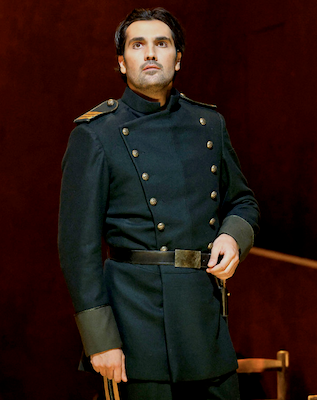
Tetelman gave a well-rounded portrayal of Corporal Don Jose, the soldier unlucky enough to have caught the eye of Carmen. The character’s rustic charm and mama’s boy loyalty was demonstrated in Tetelman’s first act duet with Louise Alder’s Micaela.
[Photo: John Tetelman as Don Jose; edited image, based on a Cory Weaver photograph, courtesy sof the San Francisco Opera.]
Opera has proven to be an effective medium for portraying how in a single moment a well-ordered life can be irreparably transformed. Carmen’s decision to lavish a moment or two of attention on Jose, especially throwing a flower at him, probably would have led nowhere. It was a coincidence that Jose was commanded to arrest Carmen after her knife-fight with another woman in the cigarette factory. Carmen raised the stakes through her invitation to Jose for romantic attention later in exchange for agreeing to let her escape the ropes that Jose used to apprehend her.
It is the second scene that defines the mettle of the tenor singing Don Jose. Having spent two months in prison and having been demoted, the character arrives at Lillas Pastia’s tavern to collect on Carmen’s romantic promises, but is still sufficiently loyal to his regiment to want to heed the bugle call requring solders to return to camp for roll call muster.
Taunted by Carmen’s ridicule, Tetelman, proved his mettle by exquisitely performing “the Flower Song” aria – La fleur que tu m’avais jetée , a high point of French opera, as well as Tetelman’s artistic contributions to date with the San Francisco Opera.
[Photo: Carmen (Eve-Maud Hubeaux, left) tells the enraged Don Jose (John Tetelman, right) to kill her or let her pass; edited image, based on a Cory Weaver photograph,, courtesy of the San Francisco Opera.]
The rest of the scene, including his fight with Zuniga (in this production an especially violent one) requires an actor who can convey intense emotion both physicialy and vocally. Between the second and third acts, it is obvious that there is a period when Carmen and Don Jose are passionate lovers, but that period is not shown in the opera.
When we next observe Don Jose, he is a mental wreck, fighting with Escamillo, Carmen’s next lover-to-be. Here again, Tetelman demonstrated mastery of the physical and vocal demands on the tenor portraying Don Jose, especially the power of Don Jose’s melodic phrases in the last scene of the opera in which the despairing Jose murders Carmen.
Christian Van Horn’s Escamillo
Performing what is surely the most famous baritone aria in French opera, was New York bass-baritone Christian Van Horn.
[Photo: Escamillo (Christian Van Horn, above) rides his horse into Lillas Pastia’s Tavern; edited image, based on a Cory Weaver photograph, courtesy of the San Francisco Opera.]
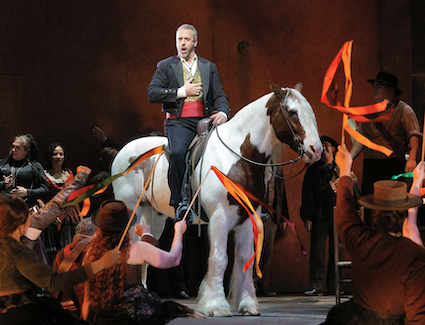
Entering the scene on a very laid-back horse, he dispatched the introductory Votre toast je peux vous le rendre stalwardly, leading to the universally recognized refrain Toreador, en garde, Van Horn, in excellent voice, performed the cheerful aria with gusto,
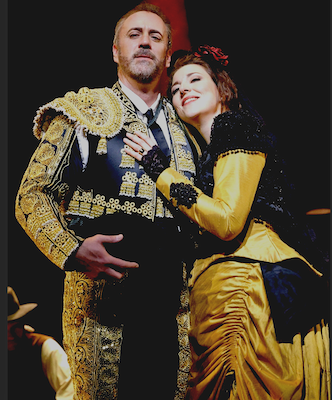
Van Horn shone In Escamillo’s two later appearances, engaging in a knife fight with Don Jose in the smugglers’ hideaway, and appearing at the bull ring’s entrance dressed elegantly in his suit of light with Carmen at his side,
[Photo: Carmen (Eve-Maud Hubeaux, right) as the companion and lover of Escamillo (Christian Van Horn); edited image, based on a Cory Weaver photograph, courtesy of the San Francisco Opera.]
Van Horn is one of the American artists who have been awarded the prestigious Richard Tucker award.
The San Francisco Opera has enlisted Van Horn’s versatility in portraying a wide range of roles, from such iconic villains as Offenbach’s foursome [Review: Matthew Polenzani Triumphs in Pelly’s Take on “Tales of Hoffmann” – San Francisco Opera, June 5, 2013] to Britten’s John Claggart [Review: An Indomitable “Billy Budd”, San Francisco Opera, September 7, 2019] to such bel canto era personages as Handel’s Zoroastro [Review: A Finely Sung “Orlando” Melds Handel’s Seductive Music with Harry Fehr’s Surreal Staging – San Francisco Opera, June 9, 2019].
Louise Alder’s Micaela
British lyric soprano Louise Alder’s reputation includes winning the Joan Sutherland Audience Prixe at the 2017 Cardiff Best Singers of the World Competition.
[Photo Louise Adler as Micaela; edited image, based on a Cory Weaver photograph, courtesy of the San Francisco Opera.]

She proved to be an audience charmer as Micaela, beginning with her beguiling entrance soon after the opera begins. Her perfomance’s vocal highlights include her melodious duet with Don Jose, cited above.
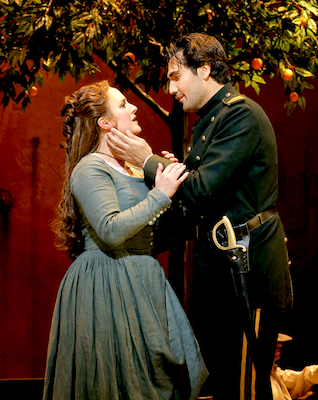
The duet between Elder’s Micaela and Tetelman’s Don Jose effectively described what would have been the course of events were it not for Carmen impulsively choosing to seduce Jose, the only man nearby who was ignoring her.
By thoughtlessly interfering in the lives of hometown sweethearts, Carmen destroyed both her own life and that of Don Jose’s.
[Photo: Don Jose (Jonathan Tetelman, right) agrees to receive a kiss from his mother transmitted by Micaela (Louise Alder, left); edited image, based on a Cory Weaver photograph, courtesy of the San Francisco Opera.]
No review of an artist performing the role of Micaela is complete without an assessment of her singing the great third act aria Je dis que rien ne m’épouvante. Here Alder would surely be a strong contender for any “best sung aria of the performance” contest.
Arianna Rodriguez’ Frasquita, Nikola Printz’ Mercedes, Christopher Oglesby’s Dancaire and Alex Boyer’s Ramendado and other Cast Members
San Francisco Opera 2024 Adler Fellowships (San Francisco Opera’s full-time young artists’program) provided two of the artists in the second act smuggler’s quintet. Virginia soprano Arianna Rodriguez was Frasquita and California mezzo-soprano Nikola Printz was Mercedes.
[Photo Arianna Rodriguez as Frasquite; edited image, based on a Cory Weaver photograph, courtesy of the San Francisco Opera.]
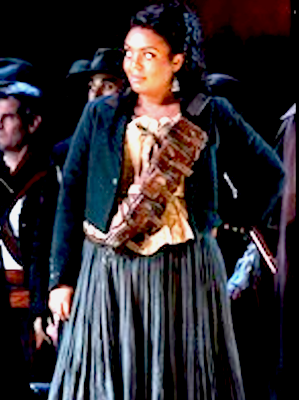
Rodriguez and Printz both sang with spirit in their ensembles with Carmen in the presence of the bullfighter Escamillo, and in their fortune-telling trio in the smugglers’ hideaway.
They also were important contributors to the success of the smugglers’ quintet in the Lillas Pastia’s tavern scene.
Two other artists were a dramatic presence as smugglers La Dancaire (Christopher Oglesby) and La Remendado (Alex Boyer). Each of the artists has sung in several previous San Francisco Opera performances.
I have praised the performances of Georgia lyric tenor Christopher Oglesby, a former Adler fellow, in multiple roles over the past several seasons, including an important comprimario role in every opera presented in the first half of the 2024-25 season.
His previous roles included Jacquino [Review: Beethoven’s “Fidelio”, An Excellent Cast for Matthew Ozawa’s Powerful Production – San Francisco Opera, October 17, 2021] and Edmondo [Review: A Passionate “Manon Lescaut” Led by Luisotti, Haroutounian and Jagde – San Francisco Opera, November 8, 2019]
New York base-baritone Alex Boyer has been absent from the San Francisico Opera since its 2016 season when he performed the role of El Remendado in Ameirican premiere of Calixto Bielto’s production of “Carmen” [Review: A Spanish “Carmen” from Calixto Bielto, San Francisco Opera, May 28, 2016] as well as roles in an important world premiere [World Premiere Review: “The Dream of the Red Chamber” Transforms into a Fascinating Opera – San Francisco Opera, September 10, 2016.]
Notably, Oglesby is the only member of this 2024 “Carmen” cast that performed in the 2019 mounting of Francesca Zambello’s production, and Boyer is the only member of this 2024 “Carmen” cast that performed in the 2016 San Francisco Opera mounting of Calixto Bielto’s “Carmen” production.
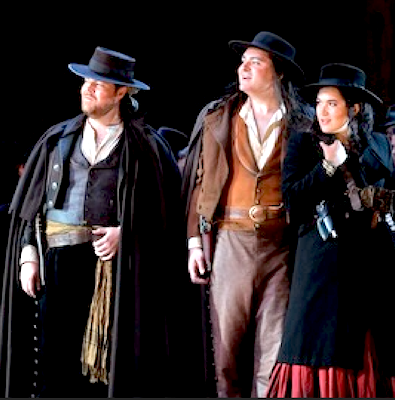
[Photo: the smuggler’s Dancaire (Christopher Ogelsby, (left), Remendado (Alex Boyer, center) and Mercedes (Nikola Printz, right); edited image, based on a Cory Weaver photograph, courtesy of the San Francisco Opera.]
Two more Adler fellows were impactful in military comprimario roles in the performance’s first half. New York bass-baritone James McCarthy, whose previous San Francisco Opera assignment had been the Second Armored Man in Mozart’s “The Magic Flute” was the officer Zuniga, Don Jose’s would-be rival for Carmen’s attention at that moment.
Michigan bass-baritone Samuel Kidd was Corporal Morales, the first principal artist whom we hear in the opera.
Kidd had already impressed me in two comprimario roles previously in San Francisco Opera’s Fall Season, Christinao [[Review: Michael Fabiano, Lianna Haroutounian Lead a Beautifully Performed, Intelligently Directed “Ballo in Maschera” – San Francisco Opera, September 15, 2024] and the Steersman [Review: ONeill and Kampe Lead a Powerfully Performed “Tristan und Isolde” – San Francisco Opera, October 27, 2024].
Maestro Benjamin Manis and the San Francisco Opera Orchestra and Chorus
“Carmen” is the vehicle for Maestro Benjamin Manis’ San Francisco Opera debut. The resident conductor of the Houston Grand Opera, Manis has been appointed by San Francisco Opera’s former Music Director, Sir Donald Runnicles, as the resident conductor of the Grand Teton Music Festival.

Manis led the San Francisco Opera Orchestra and Chorus (both of whom know the score intimately) in a flawess perfomance.
Pennsylvania Chorus Master John Keene supervised the chorus.
Director Francesca Zambello and Other Crew Members
This is the second San Francisco Opera mounting of Francesca Zambello’s “Carmen” production, it having previously been performed here five years ago [Review: Francesca Zambello’s Theatrically Compelling “Carmen” – San Francisco Opera, June 5, 2019].
My 2019 comments on Zambello’s insightful approach to “Carmen” are relevant to this performance review also.

The production was first performed 18 years ago at the Royal Opera House Covent Garden.
The sets and costumes were created by English designer Tanya McCallin, who also created the massive sets for director Lee Blakeley’s production of Sondheim’s “Sweeney Todd” [Review: “Sweeney Todd” at Houston Grand Opera: Nathan Gunn, Director Lee Blakeley Make a Compelling Case for Sondheim as Opera, April 24, 2015] and [Review: Searing Performances by Brian Mulligan and Stephanie Blythe for San Francisco Opera’s First “Sweeney Todd” – September 12, 2015]
McCallin also created the sets and costumes for Sir David McVicar’s production of Massenet’s “Manon” [Review: A Magnificent “Manon” starring Ailyn Pérez and Stephen Costello – The Dallas Opera, March 4, 2016].
Italian director Anna Maria Bruzzese was Associate Director and Choreographer. Irish Dance Master Colm Seery was Movement Director.
Recommendation
I recommend this production and cast both to the veteran opera goer and to persons new to opera.