
San Francisco Opera continued its tradition of memorable mountings of Mozart’s operas with an excellent performance of “Le Nozze di Figaro”.
Peter Kellner’s Figaro
[Photo: Peter Kellner as Figaro; edited image, based on a Cory Weaver photograph, courtesy of the San Francisco Opera.]
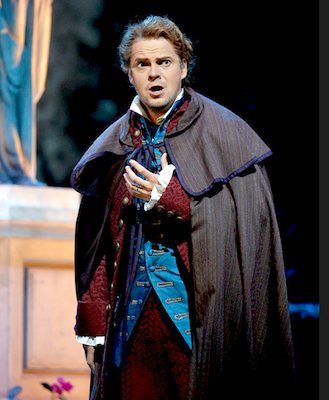
The title role was performed by Austrian tenor Peter Kellner, making his San Francisco Opera debut. From his opening duets with the Susanna (performed by soprano Slávka Zámecníková, Kellner’s real-life spouse), he was an ardent presence. He memorably sang Figaro’s first aria ‘Se vuol ballare’, denouncing the designs of his employer, Count Almaviva, on his soon-to-be wife, Susanna.
Kellner’s other major arias were performance highlights. He received an ovation at the end of Figaro’s most famous aria ‘Non piu andrai’, explaining to Cherubino the military future into which the page seemed suddenly to have been thrust. His final act aria, ‘Aprite un po’ quegli occhi’, Figaro’s warning to men of the supposed treachery of women, was convincingly sung.
Kellner gave an athletic peformance, including gymnastics, and showed dramatic sensibility in projecting Figaro’s altenating moods of anger and joy.
Slavka Zamecnikova’s Susanna
[Photo: Slávka Zámecníková as Susanna; edited image, based on a Cory Weaver photograph, courtesy of the San Francisco Opera.]
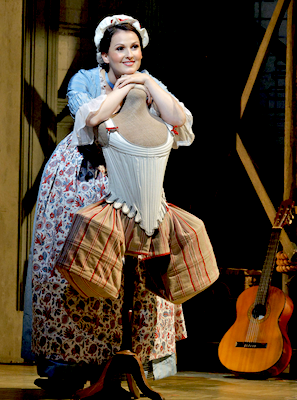
Austrian soprano Slávka Zámecníková was a bright-voiced, engaging Susanna (one of the longest operatic roles in the soprano repertory). Susanna appears in many scenes, interacting with the Count Almaviva, who plans her seduction, and with the Countess Almaviva, who plots with her to foil the Count’s misdeeds.
Susanna’s last act aria, ‘Deh vieni, non tardar’ expressing her love for Figaro, was a special moment in the performance.
[Photo: Figaro (Peter Kellner, right) and his fiancee Susanna (Slávka Zámecníková, left); edited image, based on a Cory Weaver photograph, courtesy of the San Francisco Opera.]
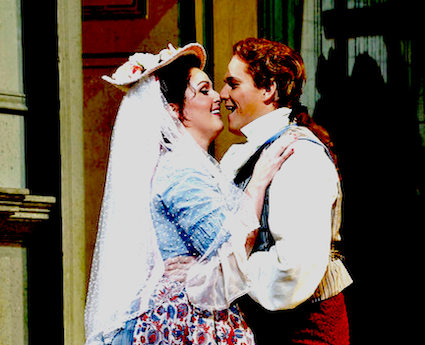
Zámecníková’s previous San Francisco Opera appearance was as Adina in Donizetti’s most-performed comic opera, “L’Elisir d’Amore” [Review: Donizetti’s Delightful, ‘Must See’ “Elixir of Love” Starring Pene Pati and Slavka Zamecnikov – San Francisco Opera, November 19, 2023].
Thomas Mole’s Count Almaviva
[Photo: Thomas Mole as the Count Almaviva; edited image, based on a Cory Weaver photograph, courtesy of the San Francisco Opera.]
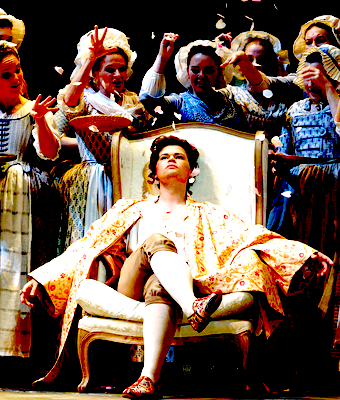
The Count Almaviva was British baritone Thomas Mole. Vocally strong and dramatically intense, Mole portrayed the Count’s villainous side in his desire to seduce Susanna. At opera’s end, Mole projected genuine contrition in the aria ‘Contessa, perdono’ after his schemes had gone awry.
This is Mole’s San Francisco Opera debut season. I had been impressed previously by his portrayal of James Stewart, Earl of Moray. [Review: Heidi Stober’s Powerful Performance, Strong Cast Support, Adds Drama to “Mary, Queen of Scots” – San Francisco Opera, September 26, 2026.]
Olivia Smith’s Countess Almaviva
[Photo: Olivia Smith as the Countess Almaviva; edited image, based on a Cory Weaver photograph, courtesy of the San Francisco Opera.]
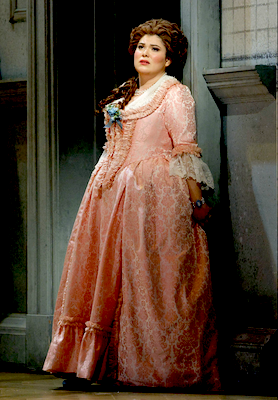
Canadian soprano Olivia Smith presented an affecting portrait of the Countess Almaviva, her first principal role at the San Francisco Opera. Smith performed the Countess’ showpiece arias, ‘Porgi, amor’ and “Dove sono’ with vocal elegance.
The Countess’ reply to the Count’s plea for pardon – ‘Più docile io sono e dico di sì’ (translated as ‘I am kinder than you, and I say yes’) – is one of the most beautiful sentiments in Mozart’s operas.
Smith has stated that she is drawn to the character. I expect, based on this performance, that the Countess will be a signature role for her.
Smith, a former Adler Fellow, has sung several smaller roles in previous seasons. Previously, I had praised Smith’s performance as Steve Jobs former girlfriend, Chrisanne [Review: Aural Splendor Permeates Composer Mason Bates’ Revised “(R)evolution of Steve Jobs” – San Francisco Opera, September 24, 2023 .
Simone McIntosh’s Cherubino
[Photo: Simone McIntosh as Cherubino; edited image, based on a Cory Weaver photograph, courtesy of the San Francisco Opera.]
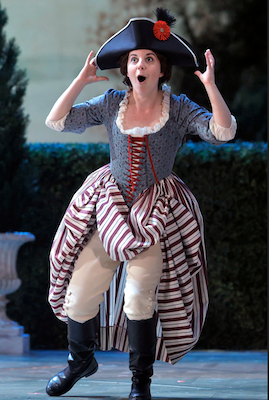
Canadian mezzo-soprano Simone McIntosh brought comic timing and a bright, secure sound, suggesting a voice of power, to the role of the lovestruck page, Cherubino. McIntosh beautifully sang Cherubino’s big aria, “Voi che sapete”, the page’s love-song that he composed for the Countess.
I had reported on McIntosh performances in two previous San Francisco Opera seasons, as a Wood Nymph [Review: “Rusalka”- Beautiful Singing, Insightful Drama – An Opera “Not to be Missed” – San Francisco Opera, June 16, 2019] and as Offred’s double [Review: A Cautionary “Handmaid’s Tale”, San Francisco Opera, September 14, 2024].
Cherubino is McIntosh’s first principal role at San Francisco Opera, and her perfomance was praiseworthy.
Maurizio Muraro’s Doctor Bartolo and Catherine Cook’s Marcellina
[Photo: Doctor Bartolo (Maurizio Muraro, left) and Marcellina (Catherine Cook, right) plot against Figaro’s marriage, prior to discovering they are FIgaro’s long-lost father and mother; edited image, based on a Cory Weaver photograph, courtesy of the San Francisco Opera.]
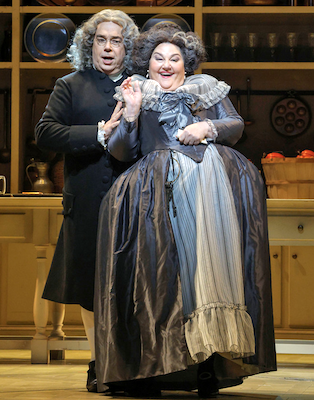
Italian bass Maurizio Muraro and California mezzo-soprano Catherine Cook were respectively Doctor Bartolo and Marcellina, whom the Count Almaviva had understood to be hostile to the marriage of Figaro and Susanna. In his first scene, Muraro performed Doctor Bartolo’s great aria ‘La vendetta, oh, la vendetta’, demonstrating his mastery of the ‘basso buffo’ genre, including its ‘patter’ passages.
In a later scene, Muraro and Cook were appropriately hilarious in one of the funniest scenes in all of Mozart operas. Marcellina discovers that Figaro is her long-lost son and that Bartolo is his father, a consequence that foils Count Almaviva’s plot. Susanna and other characters are surprised by the repetitive references to Figaro that reveal Marcellina is “sua madre’ and Bartolo is ‘sua padre’,
This is the third time I have reviewed a Muraro performance at San Francisco Opera, preceded by his appearances as Rossini’s Bartolo [Review: Daniela Mack, Alek Shrader, Audun Iversen and Maurizio Muraro Sparkle in San Francisco Opera’s “Barber of Seville” – November 14, 2013], and Donizetti’s Don Pasquale [Review: Maurizio Muraro Leads An Appealing “Don Pasquale” Cast – San Francisco Opera, October 2, 2016].
My appreciation of Muraro’s performances includes his operatic appearances in Paris [Review: Fine Cast Revives Strehler’s Treasured “Nozze di Figaro” Production – Opera National de Paris, May 31, 2011] and Santa Fe [Review: Ailyn Perez Joins Santa Fe Opera’s Excellent “Le Nozze di Figaro” Cast – July 31, 2025.]
California mezzo-soprano Catherine Cook, who participated in San Francisco Opera’s 1990 Merola program and who was a 1991 and 1992 Adler Fellow, has performed in over 350 San Francisco Opera performances. Having sung Marcellina in four previous San Francisco Opera mountings, Cook is the only artist to have sung the role of Marcellina for the company in the 21st century. This performance was her 41st Marcellina so far, with four additional performances scheduled in this run. A formidable presence in character mezzo-soprano roles, Cook was awarded the San Francisco Opera Medal in the company’s centennial year 2022..
Alek Shrader’s Don Basilio
[Photo: Alek Shrader as Don Basilio; edited image, based on a Cory Weaver photograph, courtesy of the San Francisco Opera.]
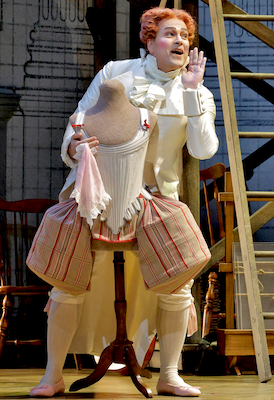
In luxury casting, Oklahoma tenor Alek Shrader, who possesses a first rank tenor voice and comedic skill, was enlisted for the character tenor role of Don Basilio. The Don assists the Count Almviva in his various schemes. Wearing an eye-catching costume, Shrader gave a robust performance in the role.
In his 2008 San Francisco Opera debut season he appeared as Victorin [Review: A Seductive Dream – Maestro Runnicles and “Tote Stadt” at San Francisco Opera, October 12, 2008], Nemorino [Review: Family Matinee “Elixir of Love”at San Francisco Opera, November 8, 2008] and Arbace [Review: An “Idomeneo” Surprise in San Francisco – Daniela Mack’s Princely Idamante, October 26, 2008].
I have reported on his performances elsewhere in the title roles of Britten’s Albert Herring [Review: Countdown to the Britten Centennial: Conductor James Conlon, Director Paul Curran in Reverential Mounting of Britten’s “Albert Herring” – Los Angeles Opera, February 25, 2012] and Bernstein’s Candide [Review: Bernstein’s “Candide” Opens 2018 Santa Fe Opera Season – June 29, 2018]. He also was Handel’s Jupiter and Apollo [Review: Handel’s “Semele” Excels with Amanda Forsythe, Daniela Mack and Alek Shrader, Opera Philadelphia, September 19, 2019].
See my interviews with him at Rising Stars: An Interview with Alek Shrader and “Opera Acting Without Music” – A Conversation with Alek Shrader
Philip Skinner’s Antonio, Sofia Gotch’s Barbarina, and Other Cast Members
[Photo: Philip Skinner performs the role of the gardener, Antonio; edited image of a publicity photograph.]
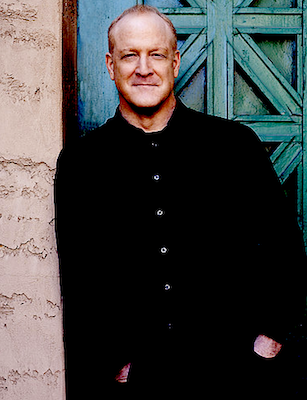
Susanna has two relatives on the Almaviva estate. One is her uncle, the gardener Antonio and her cousin, the gardener’s daughter, Barbarina.
Florida bass-baritone Philip Skinner brought humor to the role of the perplexed (and somewhat inebriated) gardener Antonio. Skinner, an experienced artist in ‘comprimario’ and character roles, portrayed Antonio sympathetically, lovingly kissing the flowers on a potted plant he has rescued from Cherubino’s leap out the Countess’ garden window.
Like his colleague Catherine Cook (Marcellina), Skinner is an alumnus of San Francisco Opera’s Merola Program (Skinner in 1985) and was an Adler Fellow (1986 and 1987). He has appeared in multiple roles throughout the succeeding seasons, for which he, like Cook, received the San Francisco Opera Medal in the company’s centennial year.
[Photo: Barbarina (Sofia Gotch, right) wins the love of Cherubino (Simone McIntosh, left); edited image, based on a Cory Weaver photograph, courtesy of the San Francisco Opera)
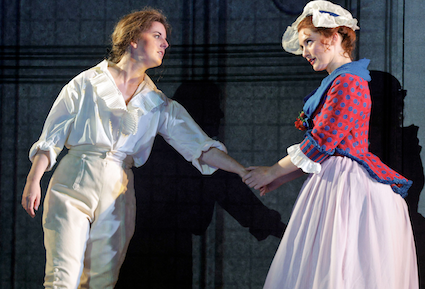
Playing Antonio’s daughter Barbarina was Sofia Gotch, a 2026 Adler Fellow. Although a small part, it is a favorite role for young sopranos early in their operatic careers. In most stagings (as in this one) the Barbarina is onstage alone, singing ‘L’ho perduta, me meschina’ one of Mozart’s beautiful melodies. Gotch, who has already been announced as the Rhinemaiden Woglinde in Wagner’s “Das Rheingold” later in the San Francisco Opera season, performed Barbarina’s aria nicely,
California soprano Jesslyn Thomas and Australian mezzo-soprano Stella Hannock were respectively the first and second Bridesmaids.
Maestro Sebastian Weigel and the San Francisco Opera Orchestra and Chorus
[PHoto: Maestro Sebastian Weigel; edited image, based on a Kirsten Bucher photograph, courtesy of the San Francisco Opera Orchestra.]
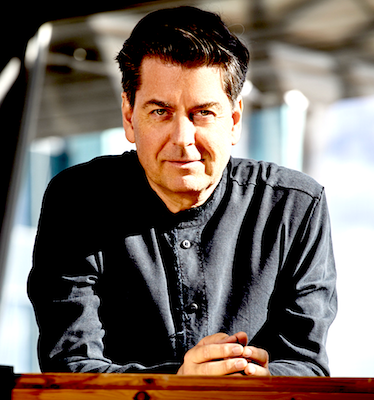
The evening began with Maestro Weigel leading the San Francisco Opera Orchestra in a spirited reading of Mozart’s famous overture, one of the greatest orchestral passages in opera. As the opera orchestra vivaciously performed Mozart’s sublime music, patterns formed on a scrim that traversed the front of the stage, seemingly inspired by the music
Pennsylvania Chorus Master John Keene prepared the San Francisco Opera Chorus, whose acting, in addition to its singing, deserves praise.
Director Shawna Lucey’s Production Revival
[Photo: Susanna (Slávka Zámecníková, in front of flag), Cherubino (Simone McIntosh, center lert) and Figaro (Peter Kellner center right) march before an American colonial flag; edited image, based on a Cory Weaver photograph, ourtesy of the San Francisco Opera.]
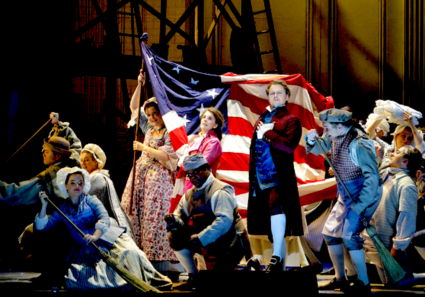
Director Shawna Lucey presided over the revival of the late Michael Cavanagh’s 2019 production [Review: Strong Cast, Arresting New Production for “Marriage of Figaro” – San Francisco Opera, October 13, 2019. That production was the first of three productions that set the three Mozart-Da Ponte operas in an American East Coast mansion built in the time of the American Revolutionary War. The other two productions were a “Cosi fan Tutte” set in the 1930s [Review: “Cosi fan Tutte” – Nicely Sung, Imaginatively Staged – San Francisco Opera, November 21, 2021 and a “Don Giovanni” [Review: Dupuis and Pisaroni Lead International Cast for Michael Cavanagh’s New “Don Giovanni” Production – San Francisco Opera, June 12, 2022] set seven decades in the future..
Lucey, who was a colleague of Cavanagh’s, incorporated her own, always intelligent, ideas into the revival.
Lucey’s contributions to the San Francisco Opera include new productions of the core repertory operas – Puccini’s “Tosca” [Review: An Appealing New “Tosca” for San Francisco Opera, October 3, 2018] and Verdi’s “La Traviata” [Review: “La Traviata” Delightful New Production, Well-Received Debuts bye Yende, Tetelman and Piazzola – San Francisco Opera, November 22, 2022]., both of them associated with scenic designer, Robert Innes Hopkins.
Erhard Rom’s Sets and Constance Hoffman’s Costumes
[Photo: Construction workers create a room for Figaro and Susanna, which will be next door to the bedroom of the Count Almaviva; edited image, based on a Cory Weaver photograph, courtesy of the San Francisco Opera.]
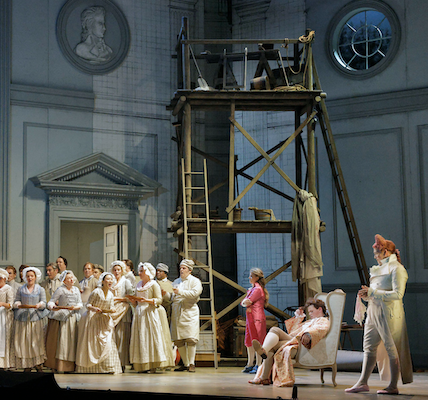
The sets (and projections) were created by Washington designer Erhard Rom and the costumes by California designer Constance Hoffman.
Colm Seery’s Choreography
[Photo: Classical dancing choreographed by Colm Seery; edited image, based on a Cory Weaver photograph, courtesy of the San Francisco Opera.
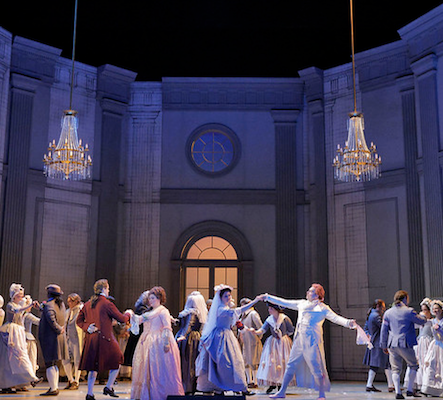
Irish director Colm Seery, who has had responsibility for most dancing taking place in recent San Francisco Opera productions, created a beautiful dancing scene.
Final Thoughts and Recommendation
I recommend the Cavanagh production of “Le Nozze di Figaro” as revived by Shawna Lucey, both for the veteran opera-goer and for persons new to opera.