A San Francisco Opera Sunday matinee performance of Richard Strauss’ “Der Rosenkavalier” marked my third visit to the War Memorial Opera House in three days. On Friday night I attended my first performance ever of Charpentier’s “Louise” [Maestro Jean Périsson Leads Arlene Saunders, John Alexander, Nicola Rossi-Lemeni and Sona Cervena in Impressive Performance of Charpentier’s “Louise” – San Francisco Opera, October 13, 1967] and the next evening of my first ever “Manon Lescaut” [Historical Performances: Dorothy Kirsten and Robert Ilosfalvy in Puccini’s “Manon Lescaut” – San Francisco Opera, October 14, 1967.]
This was my third “Rosenkavalier” and my first without the Marschallin of German soprano Elizabeth Schwarzkopf, who led the casts in performances of 1960 [Historical Performances: Schwarzkopf, Boehme in “Rosenkavalier” – San Francisco Opera, September 29, 1960] and 1964 [Historical Performances: Schwarzkopf, Seefried, Edelmann, Grist in “Der Rosenkavalier” – San Francisco Opera, September 24, 1964].
Regine Crespin’s Marschallin
French soprano Régine Crespin was memorable, both vocally and dramatically, in the iconic role of the Marschallin. Crespin’s stage presence was arresting as sang the Marschallin’s great aria Da geht er hin that is heard near the end of the first act. The aria’s reputation is mainly based on its poignant passages in which the Marschallin muses over the signs of her advancing age, But the aria allows the Marschallin a wide range of emotions, such as her obvious disgust with a titled man (Baron Ochs) who acts boorishly, out of the character she expects of a man of nobility.
Even though the opera’s action during its second act has shifted from the household of the Marschallin to the household of the nouveau riche Herr von Faninal, Crespin’s Marschallin momentously returns in the third act to bless the union of her former lover, Octavian, who was first rosenkavalier to then sweetheart of Sophie von Faninal. The Marschallin joins Octavian and Sophie in the ethereally beautiful trio Heut’ oder morgen.
Few operatic characters provide such a wide path for character development as that of the Marschallin, and Crespin displayed a full appreciation of the role’s potential.
[Below: Régine Crespin as the Marschallin; edited image, based on a Carolyn Mason Jones photograph, courtesy of the San Francisco Opera Archives]

Highlights of the Sab Francisco Opera’s previous season had included Crespin’s appearances performing Wagner [Historical Performances: Jess Thomas’ “Tannhäuser” with Régine Crespin, Janis Martin and Thomas Stewart – San Francisco Opera, October 22, 1966 ] and Berlioz [Historical Performances: Crespin, Vickers in first American production of Berlioz’ “Les Troyens” – San Francisco Opera, November 12, 1966].
Crespin’s Marschallin was the third role I saw her perform in the first two years of her appearances in San Francisco. Over the next 20 years, Crespin would perform a variety of roles in seven additional seasons, ranging from the title role of Offenbach’s comic “The Grand Duchess of Gerolstein” to a seering portrayal of the Countess in Tchaikovsky’s “The Queen of Spades”.
Sylvia Anderson’s Count Octavian
Colorado soprano Sylvia Anderson proved to be an accomplished Octavian, a signature role of Anderson’s that she sang over a hundred times in important venues worldwide. An artist succcessfully portraying Count Octavian should excel in each of the personae that Strauss and his librettist Hoftmannstahl, created for opera’s title character.
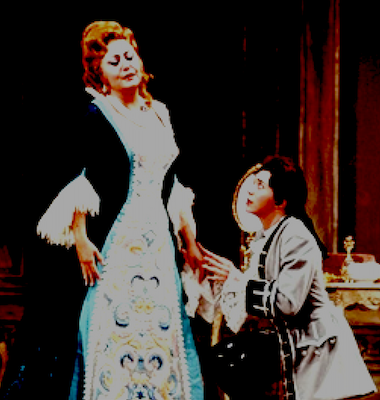
Anderson beautifully portrayed a hot-blooded youth performing the role of the “other man”, amorously satisfying the Field Marshall’s wife while her husband was away on a hunting trip. Anderson’s Octavian interacted beautifully and convincingly in his interchanges with Crespin’s Marschallin, especially in the first love scenes and the emotional final scenes with the Marschallin and Octavian’s new love, Sophie.
[Below: Count Octavian (Sylvia Anderson, right) kneels before the Marschallin (Régine Crespin, left); edited image, based on a Robert Cahen photograph, courtesy of the San Francisco Opera Archives.]
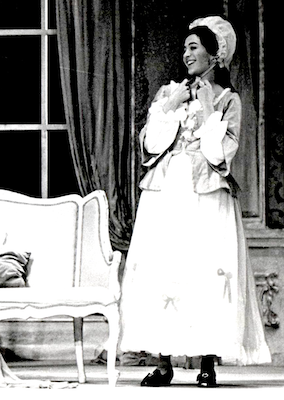
Count Octavian in the opera’s first act disguises himself as Mariandel, supposedly the Marschallin’s maid. The disguise showed quick-thinking by the lovers so as to prevent having to explain to Baron Ochs why an extramarital male was in the Marschallin’s untidied bedroom.
The disguise has an unintended effect. Octavian in women’s clothes catches Ochs’ eye (and arouses Ochs’ lust). This will turn out to be much more than a momentary flash of humor. Ochs’ attraction to “Mariandel” will provide the deus ex machina in the opera’s third act in which Och’s “Mariandel” affair will lead to Ochs’ discredit and humiliation (and, ulrimately, Octavian himself winning Sophie’s hand in marriage.)
Below: Count Octavian (Sylvia Anderson, disguised as the Marschallin’s maid, Mariandel; edited image, based on a Carolyn Mason Jones, photograph, courtesy of the San Francisco Opera Archives.]
I have attended performances in several other operas in which Anderson performed, but I found her Octavian, carrying the silver rose while dressed in the elegant rosenkavalier costume to be my favorite memory of her, both vocally and dramatically.
[Below: Sylvia Anderson as Couht Octavian; edited image, based on a Carolyn Mason Jones photograph, courtesy of the San Francisco Opera Archives.]

Reri Grist’s Sophie
Returning to the role of Sophie, which she sang in the 1964 San Francisoc Opera mounting of Bauer-Ecsy’s production (see hyperlink above) was New York soprano Reri Grist.
[Below: Reri Grist as Sophie; edited image, based on a Robert Cahen photograph, courtesy of the San Francisco Opera Archives.
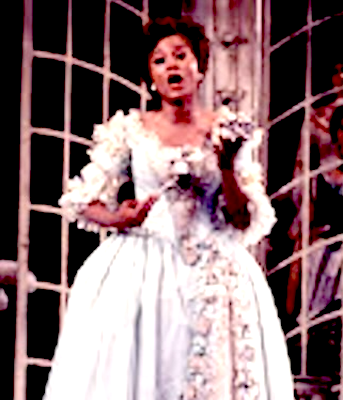
Since her San Francisco Opera debut as Rosina in 1963 [Historical Performances: Grist, Valletti, Prey in “Barbiere di Siviglia” – San Francisco Opera, September 28, 1963] a role in which she reappeared in 1965, Grist has performed in 11 roles. Grist was unquestionably the reigning lyric coloratura soprano at the War Memorial Opera House in the five consecutive seasons between 1963 and 1967.
I have observed her performances in eight additional roles: Despina in Mozart’s “Cosi fan Tutte” (1963), Sister Constance in Poulenc’s “Dialogues of the Carmelites (1963), Susanna in Mozart’s “Marriage of Figaro” (1964 and 1966) Adele in Johann Strauss’ “Die Fledermaus” (1965), Oscar in Verdi’s “Un Ballo in Maschera” (1965 and, again, at a later date in the 1967 season), Zerbinetta in Richard Strauss’ “Ariadne auf Naxos” (1965), Gilda in Verdi’s “Rigoletto”. A couple of weeks after this perforance, I would see Grist as Adina in Donizetti’s “L’Elisir d’Amore”. The only role I did not ever see her perform was the brief role of the Burgundian Lady in Orff’s “Curina Burana”. (I saw the second of the two scheuled performances when Mary Costa sang the role.)
[Below: Sophie (Reri Grist, left) receives a silver rose from Count Octavian (Silvia Anderson, right); edited image, based on a Robert Cahen photograph, courtesy of the San Francisco Opera Archives.
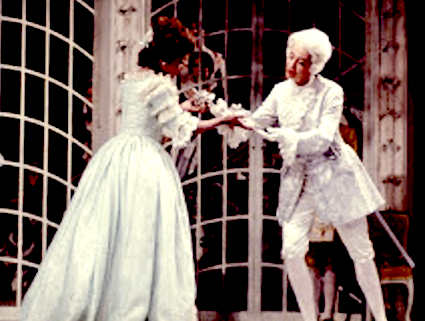
Grist would return in 1969 to reprise two of her roles (Zerbinetta and Adina), but then was absent from the San Francisco Opera until the 1981 “Adler Farewell” season, when she appeared in the title role of Massenet’s “Manon”. Her only later performance was in the small role of an Italian Singer in the 1990 performances of Richard Strauss’ “Capriccio”.
Josef Greindl’s Baron Ochs
The role of Baron Ochs was the first of three San Francisco Opera assignments for German bass Josef Greindl, appearing in his only season with the company. Closely associated with Wagner’s works, Greindl would follow his four appearances as Ochs, with four as King Marke in “Tristan und Isolde” and three as Fafner in “Das Rheingold”.
[Below: The Baron Ochs (Josef Greindl, left) greets his cousin, the Marschallin (Regine Crespin, right); edited image, based on a Carolyn Mason Jones photograph, courtesy of the San Francisco Opera Archives.]
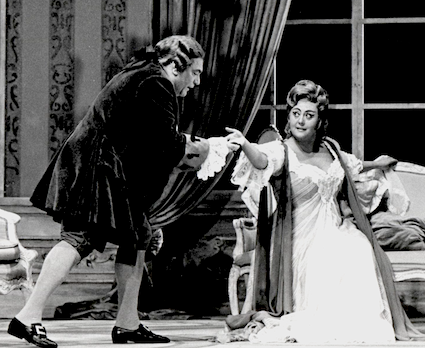
As Ochs, Greindl often displayed the lack of “nobility” that the Marschallin, in her first act critique of his behavior, decried. Greindl’s Ochs was often boorish, and the Baron’s villainous pursuit of the maid Mariandel (the disguised Octavian) assured that the audience, as the opera’s composer and librettist, intended, would have no sympathy for the Baron, when all his schemes blew up.
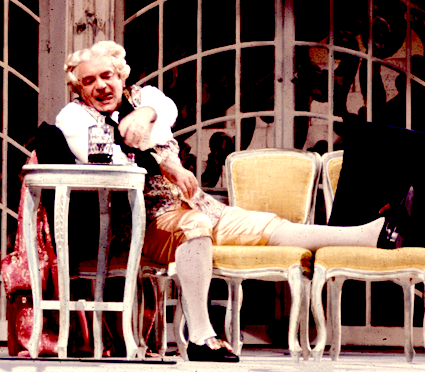
[Below: Baron Ochs (Josef Greindl) recuperates from an unexpected injury; edited image, based on a Robert Cahen photograph, courtesy of the San Francisco Opera Archives.]
John Modenos’ Faninal, Robert Ilosfalvy’s Italian Singer and Other Cast Members
Cypriot baritone John Modenos was Herr von Faninal. Hungarian tenor Robert Ilosfalvy impressed as the Italian Singer. Valzacchi was performed by Howard Fried, Annina by Marija Kova. Allan Monk played Ochs’ son Leopold.
Maestro Horst Stein and the San Francisco Opera Orchestra and Chorus
The San Francisco Opera Orchestra and Chorus was led by German conductor Maestro Horst Stein in a beautifully conceived and executed performance.
Paul Hager’s Direction and Leni Bauer-Ecsy’s Scenic Design
The “Rosenkavalier” production was a revival of the 1964 proeuction (cited above). It was a collaboration of two artists whose reputations had been established in postwar Germany – Director Paul Hager and Scenic Designer Leni Bauer-Ecsy, both recruited by General Director kurt Herbert Adler. Hager had a 30 year career with the company that began in 1954.
Bauer-Ecsy, beginning with the 1960 season, had produced sets for San Francisco Opera’s forays into such 20th century operas as Berg’s “Wozzeck” [Historical Performances: Geraint Evans, Marilyn Horne, Richard Lewis in “Wozzeck” at San Francisco Opera – September 15, 1962] and “Lulu” [Historical Performances: “Lulu” with Evelyn Lear, Ramon Vinay, Richard Lewis – September 25, 1965] and Janacek’s “Vec Makropulos” [Historical Performances: Marie Collier Triumphs in American Premiere of Janacek’s “Vec Makropulos” – San Francisco Opera, November 19, 1966].
Several core repertory operas, including those by Mozart [Historical Performances: “Nozze di Figaro” with Geraint Evans, Grist, Lorengar, Waechter – San Francisco Opera, October 3, 1964] amd Verdi [Historical Performances: “Forza del Destino” with Leontyne Price, James McCracken – San Francisco Opera, October 24, 1963] received new Bauer-Ecsy productions. For the current season she had two more assignments, each of which I was scheduled to see – Wagner’s “Tristan und Isolde” and Schuller’s “The Visitation”.
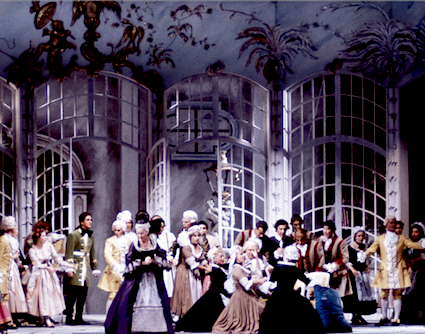
[Below: Leni Bauer-Ecsy’s scenic design for Herr von Faninal’s mansion frames action occuring in Act II of “Der Rosenkavalier” ]
“Rosenkavalier” at the War Memorial Opera House
Richard Strauss’ most celebrated operatic work was first performed by the San Francisco Opera in its 1940 season as a vehicle for the legendary soprano Lotte Lehmann. During Merola’s tenure, up to his death in 1953, the opera had been performed a total of nine times (never more than two performances in the five seasons it was mounted).
Strauss’ operas were promoted during the 29 seasons that Kurt Herbert Adler was at the company’s helm. “Rosenkavalier” was mounted in eight of those seasons, for a total of 28 performances during the Adler era.
Between 1985 and 2007 four general directors served (2007 being the second year of David Gockley’s ten year general directorship). An additional 28 “Rosenkavlier” performances took place duirng this interval. Since the year 2008, the opera “Rosenkavalier” has not been included in any San Francisco Opera season’s repertory.
After attending three operas in three day weekend, I was not scheduled to return to the War Memorial Opera House until the Saturday night of the weekend after next for the American premiere of Gunther Schuller’s Kafka-inspired opera, “The Visitation” and, the following day, Lotfi Mansouri’s new production of Donizetti’s “L’Elisir d’Amore”.