
San Francisco Opera’s first two performances ever of Wagner’s “Das Rheingold” took place in November, 1935 and November, 1936. Its third, fourth and fifth performances would not take place until 31 years later. I was present at the fifth performance in the company’s history.
Although I already had seen performances of the second of the four operas of Wagner’s “Ring of the Nibelung”. Die Walküre, on two occasions [Historical Performances: Die Walküre with Nilsson, Hotter, Rysanek, Suthaus and Rankin, San Francisco Opera in Los Angeles, November 4, 1956 and Historical Performances: Vickers, Shuard, Resnik in “Die Walküre” – San Francisco Opera, October 10, 1963], this was my first chance to be present at a performance of any of the other three “Ring” operas.
Present Day Thoughts on a 1967 “Rheingold”
My reaction to this, my first ever “Rheingold”, was that it was a fine performance with a solid international cast. However, in the retrospect of what soon will be six decades, I regard its 1967 mounting as an important step in the furtherance of several initiatives associated with the San Francisco Opera’s general director (1954-1981), the formidable Austrian emigre Maestro Kurt Herbert Adler.
[Photo: Kurt Herbert Adler, based on the album cover photograph for the 1978 London Records “Adler of the Opera” recording].

IIn my “historical reviews” of San Francisco Opera performances occurring between my first opera in 1955 and the company’s 1967 season, I have alluded to various initiatives of the company’s “Adler years”. These include the following:
(1) Adler’s close association with European conductors and opera administrators, who assisted Adler in identifying major operatic talents (including singers, conductors and stage directors), and,
(2) Adler’s efforts to assist the careers of American artists, which included the creation of one of the first American young artists’ programs (the Merola Program) in 1957.
Adler, who had been San Francisco Opera’s artistic director for four years before being officially named the general director of the San Francisco Opera, the second in its history, in 1957. He succeeded the company’s founding director, Gaetano Merola.
Merola’s tenure had been associated by performances of many of the most important 20th century opera singers from the company’s founding in 1922 through 1953, the year of Merola’s death. Adler had continued Merola’s practice of securing major singers. The Adler era introduced many operatic masterpieces and significant opera productions to the companhy’s performance repertory to strengthen further the company’s international reputation.
A notable absence in San Francisco Opera’s mid-century repertory offerings was Wagner’s four-opera “Ring of the Nibelung”. The four operas had been performed together once by the company in 1935 with a cast for the last three “Ring” operas led by Danish-American heldentenor Lauritz Melchior, Norwegian soprano Kirsten Flagstad and Austrian bass-baritone Freidrich Schorr.
Although “Walküre” was performed in several seasons since that first “Ring”, there was no occasion since 1935 that the last two “Ring” operas had been performed in the same season, although in 1947 Swedish heldentenor Set Svanholm would perform the Siegfried role in “Götterdämmerung” and would return the next season in the title role of “Siegfried”.
Adler had been preparing for a new San Francisco Opera “Ring” during the mid-1960s. The plans included new productions created for San Francisco Opera of each “Ring” opera. Originally, the plan was for Wagner’s grandson, Wieland Wagner, to produce and direct the “Ring” (as well as “Tristan”), but his death the previous year required Adler to develop alternative plans for these productions.
Adler’s plans included “RIng cycles” scheduled for the 1972 season, featuring Swedish Wagnerian superstar Birgit Nilsson as Brünnhilde. The 1967 “Rheingold” and the other three operas – one per year – would be performed in new productions created by German director Paul Hager and Austrian designer Wolfram Skalicki.
It is noteworthy that in San Francisco Opera history, only two artists – Lauritz Melchior in the 1930s and Set Svanholm in the 1940s – had sung the role of Siegfried in both of the operas in which that character appears. The choice of the new “Ring’s” Siegfried was an important consideration.
There was an artist who was particularly associated with both Adler’s investment in young American artists who was both a graduate of the Merola program and had achieved success in performing Wagner roles in Europe. That artist was South Dakota tenor Jess Thomas.
Jess Thomas’ Loge
[Photo: Jess Thomas as Loge; edited image, based on a Robert Cahen photograph, courtesy of the San Francisco Opera Archives.]
Looking back on this “Rheingold” performance decades later, I am aware that only one member of the cast would take part in the 1972 performances of the full “Rings” – Jess Thomas. I suspect that the “Rheingold” performance – a preview of the first part of the Hager/Skalicki production – was an opportunity for Thomas to perform a role in a 1972 “Rheingold”, should the schedule of performances of the four “Ring” operas permit that.
Obviously, Thomas was the candidate for the roles of Siegmund (“Walküre”). and Siegfried in the last two operas. He would become the third tenor in San Francisco Opera history – after Melchior in the 1930s and Svanholm in the 1940s – to sing both of the demanding Siegfried roles.
Less than a month earlier, Thomas had added the dramatic role of Wagner’s “Tristan” to his repertory [Historical Performances: Wagner’s “Tristan und Isolde” starring Jess Thomas, Irene Dalis and Mignon Dunn – San Francisco Opera, November 5, 1967]. His success as Tristan was confimation that he had the vocal durability to assay the lead tenor roles in the second, third and fourth operas of the “Ring”.
“Rheingold” has three tenor roles – Mime, Froh and Loge – the latter being the “trickster” god, known in Norse legend (and to Disney’s Marvel Cinematic Universe) as Loki. Wagner’s Loge is based not only on the Norse Loki, but also incorporates attributes of the “fire god” Logi (thus Wotan’s reference to him as he summons the “Magic Fire” at the conclusion of “Die Walküre”).
Thomas chose to play Loge, showing his acting skills for this significant “character tenor” role. In 1972, the schedule of “Rings” assured he would sing all of the Siegmund and Siegfried performances, with no time available for a Thomas Loge in 1972, but his 1967 Loge is a happy memory.
It is the Wagnerian repertory for which Thomas is best known. I have previously reported on his Wagnerian opera performances as Walther [Historical Performances: Jess Thomas’ Victorious “Die Meistersinger” – San Francisco Opera, September 11, 1965], Tannhäuser [Historical Performances: Jess Thomas’ “Tannhäuser” with Régine Crespin, Janis Martin and Thomas Stewart – San Francisco Opera, October 22, 1966] and Tristan (He also performed the title role of “Lohengrin” in 1965, but my schedule pursuing a college degree prevented me from attending any of his three performances.)
Besides his Wagner roles, I also had seen him perform the roles of Mario Cavaradossi [Historical Performances: “Tosca” with Marie Collier, Jess Thomas and Ramon Vinay – San Francisco Opera, October 21, 1965], and two days later, that of Bacchus [Historical Performances: “Ariadne auf Naxos” with Hillebrecht, Thomas, Grist, Vanni – San Francisco Opera, October 23, 1965].
David Ward’s Wotan and John Modenos’ Alberich
[Photo: Wotan (David Ward, right) and Alberich (John Modenos, left) have very different ideas on how to use the power of the Nibelung Ring; edited image, basd on a production photograph, courtesy of the San Francisco Opera Archives.]

Of the several roles in “Rheingold”, the strongest impression is often made by the artist who plays the King of the Gods, Wotan. Scottish bass David Ward, in his San Francisco Opera debut, proved to be vocally strong and dramatically effective.
Subsequently, Ward traveled with the company to Los Angeles in Spring 1969, where he performed the “Walküre” Wotan. After that he was engaged by the company two more times – as Sarastro in the Fall 1969 production of “The Magic Flute”, and 13 years later, as Heinrich der Vogler in Wagner’s “Lohengrin”. The latter performance took place only a half year before Ward’s death at age 61.
Irene Dalis’ Fricka
[Photo: Mezzo-soprano Irene Dalis; edited Opera San Jose image, from a 2013 article.]

California mezzo-soprano Irene Dalis, who had the previous month sang a series of Isoldes to Jess Thomas’ Tristans performed the role of Wotan’s imposing wife, Fricka.
This was my sixth occasion to attend Dalis performances at San Franciso Opera, where she performed during the 1957 through 1973 seasons. Before her Isolde, I was present for her performances as the Empress’ Nurse [Historical Performances: The Woman Without an Equal: Leonie Rysanek in “Frau ohne Schatten”: San Francisco Opera, September 24, 1960 and Historical Performances: Ella Lee, Dalis, Kuchta, Waechter, Martell in “Frau ohne Schatten” – San Francisco Opera, September 26, 1964], Ortrud [Historical Performances: Sandor Konya, Irene Dalis in “Lohengrin” – San Francisco Opera, October 27, 1960], Marina [Historical Performances: An American “Boris Godunov” Starring Tozzi and Dalis – San Francisco Opera, September 21, 1961[, the Princess Eboli [Historical Performances: Konya, Tozzi, Dalis, Thomas Stewart in “Don Carlo” at San Francisco Opera – September 22, 1962] and Kundry [Historical Performances: Konya, Dalis, Waechter, Tozzi in “Parsifal” – San Francisco Opera, September 12, 1964].
She was my first ever Amne in “Frau ohne Schatten”, Ortrud in “Lohengrin”, Marina Mnishek in “Boris Godunov”, Pricess Eboli in “Don Carlo”, Kundry in “Parsifal” and Isolde.
Dalis sang at San Francisco Opera in ten seasons during the period 1957 through 1973. Although she returned in seasons 1969, 1971 and 1973 for roles in operas by Janacek, Verdi and Richard Strauss, this was her final performance of a Wagner role for San Francisco Opera.
Arlene Saunders’ Freia, Rod McWherter’s Froh and Delme Bryn-Jones’ Donner
[Photo: Soprano Arlene Saunders was Freia; edited image, based on a historical photograph.]

Wotan’s and Fricka’s daughter Freia, whose kidnapping by the giants Fafner is one of the major plot points of “Rheingold”, was sung impressively by soprano Arlene Saunders.
Earlier in the 1967 season Saunders had performed the title role of “Louise” [Maestro Jean Périsson Leads Arlene Saunders, John Alexander, Nicola Rossi-Lemeni and Sona Cervena in Impressive Performance of Charpentier’s “Louise” – San Francisco Opera, October 13, 1967] and as Marguerite in “Faust” [ Historical Performances: Gounod’s “Faust” Starring Kraus, Ghiaurov, Saunders and Wixell – San Francisco Opera, November 4 and November 12, 1967]. She would return to San Francisco Opera once more in 1971, as Eva in Wagner’s “Die Meistersinger”.
Pennsylvania tenor Rod MacWherter portrayed nine roles in seven operas in the 1967 San Francisco Opera season, his only appearances with the company. The most important, to me, were his two Wagnerian assignments, Melot in “Tristan und Isolde” and Froh in “Rheingold”.
The music assigned to Froh, the rainbow god, in the closing scene of “Rheingold” is among the “Ring’s” most stunningly lyrical passages.
Welsh baritone Delme Bryn-Jones performed the role of Donner, the god of thunder, with distinction. He was another artist whose appearances with the San Francisco Opera occurred only during its 1967 season. I previously had reported on his Lescaut [Historical Performances: Dorothy Kirsten and Robert Ilosfalvy in Puccini’s “Manon Lescaut” – San Francisco Opera, October 14, 1967] and Schaunard [Historical Performances: “La Boheme” starring Luciano Pavarotti and Mirella Freni – San Francisco Opera, November 19, 1967].
Mignon Dunn’s Erda, Thomas O’Leary’s Fafner, Josef Greindl’s Fasolt and Robert Glover’s Mime
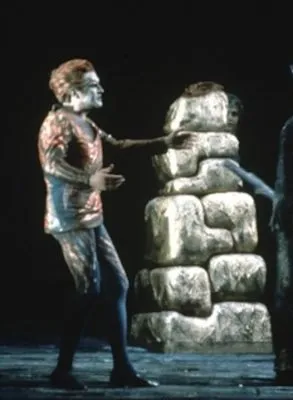
[Photo: the giants Fafner (Thomas O’Leary, right) and Fasolt (Josef Greindl, left) engage in a fatal argument; edited image, based on a production photograph, courtesy of the San Francisco Opera Archives.

In one of the critical passages in the entire “Ring” mezzo-soprano Mignon Dunn sang the contralto notes of the goddess Erda’s ominous warning ‘Weiche, Wotan, weiche!’, that he must flee from the Ring that the Nibelung Alberich has cursed.
This was the third of Dunn’s impactful 1967 performances of major roles displaying vocal power in the mezzo range. She previously had appeared as Brangäne in “Tristan” and Ulrica [Historical Performances: Leontyne Price Stars in “Ballo In Maschera’s” Boston-version revival – San Francisco Opera, November 18 and 26, 1967]. She would not return to San Francisco Opera during the Adler era which ended in 1981, appearing only one more time, in 1982, as Baba the Turk in Stravinsky’s “The Rake’s Progress”.
Performing the role of Fafner was bass Thomas O’Leary, who had assumed major bass roles during the 1965, 1966 and 1967 seasons, including Arkel in Debussy’s “Pelleas et Melisande”, Sarastro in Mozart’s “The Magic Flute” and Banquo in Verdi’s “Macbeth”. He would not return to the San Francisco Opera after this performance.
This was also German baritone Joseph Greindl’s final San Francisco Opera performance. He appeared only in the 1967 season, previously as Baron Ochs in “Rosenkavalier” [[Historical Performances: Régine Crespin, Sylvia Anderson, Reri Grist and Josef Greindl Shine in Elegant “Der Rosenkavalier” – San Francisco Opera, October 15, 1967] and also as King Marke in the previously mentioned “Tristan und Isolde”.
Canadian character tenor Robert Glover played Alberich’s disloyal servant Mime. Glover had played professional hockey, under his real name of Roy Glover, before being recruited to the 1963 Merola class. He chose the name Robert Glover for his opera performances, including, in mid-1965, his San Francisco Opera Spring Opera debut and in Fall 1965, his main company debut.
Among Glover’s many company performances were as Vitek in the 1965 American premiere in Berg’s “Lulu” and the four character tenor roles in SPOT’s “Tales of Hoffmann” [Historical Performances: Nicholas di Virgilio, Simon Estes Lead Impressive Cast in “Tales of Hoffmann” San Francisco Opera’s Spring Opera Theater [SPOT] – June 23, 1967]. Glover returned for the San Francisco Opera’s 1968 season and the revival of “Rheingold” Mime in the Spring 1969 San Francisco Opera tour to Los Angeles, his final performances for the company.
Sheila Marks’ Woglinde, Marija Kova’s Wellgunde and Sylvia Anderson’s Flosshilde
[Photo: The Rhinemaidens guard the Rhine gold; edited image, based on a prodction photograph, courtesy of the San Francisco Opera Archives.]]

The three Rhinemaidens were performed by Colorado soprano Sylvia Anderson (Flosshilde), soprano Sheila Marks (Woglinde) and mezzo-soprano Marija Kova (Wellgunde).
Anderson, earlier in the season, had starred as Octavian the “Der Rosenkavalier” production cited above. She would perform both lead and ‘comprimario’ roles in the four San Francisco Opera seasons 1967 through 1970.
Marks (a 1966 and 1967 Merola program artist) performed significant ‘comprimario’ roles in the San Francisco Opera’s 1967, 1968 and 1969 seasons, and starred as Countess Almaviva in the company’s 1969 Spring Opera production of Mozart’s “The Marriage of Figaro”.
Kova had performed in the company’s 1966 Spring Opera production of Thomas’ “Mignon” and several ‘oomprimario’ roles in the 1967 San Francisco Opera season.
Maestro Leopold Ludwig and the San Francisco Opera Orchestra
Conducting the San Francisco Opera Orchestra was Maestro Leopold Ludwig, who had been a principal conductor for the company from its 1958 through its 1965 seasons.
Ludwig returned to the company to conduct its 1967 “Rheingold” and 1968-69 “Walküre” productions, but did not return to the company after those “Walküre” performances.
Paul Hager’s Direction and Set Designs by Wolfram Skalicki and Davis L. West
[Photo: David Ward as Wotan; edited image, based on a Robert Cahen photograph, courtesy of the San Francisco Opera Archives.]

German director Paul Hager joined the San Francisco Opera as principal director, beginning with the 1954 season and remained with the company through 1973.
Hager was director, assisted by his wife Ghita Hager, for each of the four operas of the “Ring”, and the presentatation of all four in 1972.
Austrian designer Wolfram Skalicki created the “RIng’s” sets and costumes. Beginning in 1962 and throughout the next decade and a half, Skalicki’s creations were essential to a significant part of the company’s repertory. Productions with set and costume designs attributed to Wolfram and, often, also to his wife Amerei, were revived into the first decade of the 21st century.
Skalicki’s designs were first seen in the 1962 San Francisco Opera season, most notably his original costumes to accompany a Zeffirelli production “Don Giovanni” imported from the Dallas Opera [Historical Performances: “Don Giovanni” with Tozzi, De Los Angeles, Schwarzkopf, Evans and Lewis in Zeffirelli’s Production – San Francisco Opera, October 20, 1962].
The company turned to Skalicki for many new productions, including Tchaikovsky’s “Pikovaia Dama” [Historical Performances: “Queen of Spades” with McCracken, Kirsten, Resnik – San Francisco Opera, October 5, 1963], “Fidelio [Historical Performances: Birgit Nilsson, Jon Vickers, Geraint Evans in “Fidelio” – San Francisco Opera, October 17, 1964], Katerina Ismailova [Historical Performances: Shostakovich’s “Katerina Ismailova” with Marie Collier, Jon Vickers – San Francisco Opera, October 31, 1964] and “Les Troyens [Historical Performances: Crespin, Vickers in first American production of Berlioz’ “Les Troyens” – San Francisco Opera, November 12, 1966].
This would not be my last opera performance of 1967. My next operatic performance would be my first opera presented by an organization that was not the San Francisco Opera or its subsidieary, the Spring Opera Theatre [SPOT].