
During San Francisco Opera’s 1967 Fall opera eason I had already seen eight of the 13 scheduled operas performed.
In the first weekend of November, I had the attended the American premiere of Schuller’s “The Visitation” on Friday night. On the following Saturday night, I saw the season’s second of five performances of Gounod’s “Faust”. I would attend both the second and the fifth, the latter of which occurred on my Sunday subscription series eight days later.
The opera was revived as a vehicle for tenor Alfredo Kraus and for the San Francisco Opera debut of Bulgarian bass Nicolai Ghiaurov.
“Faust” had been my first-ever opera, that I saw as a high school freshman, with a cast consisting of major mid-20th century opera recording stars [Historical Performances: Peerce, Albanese, Siepi and MacNeil in “Faust”, San Francisco Opera Fall Tour, San Diego, November 3, 1955]. San Francisco Opera’s 1967 mounting of the opera provided me the opportunity to see my second and third-ever performances of the work.
Alfredo Kraus’ Faust
[Photo: Alfredo Kraus as Faust; edited image from a youtube post.]

The role of Faust was a signature role of Canary Island Spanish tenor Alfredo Kraus. His attractive lyric tenor was used to great effect throughout the performance. It was stunning in the role’s principal aria ‘Salut demeure, chaste et pure’, one of the most beloved lyric tenor arias in the French operatic repertory.
Faust was Kraus’ fourth San Francisco Opera role. Previously, he had sung the roles of Arturo [Historical Performances: Sutherland, Kraus Introduce “I Puritani” to San Francisco Opera – September 20, 1966], the Duke of Mantua [Historical Performances – “Rigoletto” with Glossop, Kraus, Grist and Kreppel – San Francisco Opera, October 16, 1966 ] and Nemorino [Historical Review: Grist, Kraus, Wixell and Bruscantini Excel in Lotfi Mansouri’s Lively Production of “L’Elisir d’Amore” – October 29, 1967].
Kraus’ masterful interpretation of each of these four roles – Arturo, the Duke, Nemorino and Faust – provide evidence of Kraus’ significance in the history of operatic performance. I was able to have seen and heard him in each of these San Francisco Opera performances when he was still in his late 30s,
Kraus was famous for his attention to maintaining a voice equipped to sing these lyric tenor roles, where vocal expressiveness and agility rather than vocal power were regarded as dominant virtues. A consequence of Kraus’ care in maintaining a ‘leggiero’ vocal quality is that he continued to perform opera beyond age 70.
Following the Sunday matinee on November 12, Kraus departed from the Was Memorial Opera House and would not return to the San Francisco Opera for a period of 18 years. Then, in 1985, I would see a sixth Kraus performance, in the title role of Massenet’s “Werther” (with Renata Scotto as Charlotte), the fifth of the five roles which I saw Kraus perform.
Arlene Saunders’ Marguerite
[Photo: Marguerite (Arlene Saunders, right) and Faust (Alfredo Kraus, left) sing of a night of love; edited image, based on a production photograph, courtesy of the San Francisco Opera Archives.]
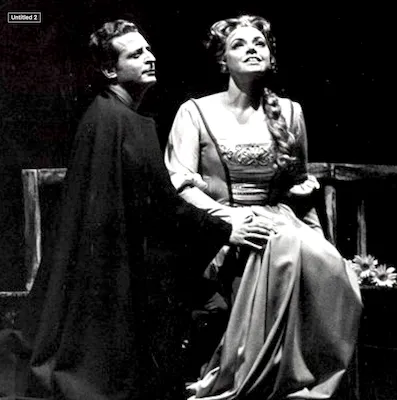
Arlene Saunders was an attractive Marguerite with a beautifully sounding lyric coloratura voice. She performed Marguerite’s major arias, espcially the Jewel Song, ‘Je ris de me voir si belle’, to enthusiastic audience applause. She and Kraus performed the great Garden Scene duet ‘O nuit d’amour, ciel radieux’ memorably.
Marguerite was the second of three roles Saunders would perform in the 1967 season, preceded by Louise [Maestro Jean Périsson Leads Arlene Saunders, John Alexander, Nicola Rossi-Lemeni and Sona Cervena in Impressive Performance of Charpentier’s “Louise” – San Francisco Opera, October 13, 1967]. Saunders would perform one additional role in the 1967 season, Freia in Wagner’s “Das Rheingold”.
Saunders would return to the San Francisco Opera in the 1971 sseason to perform the role of Eva in Wagner’s “Die Meistersinger”, her final assignment with the company.
Nikolai Ghiaurov’s Mephistopheles
[Photo: Bulgarian bass Nikolai Ghiaurov; edited image of an historical photograph.]

In his San Francicsco Opera debut, Bulgarian bass Nikolai Ghiaurov sang the role of Mephistopheles. He was a memorable presence throughout the performance.
As with the other cast principals, each of whom has a famous “showstopper” aria, Ghiaurov’s presentation of the golden calf aria, ‘Veau d’Or’, was warmly received.
Gounod’s Mephistopheles has chosen a woman for Faust who lives in a specific community. There she interacts with Valentin, her soldier brother, with Siebel, a youthful suitor wanting to become her boyfriend, and with Dame Martha, her neighbor.
If the Biblical Devil is the personification of evil, Gounod’s Mephistopheles is a much more nuanced character. He certainly possesses the supernatural powers that I would expect any true Devil to have, but Instead of an evil-through-and-thourgh Devil, Mephistopheles is socially adept, charming when he needs be (such as distsracting Marthe to allow Faust and Marguerite to have time alone).
He appears even to have a sense of himor. This provides the artist performing the role with opportunities to use a range of acting skills, which Ghiaurov displayed throughout the performance
[Phoro: Faust (Alfredo Kraus, right) watches Mephistopheles (Nikolai Ghiaurov, left); edited inage, based on a production photograph, courtesy of the San Francisco Opera Archives.]

In the 1967 San Francisco Opera season, Ghiaurov and his future wife, Mirella Freni, both performed contermporaneously for the San Francisco Opera, although in diffferent operas (Freni in “La Boheme” with Luciano Pavarotti). Freni and Ghiaurov would marry 11 years later.
At the end of the 1967 “Faust” performance run, Ghiaurov left the War Memorial Opera House, not to return again until 16 years later, when he appeared in the title role of Mussorgsky’s “Boris Godunov”.
Between and 1986 and 1988 and in 1990, he appeared in a single role each year, beginning in 1986 as Prince Gremin in Tchaikovsky’s “Eugene Onegin” with his wife, Mirella Freni as Tatyana.
Ghiaurov showed his comic skills in 1987 as Don Basilio to Renato Capecchi’s Don Bartolo in Rossini’s “Il Barbiere di Siviglia”. In 1988 he participated as Colline in a telecast of Puccini’s “La Boheme” with Freni and Pavarotti (released on DVD). His final appearances at the San Francisco Opera were in 1990as Prince Khovansky in Mussorgsky’s “Khovanschina”.
Sylvia Anderson’s Siebel, Ingvar Wixell’s Valentin and Other Cast Members
Photo: Siebel (Sylvia Anderson, on dais, center) and Valentin (far right. partially obscured)

The role of Siebel, the youth enamored of Marguerite, was sung by Colorado-born mezzo-soprano Sylvia Anderson, a former San Francisco Opera Adler Fellow.
Anderson had made her San Francisco Opera debut earlier in the season, singing what was to become her signature role, Count Octavian, which she performed over 100 times in her career. I saw her in the role on the Sunday matinee that took place two weekends earlier [Historical Reviews: Régine Crespin, Sylvia Anderson, Reri Grist and Josef Greindl Shine in Elegant “Der Rosenkavalier” – San Francisco Opera, October 15, 1967]. I would see her once more in the 1967 season, as one of the Rhinemaidens in Wagner’s “Das Rheingold”.
Anderson would sing 17 roles over in each of the four seasons between 1967 and 1970 (including the title role of Bizet’s “Carmen” for a student matinee), but Octavian and Siebel (the latter a role she would repeat in 1970 with an otherwise different cast) were the only “trouser roles” (Anderson playing a young man) she sang for the San Francisco Opera.
[Photo:: the crowd of villagers surround Valentin (Ingvar Wixell, center left, on dais)) smf Siebel (Sylvia Anderson, center, on dais); edited image, based on a production photograph, courtesy of the San Francisco Opera Archives.]

Few debuting artists (if any) in San Francisco Opera history have attempted (and succeeded at) a performance schedule as intense as Swedish tenor Ingvar Wixell, which began with his San Francisco Opera debut as Belcore in Donizetti’s “L’Elisir d’Amore) on October 21.
Over the next 35 days Wixell would perform 15 times in four roles, three times as Belcore, three times as Held in “The Visitation”, five times as Valentin and five times as Marcello in Puccini’s “La Boheme”. This feat included such challenges as a three day period, consisting of a Marcello performance sandwiched between two Valentins.
Wixell’s ability to endure challenging schedules while performing at high artistic levels in both dramatic and comic roles insured that he would become an invaluable contributer to San Francisco Opera performances over the next two decades.
Two smaller roles were performed by esteemed veterans of San Francisco Opera, baritone Allen Monk, in his San Francisco Opera debut season as Wagner,. Czech soprano Sona Cervena, who performed a principal role earlier in the season in Charpentier’s “Louise”, was Marguerite’s neighbor, Dame Marthe.
I had not seen “Faust”, my first opera, for a dozen years. Just as my first opera matched two major recording superstars (Jan Peerce and Cesare Siepi) as Faust and Mephistopheles, the 1967 “Faust” matched operatic recording superstars – Kraus and Ghiaurov – in those same roles.
Maestro Jean Périsson and the San Francisco Opera Orchestra and Chorus
San Francisco Opera’s 1967 main season consisted of 13 operas, two of which -“Faust” and “Louise” – were French. The two French productions shared the conductor (Maestro Périsson) , French director Louis Erlo, the prima donna, Arlene Saunders, cast member Sona Cervena, and the choreographer, Thomas Andrew.
Having conducted the performance of “Louise” [Maestro Jean Périsson Leads Arlene Saunders, John Alexander Nicola Rossi-Lemeni and Sona Cervena in Impressive Performance of Charpentier’s “Louise” – San Francisco Opera, October 13, 1967], Maestro Périsson led the San Francisco Opera Orchestra and Chorus in what was welcomed as an authentically French approach to Gounod’s score.
Louis Erlo’s Direction, Wolfram Skalicki’s Sets, and Thomas Andrew’s Choreography
French director Louis Erlo’s relationship with the San Francisco Opera had begun the season before in a production that introduced (in an abridged version) Berlioz’ “Les Troyens” to American audiences [Historical Performances: Crespin, Vickers in first American production of Berlioz’ “Les Troyens” – San Francisco Opera, November 12, 1966].
In the previous San Francisco Opera season, Erlo, in addition to “Troyens”, had directed a performance of Bizet’s “Carmen” which was the occasion of Grace Bumbry’s San Francisco Opera debut in the title role.
The San Francisco Opera “Troyens” sets were created by Austrian designer Wolfram Skalicki, who also produced the sets for the Erlo-directed production of “Faust”.
[Photo: Wolfram Skalicki’s sets for the Church Scene in “Faust”; edited image, based on a production photograph, courtesy of the San Franciisco Opera Archives.]

In the previous San Francisco Opera season, Erlo, in addition to “Troyens”, had directed a performance of Bizet’s “Carmen” which was the occasion of Grace Bumbry’s San Francisco Opera debut in the title role.
Besides his two French repertory assignments for the 1967 San Francisco Opera season, Erlo was enlisted to direct Verdi’s “Macbeth” [“Historical Performances”: Chester Ludgin, Grace Bumbry in Verdi’s “Macbeth” – San Francisco Opera, October 6, 1967“.], in which Bumbry portrayed Lady Macbeth.
Thomas Andrew, the 35-year old principal choreographer at the New York City Opera, a position he held since 1962, was present for the full 1967 San Francisco Opera season. He developed the ballet for the season-opening production of Ponchielli’s “La Gioconda” [Historical Performances: “La Gioconda” with Leyla Gencer, Renato Cioni, Grace Bumbry and Maureen Forrester – San Francisco Opera, October 1, 1967].
Following the “Gioconda”, Andrew directed the dancing for all three of Erlo’s directorial assignments, including, for “Faust”, the full ballet for the usually cut Walpurgis Night scene. In addition to the full ballets for “Gioconda” and “Faust”, Andrew created the choreography for the virtually never-performed “Macbeth” ballet.
In addition to the three full ballets, Andrew also choreographed the dancing in “Louise” and “L’Elisir d’Amore” and was preparing the “masked ball” dancing for the yet to open production of Verdi’s “Un Ballo in Maschera”.
1967 was to be Andrew’s only season with the San Francisco Opera. He succumbed to a fatal infection in 1984 at age 52,
Coda
After my Friday and Saturday night San Francisco Opera performances, I returned to the War Memorial Opera House the next afternoon for the Sunday matinee in which I saw my first-ever performance of Wagner’s “Tristan und Isolde”.