
I attended the third of five scheduled San Francisco Opera performances of Matthew Ozawa’s handsome new produciton of Wagner’s “Parsifal”.
The opera was beautifully sung, the singers accompanied by the brilliant sound of the San Francisco Opera Orchestra, led by the company’s Music Director, Maestra Eun Sun Kim.
Brandon Jovanovich’s Parsifal
[Photo: The naive, youthful Parsifal of Act I (Brandon Jovanovich) embraces a pillar of the Temple of the Grail ; edited image, based on a Cory Weaver photograph, courtesy of the San Francisco Opera.]

Montana tenor Brandon Jovanovich, whose previous San Francisco Opera Wagnerian performances have helped establish his reputation in the genre, took on the role of Parsifal. Vocally, Jovanovich has shown mastery of Wagner’s ‘jugendlicher heldentenor’ roles, and brought superb vocal control and, when needed, vocal power as Parsifal.
Jovanovich approached the role with a dramatically intelligent portrayal of the character’s very different behaviors in each of the opera’s three acts. In the first act, he is a naive youth (who does not appear until well into the very long – I hour 40 minutes – Act I). Much of his time onstage in that act is spent listening and reacting silently to the the words and actions of Gurnemanz, Amfortas, Kundry and various Knights of the Grail.
Once the Parsifal of Act I begins to understand what is taking place and is drawn to Amfortas and his Temple of the Grail, his lack of sophistication (status as a “fool”) begins to change. Gurnemanz’ words draw him to the Grail Temple and the rituals taking place therein.
In the second act Parsifal engages the dark magic of the sorcerer Klingsor, first resisitng the Flower Maidens attempts to seduce him, and then defeating Klingsor by catching the Holy Spear, with which Klingsor had intended to kill him.
Now in possession of the holy relic that caused Amfortas’ wound, Parsifal has achieved the moral authority to take a leadership role as a Knight of the Grail. Ultimately, Parsifal comprehends the negative impact that Klingsor’s possession of the Spear has on Amfortas’ unhealing wound and the danger Klingsor poses to the Grail itself.
In the final act Parsifal asserts his power, baptizing Kundry, healing Amfortas’ wound, and becoming the King of the Grail Knights.
I have followed Jovanovich’s career closely over the past 18 years. (See my 2010 interview at Rising Stars: An Interview with Brandon Jovanovich.) Parsifal is the fifth Wagnerian role I have seen Jovanovich perform. I was present at his very first Wagnerian efforts, consecutive-day performances, debuting respectively, as Froh and Siegmund, in Francesca Zambello’s productions of the first two operas of the “Ring of the Nibelung” [Review: “Rheingold” Evolves in First Full Zambello “Ring” – San Francisco Opera, June 14, 2011] and [Review: Power Singing, Powerful Imagery in Zambello’s “Walküre” – San Francisco Opera, June 15, 2011].
For my reviews of Jovanovich’s San Francisco Opera performances as Lohengrin, see [Review: Jovanovich is a Joy in Luisotti’s Luminous “Lohengrin” – San Francisco Opera, October 20, 2012] and as Walther, see [Review: McVicar’s Magical, Masterful “Meistersinger” – San Francisco Opera, November 18, 2015]. I have also reviewed his performance as Siegmund in Chicago [Review: Chicago’s Imaginative New “Walküre”: Goerke, Owens, Jovanovich, Strid Excel – Lyric Opera, November 30, 2017].
I also reviewed his Houston Grand Opera performance in the title role of Verdi’s “Don Carlos” (in the original French five-act version that restored some cuts made for its Parisian premiere). I reviewed his Aeneas in Lyric Opera of Chicago’s production of Berlioz’ “Les Troyens”, and his Sam Polk in San Francisco Opera’s production of Floyd’s “Susannah”.
Other roles included the Prince in Dvorak’s “Rusalka” (Chicago and San Francisco), Luigi in Puccini’s “Il Tabarro” (San Francisco), Pinkerton in Puccini’s “Madama Butterfly” (San Francisco, Los Angeles and Santa Fe) and as Don Jose in Bizet’s “Carmen” (Chicago, Los Angeles and Munich, Germany).
[Photo: Parsifal (Brandon Jovanovich, left) is embraced by his mother, Herzeleide (dancer Charmaine Butcher, right); edited image, based on a Cory Weaver photograph, courtesy of the San Francisco Opera.]

Production designer Ozawa’s emphases are no 21st century imposition of contemporary thought on a 19th century operatic masterpiece. They highlight references as to what makes Parsifal tick, found in the works of the 12th century French poet Christien de Troyes and the 12th century cleric Geoffrey of Monmouth. They absorb other sources of the legends of King Arthur, the Knights of the Round Table, and the Quest for the Grail and the mystical properties it possesses.
Surveying the “Arthurian” sources, a fool is an unsophisticated youth, untutored, say, in the demands of knighthood. Wagner’s text makes reference to Parsifal’s father, the knight Gamuret, who was killed in battle before Parisfal’s birth. Medieval Arthurian sources let us know that, in addition to Gamuret, several of Parsifal’s elder brothers, also knights, were killed in battle.
Parsifal’s mother, Herzeleide, was determined to raise her son in a rural place, away from any contact with the influences that would expose her only surviving son to the perils of knighthood. The first act costume that Jovanovich wears (see photo above) is the kind of apparel a rural youth not destined for knighthood might wear.
In Ozawa’s production. Parsifal is embraced by the Mother who attempted to protect him from the dangers of being a Knight in Quest of the Grail, thereby blessing Parsifal’s transformation from an “unsophisticated fool” to an enlightened Knight of the Grail.
Brian Mulligan’s Amfortas
[Photo: Brian Mulligan as Amfortas; edited image, based on a Cory Weaver photograph, courtesy of the San Francisco Opera.]

New York baritone Brian Mulligan was cast as Amfortas, the current King of the Knights of the Grail, who suffers from a severely painful wound caused by the Holy Spear, inflicted by the sorcerer Klingsor.
Mulligan possesses a rich, warm baritone that is prerequisite for this role, and the dramatic presence to convey unceasing painful agony. Wearing New York designer Jessica Jahn’s inventive costumes created for his role, Mulligan proved to be a sympathetic Amfortas.
Mulligan has proven to be an effective Wagnerian baritone at the San Francisco Opera, performing in two operas of Francesca Zambello’s “Ring of the Nibelung”, as Donner [Review: Another Zambello Ring Cycle Begins – Wagner’s “Das Rheingold”, San Francisco Opera, June 19, 2018]. and as Gunther [Review: Theorin, Brenna Triumphant in Zambello’s “Götterdämmerung” – San Francisco Opera, June 24, 2018]. Mulligan was also “The Crucible”‘s John Proctor in Zambello’s Glimmerglass Festival production [Review: Mulligan, Barton, Zambello, Paiement Make the Case for “The Crucible” – Glimmerglass Festival, August 5, 2016].
Two seasons ago he sang the ‘heldenbariton’ role of Telramund in the production of “Lohengrin” conducted by Eun Sun Kim [Review: A Musically, Visually Satisfying “Lohengrin” – San Francisco Opera, October 15, 2023].
Mulligan is a versatile performer, appearing in such varied roles as President Nixon [Review: 25 Years Old, “Nixon in China” Arrives at San Francisco Opera, June 8, 2012], Yeletsky [Review: Robert Carsen’s Brilliantly Refocused “Pique Dame” – Zurich Opera, May 3, 2014], and Sweeney [Review: Searing Performances by Brian Mulligan and Stephanie Blythe for San Francisco Opera’s First “Sweeney Todd” – September 12, 2015].
{Personal note: Baritone Ryan McKinny, who performed at the San Francisco Opera earlier this season, and who has sung the role of Amfortas at Wagner’s Bayreuth Theater, shared with me his thoughts on the relevance of Amfortas and other characters in the opera to matters of the present day [Guest Commentary by Ryan McKinny: Why We Need Parsifal]).
Kwangchul Youn’s Gurnemanz
[Photo: Kwangchul Youn as Gurnemanz; edited image of a Cory Weaver photograph, courtesy of the San Francisco Opera.]

South Korean bass Kwangchul Youn performed the role of Gurnemanz, the character whom Wagner entrusted to present long passages of exposition. It is he who explains the history of the Grail and the knights that guard it, the origin of Amfortas’ wound and the prophecy about the arrival of a compassionate “fool”. Youn’s powerful bass voice and physical endurance made for an impressive performance
Youn was the Gurnemanz in January 2024 Houston Grand Opera performances of “Parsifal” conducted by Maestra Kim. Since that time he has had four assignments at the San Francisco Opera under Maestra Kim’s baton. In the 2023-24 season he was Sarastro [Review: Barrie Kosky’s Production of Mozart’s “The Magic Flute” – San Francisco Opera, June 2, 2024].
In 2024-25 Youn performed the role of King Marke in the performance of “Tristan und Isolde” referenced above, and was a soloist in a performance of Beethoven’s Ninth Symphony [Review: Maestra Eun Sun Kim, San Francisco Opera Orchestra, Chorus and Soloists Celebrate 200th Anniversary of Beethoven’s “Symphony Number Nine” – October 26, 2024].
Tanja Ariane Baumgartner’s Kundry
[Photo: Kundry (Tanja Ariane Baumgartner) in her Act 1 costume; edited image, based on a Cory Weaver photograph, courtesy of the San Fnancisco Opera.]

In her San Francisco Opera debut season, Swiss soprano Tanja Ariane Baumgartner took on the role of Kundry. Dressed at the beginning in a fantastical costume from designer Jahn, Weingartner gave a vocally solid, rousing portrayal of this woman of mystery.
Kundry is unlike almost every other Wagnerian character, who is either an immortal god or a mortal being with a human lifespan. Kundry, like the Dutchman in Wagner’s “Der Fliegende Holländer”, is no immortal, but both Kundry and the Dutchman are spellbound by a curse specific to them that prevents either from aging until someone comes into their life (Senta for the Dutchman; Parsifal for Kundry) who breaks the spell.
Baumgartner gave a textbook reading of how to sing the complex harmonies Wagner wrote for this vibrant personality.
This was my first opportunity to hear Weingartner in person, whom I was scheduled to see in 2020 in a Lyric Opera of Chicago presentation of Sir David Pountney’s “Ring of the Nibelung”. Alas, the premiere of the complete Pountney “Ring” became a victim of the Covid-19 pandemic. Her San Francisco Opera appearance as Kundry was balsam for my wound left by the canceled “Ring”.
Falk Struckmann’s Klingsor and Other Cast Members
[Photo: Falk Struckmann as Klingsor; edited image of a Cory Weaver photograph, courtesy of the San Francisco Opera.]

German bass-baritone Falk Struckmann returned to the San Francisco Opera to perform the role of the villainous Klingsor, the enemy of the Knights of the Grail.
Struckmann’s San Francisco Opera debuts (as Alberich in the three operas of Francesca Zambello’s “Ring” in which the character appears) took place in 2018. [See Review: Another Zambello Ring Cycle Begins – Wagner’s “Das Rheingold”, San Francisco Opera, June 19, 2018 and Review: An Heroic, Passionate “Siegfried” – San Francisco Opera, June 22, 2018 and Review: Theorin, Brenna Triumphant in Zambello’s “Götterdämmerung” – San Francisco Opera, June 24, 2018.
Struckmann’s highly dramatic bass-baritone, well suited for the sinister Alberich, was equally effective for the evil Klingsor. His acting was effective also, Struckmann presenting a vivid portrait of one of the great Wagnerian villains.
The Voice of Titurel was performed by British bass David Soar. The First and Second Knights were Adler Fellows South Carolina tenor Samuel White and South Korean bass-baritone Jongwon Han.
The First Esquire and First Flower Maiden were performed by California soprano Eliza Sunshine. The Second Esquire and Third Flower MIIiden were performed by Iowa soprano Laura Krumm.
The Third and Fourth Esquires were performed by Welsh tenor and Adler Fellow Thomas Kinch and by Georgia tenor Christopher Oglesby.
The Second, Fourth, Fifth and Sixth Flower Maidens were sung, respectively, by Illinois soprano and Adler Fellow Georgina Adams, California soprano Jana McIntyre, British Columbia soprano and Adler Fellow Olivia Smith and Missouri soprano and Adler Fellow Caroline Corrales. California mezzo-soprano Nikola Printz was a Voice.
California Dancer Charmaine Butcher assayed the role of the Mother.
Maestra Eun Sun Kim and the San Francisco Opera Orchestra and Chorus
For the past several seasons, the company’s Music Director, Maestra Eun Sun Kim, has chosen both a Wagner and Verdi opera to conduct. These pairings have included “Lohengrin” and “Il Trovatore” in 2023-24 and “Tristan und Isolde” and “Ballo in Maschera” in 2024-2025.
In each of these seasons, the Wagner-Verdi pairings have been exciting musical journeys, in which Maestra Kim and the San Francisco Opera Orchestra have demonstrated the special bond that has evolved in their exploration of these works. “Parsifal” was her choice for the 2025-26 San Francisco Opera season, matched with Verdi’s “Rigoletto”.
It is this season’s “Parsifal” that has demonstrated just how special Maestra Kim’s association with the San Francisco Opera Orchestra has become. The Orchestra’s performance under Kim’s leadership, was revelatory. It was thrilling to be present for it.
“Parsifal” abounds in beautiful orchestral passages, beginning with its overture, that introduces the ‘leitmofivs’ for the holy objects of the Grail and the Spear around which the dramatic action of the opera takes place.
The previous night, under Maestra Kim’s direction, the San Francisco Opera Orchestra demonstrated its ability to perform Beethoven’s Fifth Symphony and the complex orchestral works of Manuel de Falla at world class levels. A half-day later it returned to the War Memorial Opera House for this stunningly beautiful presentation of “Parsifal”, one of Wagner’s finest works.
The San Francisco Opera Chorus, as always, performed Wagner’s music impressively, under the leadership of Pennsylvania chorus director John Keene. There were 72 choristers for this production. Combined with the 19 principal singers and nine dancers, there were 100 vocal artists on stage.
Matthew Ozawa’s Production
[Photo: The Temple of the Grail; edited image, based on a Cory Weaver photograph,, courtesy of the San Francisco Opera.]

California director Matthew Ozawa’s creative team included Illinois choreographer Rena Butler, English set designer Robert Innnes Hopkins, New York costume designer Jessica Jahn and Japanese lighting designer Yuki Nakase Link.
The several sources of inspiration for Wagner’s libretto for “Parsifal” include the extant literature from English and French story-tellers, regarding King Arthur’s Knghts of the Round Table, and the Quests that several of the Knights pursued, searching for the Grail. Ozawa’s production respects these sources and presents beautifully-conceived visual images of the Temple of the Grail.
One of the memorable features of the production are the Hopkin’s set designs, in particular the first Act’s transformation from a forest scene to the Temple of the Grail that is constructed before our eyes.
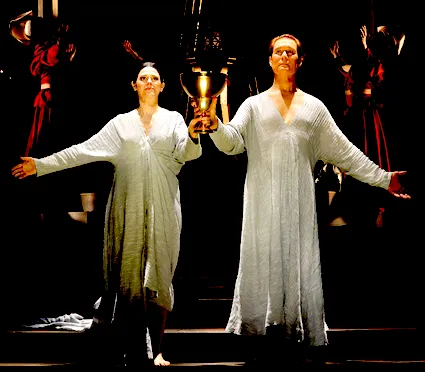
Ozawa’s ending celebrates the transformation of both Parsifal and Kundry. Parsifal has transformed from a sheltered, unsophisticated youth to become King of the Knights of the Grail. The once spellbound Kundry has been baptized by Parsifal and released from her curse. The two characters lift the Grail from its place of repose and, both holding it, come to the front of the stage together.
Photo: Kundry (Tanya Ariane Baumgarner, left) and Parsifal (Brandon Jovanovich, right); jointly hold the Grail; edited image, based on a Cory Weaver photograph, courtesy of the San Francisco Opera.]
For previous reviews of Matthew Ozawa’s San Francisco Opera productions, see Review: Beethoven’s “Fidelio”, An Excellent Cast for Matthew Ozawa’s Powerful Production – San Francisco Opera, October 17, 2021 and Review: Orlinski’s Astounding, Acrobatic Orfeo: “Orfeo ed Euridice”, San Francisco Opera, November 20, 2022.
For the most recent reviews of previous set designs by Robert Innes Hopkins at San Francisco Opera, see: Review: “La Traviata” Delightful New Production, Well-Received Debuts by Yende, Tetelman and Piazzola – San Francisco Opera, November 22, 2022 and Review: Donizetti’s Delightful, ‘Must See’ “Elixir of Love” Starring Pene Pati and Slatka Zamecnikova – San Francisco Opera, November 19, 2023..
Recommendation
I strongly recommend Matthew Ozawa “Parsifal” production, its cast and the musical performance.