It has been 16 years since the Santa Fe Opera last presented Mozart’s final opera, “The Magic Flute”. This season the Santa Fe Opera premiered a new production of the opera, co-produced with England’s Garsington Opera Festival.
A talented group of opera singers were recruited for the opera’s large cast.
Josh Lovell’s Tamino
[Photo: Josh Lovell as Tamino; edited image, based on a Bronwen Sharp photograph, courtesy of the Santa Fe Opera.]
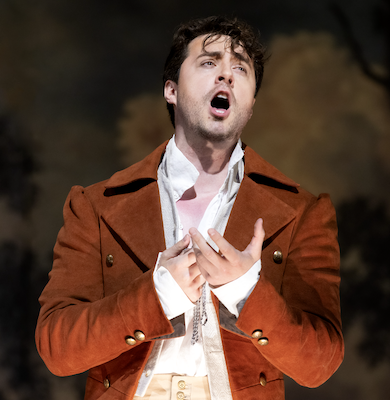
Canadian tenor Josh Lovell displayed a pleasant lyric tenor voice for Tamino, the role of his 2026 Santa Fe Opera debut.
Performing a role that appears in many scenes of the opera, he was an engaging actor. His major aria ‘Dies Bildnis’ (sung in its English translation), that occurs early in the opera, was elegantly sung.
Lovell, a member of the Lyric Opera of Chicago’s Ryan Opera Center Young Artists’ program, was a 2018 Grand Prize winner in the Netherlands’ International Vocal Competition Hertogenbosch.
This season Lovell also appears in a second opera – as Claude LeJeune in “Lili Elbe” [American Premiere Review: Tobias Picker’s Transgender-Themed Opera – Santa Fe Opera, August 5, 2026].
Joelle Harvey’s Pamina
[Photo: Pamina (Joelle Harvey, left) is embraced by Tamino (Josh Lovell, right); edited image, based on a Bronwen Sharp photograph, courtesy of the Santa Fe Opera.]
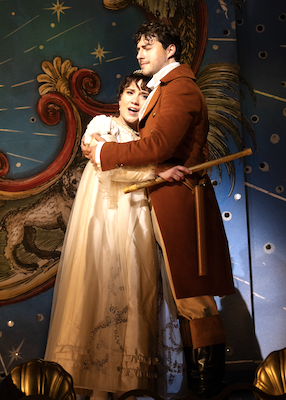
New York soprano Joelle Harvey was a vibrant presence as Pamina
Her stunning performance of Pamina’s aria ‘Ach, ich fühl’s’ (in its English translation) was a highlight of the evening, warmly applauded by the Santa Fe Opera audience.
Harvey obtained both her bachelors’ and masters’ degrees at the University of Cincinnati College -Conservatory of Music.
I reported on a Harvey performance once before – as the child Flora in Britten’s ghostly opera [Review: Houston’s Haunting, Inscrutable “Turn of the Screw” – January 29, 2010].
Will Liverman’s Papageno
[Photo: Papageno (Will Liverman) rides an ostrich with his net ready for catching birds; edited image, based on a Bronwen Sharp photograph, courtesy of the Santa Fe Opera.]
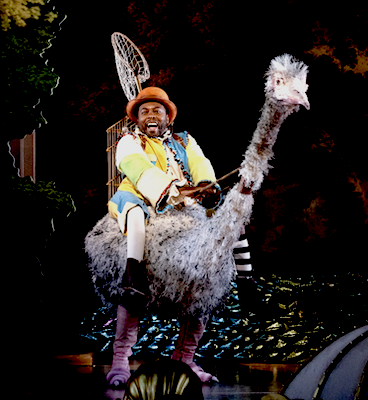
Illinois baritone Will Liverman was a joyful Papageno, performing his “bird-catching” duties for the Queen of the Night, riding an ostrich. Performing some of the opera’s most familiar music, Liverman’s lively baritone voice and comic shenanigans resonated with the opera’s audience.
Liverman is a graduate of the Juilliard School. He participated in the Young Artists’ Programs at the Opera Theater of Saint Louis and the Glimmerglass Festival.
A former Santa Fe Opera Apprentice, Liverman made his Santa Fe Opera debut as Schaunard in the 2019 season [Review: A Magnificent Mimi Leads a Youthful “Boheme” Cast – Santa Fe Opera, June 28, 2019]. Also that season he performed the Mill Foreman in “Jenufa” [Review: Wilde, Racette, Lewis in Dramatically Intense, Melodic “Jenufa” – Santa Fe Opera, July 24, 2019].
His comic talents were evident elsewhere in the role of Pantaloon [Review: Opera Philadelphia’s Richly Melodic, Laugh-filled “Love for Three Oranges” – September 20, 2019],
Jeni Houser’s Queen of the Night
[Photo: the Queen of the Night (Jeni Houser) explains what motivates her; edited image, baesd on a Bronwen Sharp photograph, courtesy of the Santa Fe Opera.]
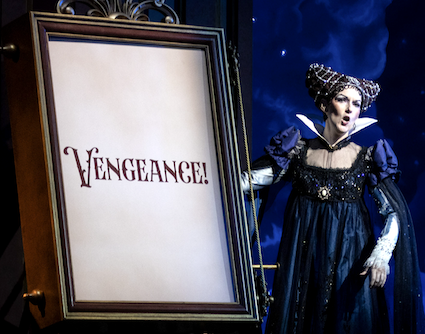
Wisconsin soprano Jeni Houser was the Queen of the Night. In each of the opera’s two acts she demonstrated her facility for the role’s coloratura fireworks. She succeeded in presenting a sharp image of the opera’s principal villainess.
This was my second opportunity to report on Houser’s Queen of the Night, following a performance in Barrie Kosky’s popular “silent screen” production [Review: A Youthful Cast Excels in Los Angeles Opera “Magic Flute” – December 1, 2019].
My performance reviews of the Glimmerglass 2014 Festival offering included noting Houser’s presence in smaller roles. I also reported on a Minnesota Opera “Thais” in which she sang the part of La Charmeuse [Review: Minnesota Opera’s Splendidly Exotic, Erotic “Thaïs” – May 12, 2018].
Alexander Kopeczi’s Sarastro
[Photo: Alexander Kopeczi as Sarastro; edited image, based on a Bronwen Sharp photograph, courtesy of the Santa Fe Opera.]
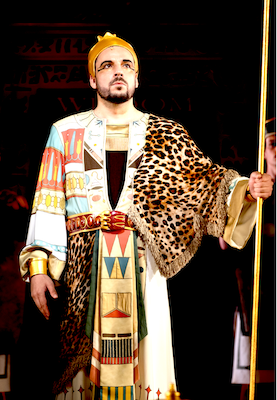
In an opera in which the opposite forces of darkness and light are major themes, it is Sarastro who represents reason and “the light” as the opposite of the Queen of the Night’s superstitions and darkness.
Romanian bass Alexander Kopeczi performed Sarastro’s two arias ‘O Isis und Osiris’ and ‘Der Holle Rache’ (both in English translation) with authority,
This is Kopeczi’s Santa Fe Opera debut season, in which he performs two roles, the other being Prince Gremin [Review: A Pushkin-Centered “Eugene Onegin” – Santa Fe Opera, August 6, 2026].
Jazmine Saunders’ Papagena
[Photo: Papageno (Will Liverman. left) is delighted to meet Papagena (Jazmine Saunders, right), the girlfriend who had been promised to him.]
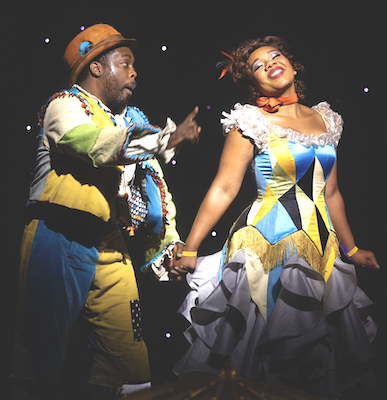
In the opera three of the main characters, Tamino, Pamina and Papageno, go through a series of trials with the promise of a worthy prize. For Tamino and Pamina, it is each other. For Papageno it is his new love, Papagena.
Second Year Apprentice New York soprano Jazmine Saunders sang he role of Papagena. She proved to be a sprightly mate for Papageno.
What to me seemed not only the most outrageous, but also the funniest, idea in the production was the predictions of the future progeny of Papageno and Papagena. At the first mention of “first comes a Papageno”, the representation of a baby wrapped in a blanket is thrown to them (and to nursemaids attending baby carriages onstage). And, at “then comes a Papagena” another baby is thrown. As that familiar refrain continues for much of the rest the scene more and more babies are thrown onstage for the couples and the nursemaids to catch.
The audience, myself included, roared with laughter.
Spencer Hamlin’s Monostatos and Other Cast Members
[Photo: Spencer Hamlin as Monostatos; edited image, based on a Bronwen Shapr photograph, courtesy of the Santa Fe Opera.]
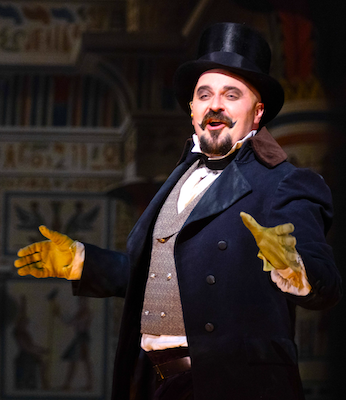
Connecticut tenor Spencer Hamlin portrayed Monostatos, one of Sarastro’s employees, who, by opera’s end, switches sides to become an ally of the Queen of the Night.
Hamlin’s duet with Liverman’s Papageno was appropriately hilarious and his solo aria ‘Alles fühlt der Liebe Freuden’ (in its English trqnslation) was nicely sung.
Hamlin had appeared in smaller roles in the 2023 and 2024 Santa Fe Opera seasons.
Other cast members included Chinese bass-baritone Le Bu as the Speaker, one of his two 2026 Santa Fe Opera roles, the other being the Bonze [Review: “Madama Butterfly”, Brescia Version with Karen Chia-Ling Ho, Stephen Costello, Jarrett Ott and Maestro John Fiore – Santa Fe Opera, August 3, 2026].
The Three Ladies were performed by Second Year Apprentices (First Lady) Virginia soprano Jasmin Ward; (Second Lady) Missouri mezzo-soprano Deanna Ray Eberhardt, (Third Lady) Illinois mezzo-soprano Lauren Randolph.
The Three Boys were performed by First Year Apprentices (First Boy) Chinese soprano Dani Jingdan Zhang, (Second Boy) Florida soprano Sabrina Langlois and (Third Boy) Michigan mezzo-soprano Natalie Corrigan.
The Two Priests were performed by Second Year Apprentice Texas bass Will Ryan and First Year Apprentice California tenor Dominic Salvati.
The Two Armored Men were performed by Second Year Apprentice New York tenor Matthew Goodheart and First Year Apprentice South Korean bass Songhoon Han.
Maestro Harry Bicket and the Santa Fe Opera Orchestra and Chorus
[Photo: Maestro Harry Bicket conducts the Santa Fe Opera Orchestra in “The Magic Flute”; edited imagea, based on a Bronwen Sharp photograph, courtesy of the Santa Fe Opera.]
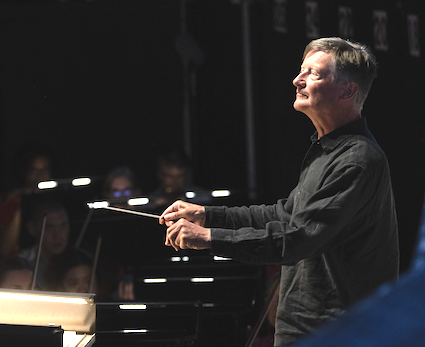
Santa Fe Opera’s English Music Director Harry Bicket led the Santa Fe Opera Orchestra and Chorus in an affectionate performance of Mozart’s opera.
Bicket’s conducting of two of the season’s five operas allowed us to hear his interpretations of masterpieces of both Mozart and Handel.
Between 2019 and 2026, in addition to Mozart’s “The Magic Flute”, Maestro Bicket has conducted the three Mozart opera masterpieces with libretti by Lorenzo da Ponte – “Nozze di Figaro” [Review: A Clockwork “Marriage of Figaro” Delights – Santa Fe Opera, July 23, 2021], “Cosi fan Tutte” [Review: “Cosi Fan Tutte” – World Class Singing, Deconstructed Staging – Santa Fe Opera, July 26, 2019] and ‘Don Giovanni” [Review: Stephen Barlow Creates an Elegant New “Don Giovanni” Production – Santa Fe Opera, June 29, 2024].
The Santa Fe Opera Apprentices act as the opera’s chorus, under the leadership of Utah Chorus Master Suzanne Sheston.
The Garsington Opera/Santa Fe Opera Co-Production
[Photo: SImon Higlett’s main stage scenic design; edited image, based on a Bronwen Sharp photograph, courtesy of the Santa Fe Opera.]
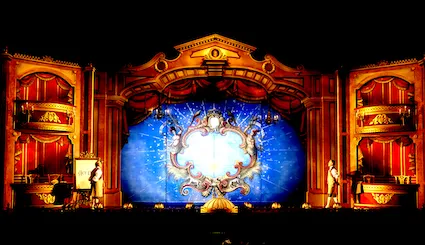
Santa Fe Opera, in each of the past three seasons has mounted a production associated with England’s Garsington Opera. The first two were productions imported from Garsington – mountings of an opera by Richard Strauss [Review: A Spectacular “Der Rosenkavalier” – Santa Fe Opera, July 24, 2024] and by Benjamin Britten [An Elegant Production for Britten’s Ghostly “Turn of the Screw” – Santa Fe Opera, August 1, 2025].
The production premiere of “The Magic Flute” took place in Santa Fe and will be seen in Garsington later.
It marks the first Santa Fe Opera production associated witih the frequent British collaborators, director Christopher Lunscombe and scenic designer Simon Higlett.
Lunscombe and Higlett conceived the new production of “The Magic Flute” as taking place in a Victorian “pantomime” (or “panto”), a theater that produced pleasant fantasies that encouraged audience involvement. At different times in the Lunscombe-Higlett performance of “The Magic Flute” the audience is invited to respond to a question or ro make sounds.
Both the opera’s spoken and sung passages were performed in English, rather than ira oeifinL German, Christopher Luscombe’s Direction
[Photo: Director Christopher Luscombe; resized image from a United Agents photograph.]

British actor and director Christopher Luscombe’s career has been centered around acting and directing for the Royal Shakespeare Theater, London’s West End Theaters and Opera performances in festival settings
Prior to the co-production between Garsiington Opera and Santa fe Opera, Lunscombe and Higlett had produced Garsington opera productions of Rossini’s “The Barber of Seville” and Donizetti’s “L’Elisir d’Amore”.
Simon Higlett’s Scenic Design and Robert Perdziola’s Costumes
[Photo: SImon Higlett’s main stage scenic design; edited image, based on a Bronwen Sharp photograph, courtesy of the Santa Fe Opera.]

The many fantastic elements contained in “The Magic Flute” present numerous opportunities for imaginative departures from tradition.
One of the production’s delights is its creation of both unfriendly monsters and friendnly animals. A the dragon-headed beast chases Tamino in the very first scene. Tamino later charms a lion, rabbit, seal and bear with his flute.
[Photo: Tamino (Josh Lovell, center) tames the animals; edited image, based on a Bronwen Sharp photograph, courtesy of the Santa Fe Opera.]
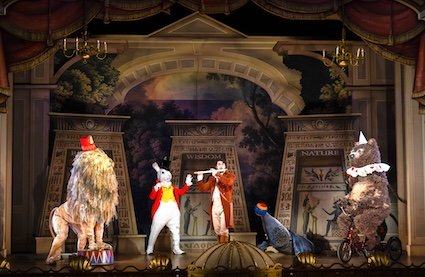
Highlett was paired with costume designer Robert Perdziola. In addition to the praise deserved for this production’s costumes, in a past review I had acknowledged his important contribution to Frank Corsaro’s famous production of Gounod’s “Faust” [Review: Lyric Opera Revives Inventive Corsaro-Perdziola “Faust” – Chicago, November 3, 2009].
Recommendation
I recommend the Santa Fe Opera/Garsington Opera co-production of Mozart’s “The Magic Flute” both to the veteran opera-goer and the person new to opera.