
The late British director Lee Blakeley’s production of “Madama Butterfly” premiered at Santa Fe Opera in 2010. The company revived his production in 2018 and again this season.
For both this season and the 2018 revival, Conductor John Fiore utilized the music and libretto of Puccini’s first revision of the score – the now seldom-heard Brescia edition. That edition premiered months after the 1904 ‘fiasco’ at “Butterfly’s” La Scala world premiere.
Karen Chia-Ling Ho’s Cio-Cio-San
[Photo: Karen Chia-Ling Ho as Madama Butterfly; edited image, based on a Bronwen Sharp photograph, courtesy of the Santa Fe Opera.]
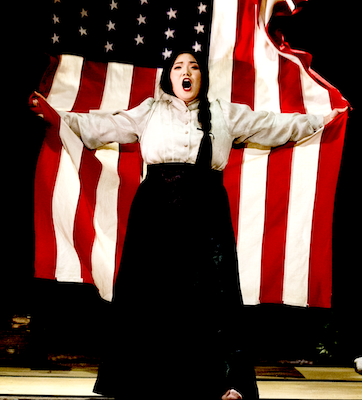
Portraying Cio-Cio-San was Taiwanese soprano Karen Chia-Ling Ho, in her Santa Fe Opera debut season. She displayed vocal power throughout the evening, in a dramatically compelling performance of the title role.
Her love duet with Stephen Costello’s Pinkerton expressed deep emotion. Her most famous aria, ‘Un bel di’, in which she expressed her fantasy-driven expectation of Pinkerton’s return, received an enthusiastic ovation from the Santa Fe Opera audience.
This was my third opportunity to review a performance by Chia-Ling Ho, following her San Francisco Opera appearances as Princess Jia [Review: A Pleasing Revival of “Dream of the Red Chamber” at San Francisco Opera, June 14, 2022] and Mimi [Review: A Superbly Performed “Boheme”, Starring Pene Pati, Karen Chia-Ling Ho, Andrea Carroll and Lucas Meachem – San Francisco Opera, June 15, 2025]. My admiration for her operatic accomplishments increases with each performance I attend.
Stephen Costello’s Lieutenant Benjamin Franklin Pinkerton
[Photo: Stephen Costello as Pinkerton; edited image, based on a Bronwen Sharp photograph, courtesy of the Santa Fe Opera.]
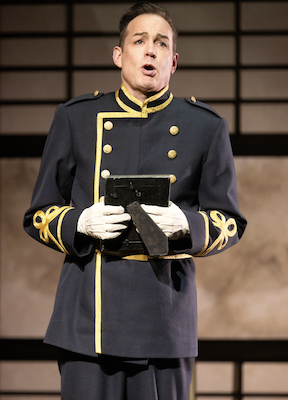
Pennsylvania tenor Stephen Costello assayed the role of Pinkerton. The character appears in the first and third acts. In the first act, Pinkerton is an ardent bridegroom, defending his fiance Cio-Cio-San against a problematic family and joining her in a glorious series of ‘wedding night” duets. The finale of the first act ranks among the most beautiful music in all of opera. Costello and Chia-Ling Ho performed these duets exquisitely.
But what Cio-Cio-San sees as the actions of a perfect husband is to Pinkerton a sexual adventure in a foreign culture. Despite the consul Sharpless warning Pinkerton that Cio-Cio-San “trusts you”, Pinkerton’s abandonment of her and a child of whose existence he was unaware, leads to her suicide.
Audiences regard Pinkerton as a villainous character. American audiences especially greet the tenor singing the role at final curtain calls with a mostly good-natured chorus of boos (which Costello at curtain call encouraged with hand gestures inviting more volume). Pinkerton is a great role vocally and dramatically, which Costello performed with distinction.
Costello, a graduate of Philadelphia’s presigious Academy of the Vocal Arts, has shown accomplishment as a lyric tenor from my earliest acquaintance with his work. I praised him in the title role of Donizetti’s “Roberto Devereux” [Review: The Donizetti Revival, Second Stage: Papian, Costello in Lawless’ Dallas Opera’s “Roberto Devereux” – January 23, 2009] and, later, as Tonio [Review: Vargicova, Costello, Podles and Burdette Romp in Hilarious, Beautifully Sung “Fille du Regiment” – San Diego Opera, January 26, 2013].
From early on, it was evident that Costello’s successes in such ‘lirico-spinto’ roles as Rodolfo [Review: Pérez, Costello Lead Youthful Cast in Classic, Cinematic “Boheme” Production: Los Angeles Opera, May 12, 2012] and Lensky [Review: A Fascinating “Eugene Onegin” at The Dallas Opera, October 30, 2016] would lead him to star in such true ‘spinto’ roles as Pinkerton.
See also my interviews with Costello in 2011 [Rising Stars: An Interview with Stephen Costello, Part 1 and Rising Stars: An Interview with Stephen Costello, Part 2] and 2016 [Santa Fe Opera’s First-Ever Roméo : A Conversation with Stephen Costello].
Jarrett Ott’s Sharpless
[Photo: Jarrett Ott as the American consul Sharpless; edited image, based on a Bronwen Sharp photograph, courtesy of the Santa Fe Opera.]
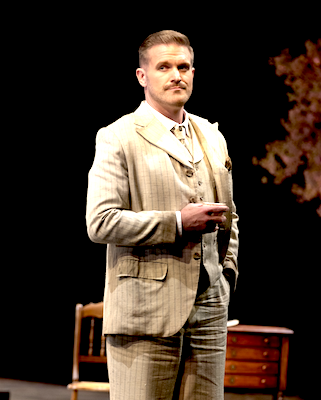
In this ‘verismo’ opera, the American Consul Sharpless is the moral compass. Sharpless is one of Puccini’s most musically beautiful baritone roles. In Sharpless’ first act duet with Pinkerton, Sharpless sings some of Puccini’s finest music.
Pennsylvania baritone Jarrett Ott was persuasive in this role. Ott’s dramatic instincts and vocal strength makes him the ideal Sharpless.
Ott returned to the Santa Fe Opera after prior performances as Guglielmo [Review: “Cosi Fan Tutte” – World Class Singing, Deconstructed Staging – Santa Fe Opera, July 26, 2019] and John Seward [Review: Anthony Roth Costanzo, Jarrett Ott and Kathryn Henry Lead Strong Cast for Corigliano’s New “Lord of Cries” – Santa Fe Opera, July 21, 2021].
For my interview with Ott, see: Rising Stars: An Interview with Jarrett Ott.
Sun-Ly Pierce’s Suzuki
[Photo: Sun-Ly Pierce as Cio-Cio-San’s servant and companion, Suzuki; edited image, based on a Bronwen Sharp photograph, courtesy of the Santa Fe Opera.]
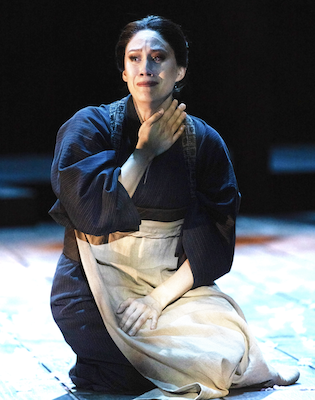
New York soprano Sun-Ly Pierce was a creditable Suzuki, Cio-Cio-San’s faithful servant, companion and protector.
Pierce’s portrayal of Suzuki’s loyalty to a mistress whose family has forsaken her provides a extra degree of sympathy for both the artist and the character she plays. Pierce was affecting in her maternal effort to keep up the spirits of both Cio-Cio-San and her toddler son Trouble.
Pierce’s Suzuki was affectingly sung, but only allowed her to display a part of her vocal talent. One expects more to be shown in 2027, because Santa Fe Opera has already announced a much different role for Pierce next season, that of Rosina, the ‘coloratura mezzo-soprano prima donna’ of Rossini’s “The Barber of Seville”.
Ya-Chung Huang’s Goro, Le Bu’s Bonze and Yeongteok Yang’s Prince Yamadori
[Photo: Ya-Chung Huang as Goro; edited image, based on a Bronwen Sharp photograph, courtsy of the Santa Fe Opera.]
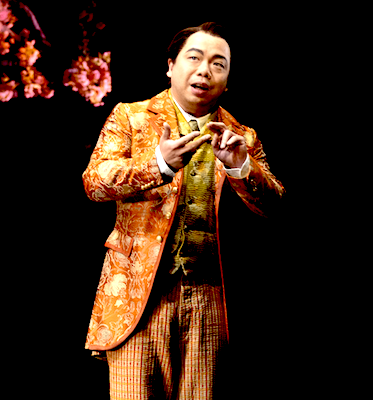
Taiwanese tenor Ya-Chung Huang, in his Santa Fe Opera debut season, portrayed the marriage broker, Goro. The character is a self-absorbed sex trafficer, obviously economically benefiting from the funds foreigners were willing to spend to obtain comfortable sexual relationships with young Japanese girls.
Huang’s Goro is appropriately busy, supervising an “official” wedding in the first act, and returning in the second act in an attempt to sell Cio-Cio-San to Prince Yamadori. Huang is vocally solid and dramaticallly effective.
[Photo: the Bonze (Le Bu, left) shows his disapproval of the recent actions of Cio-Cio-San (Karen Chia-Ling Ho, right); edited image, based on a Bronwen Sharp photograph, courtesy of th Santa Fe Opera.]
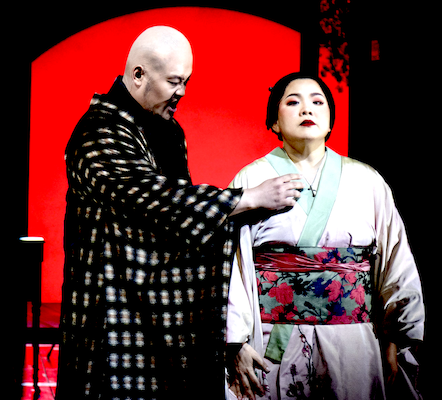
Chinese bass-baritone Le Bu was a formidable presence performing the role of Cio-Cio-San’s uncle Bonze. Although the role lasts only a few minutes, more than one artist singing it has described the role in such terms as “a moment of terror”, because the voice has to be ready to vocalize strenuous music at full volume. For the record, Le Bu was a terrific-sounding wedding disrupter.
Also appearing is South Korean baritone Yeongtaek Yang in the role of the wealthy Prince Yamadori, whom Goro hopes to persuade Butterfly to wed. Yang is a second-year Santa Fe Opera Apprentice.
Alyssa Goretksy’s Kate Pinkerton, Hanako Ingliss’ Trouble and Other Cast Members
[Photo: Alyssa Goretsky as Kate Pinkerton; edited image, based on a Bronwen Sharp photograph, courtesy of the Santa Fe Opera.]
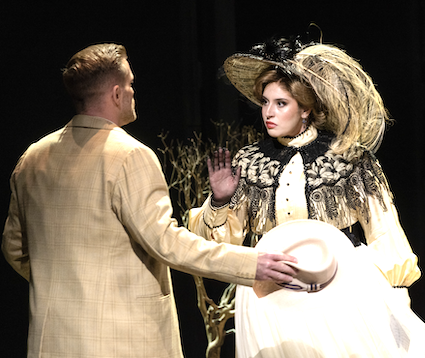
In the Brescia edition of “Madama Butterfly”, there is a larger role for Pinkerton’s “American wife”, Kate. California soprano Alissa Goretsky was cast in the role of a woman determined to properly care for her husband’s son Trouble, whom she and he only learned about in the last few hours.
Goretsky effectively demonstrated compassion for the woman her husband had obviously wronged and for the child. Although the role of Kate was brief, Goretsky made a strong impression.
[Photo: the young boy Trouble (Hanako Ingliss) is draped in a flag by Suzuki (Sun-Ly Pierce, above left); edited image, based on a Bronwen Sharp photograph, courtesy of the Santa Fe Opera.]
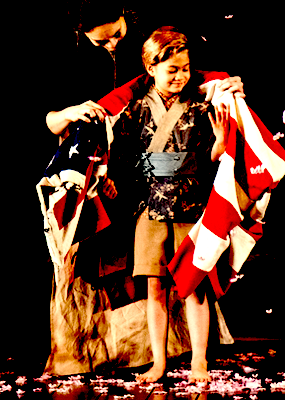
New Mexico actor Hanako Ingliss plays the boy Trouble in an enchanting performance for which she received a well-deserved audience ovation.
I was reminded of another production in which Trouble is an adult wandering through the opera’s scenes learning of his family’s backstory [Review: Karah Son, Michael Fabiano Lead Brilliant Cast in Amon Miyamoto’s Fascinating Production of “Madama Butterfly” – San Francisco Opera, June 3, 2023].
Other members of the cast include other Cio-Cio-San relatives, in addition to her Uncle Bonze. Second-year Santa Fe Opera Apprentices were Georgia soprano Lauryn Davis as her cousin and Michigan baritone Kyle White as her drunken Uncle Yakuside.
First-year Santa Fe Opera Apprentices were Belarus mezzo-soprano Darya Narymanava as Cio-Cio-San’s Mother and Kentucky mezzo-soprano Sophia Baete as her Aunt. Missouri baritone Matthew Juhlin was the Imperial Commissioner and New Hampshire bass-baritone Evan Lazdowski was the Official Registrar.
Maestro John Fiore and the Santa Fe Opera Orchestra and Susanne Sheston’s Chorus
[Maes John Fiore; edited image of a Crescendi Artists photograph.]
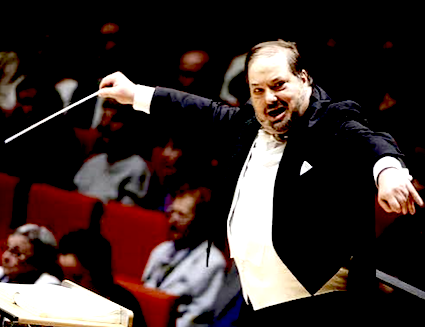
Conducting the Santa Fe Opera Orchestra was Washington State Maestro John Fiore. An expert on the Brescia edition of “Butterfly”, he oversaw an authoritative and sensitive performance.
Maestro FIore’s early appearances at Santa Fe Opera took place in seven seasons between 1989 and 2006. His most recent assignments enlist his authoritative presence in the Puccini repertory – the 2018 revival of the Blakeley “Butterfly” and 2023’s production of “Tosca” [Review: A Well-Sung “Tosca” Starring Leah Hawkins, Joshua Guerrero, Reginald Smith, Jr. and Blake Denson – Santa Fe Opera, June 30, 2023].
The Santa Fe Opera Apprentices, under the leadership of Utah Chorus Master Suzanne Sheston, sing the “humming chorus” that bridges Acts II and III in this production.
Lee Blakeley’s Original Production and Melanie Bacaling’s Revival Direction
The revival was overseen by Illinois director Melanie Bacaling, who demonstrated faithfulness to the late British director Lee Blakeley’s concepts.
Blakeley was a strong propoent of “reality-based” approaches of operas of European compoisers with Asian themes. His 2010 production of “Madama Butterfly” and 2012 Santa Fe Opera production of Bizet’s “The Pearll Fishers” [Review: The Stylishly Gallic Santa Fe Opera – Eric Cutler, Nicole Cabell Radiant in Bizet’s “Pearl Fishers”, July 31, 2012] exhibit his philosophy. For the latter opera, he required all the characters to wear the style of clothing that working Sri Lankans would have worn in the 19th century. For “Butterfly” he focused the production on the poverty into which Cio-Cio-San’s mother had descended after her husband’s Mikado-directed suicide.
[Photo: a view of the impoverished neightborhood in which Cio-Cio-San’s house and garden is located; edited image, based on a Ken Howard photograph from the Los Angeles Opera’s 2016 performance of Lee Blakeley’s production, courtesy of the Los Angeles Opera.]
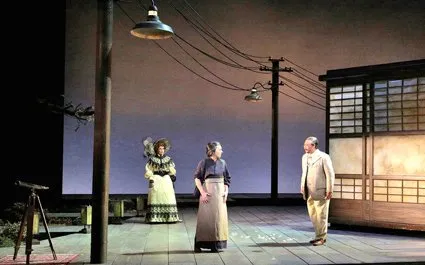
That poverty, made more severe by Pinkerton’s disappearance and the estangement of Cio-Cio-San from her family, is presented strikingly in the depiction of the Nagasaki neighborhood in which Cio-Cio-San’s house and garden are situated.
Another feature of Blakeley’s Asian-themed productions of 2010 and 2012 was his use of the natural setting in which the Santa Fe Opera is located. Both productions incorporate the mountainous background which is present when the theater’s back wall is open to the sky.
Blakeley’s vision of the opera’s setting, as realized by his scenic designer Jean-Marc Puissant, was retained for both the production’s 2018 and 2026 revIvals.
Jean-Marc Puissant’s Scenic Design and Brigitte Reiffenstuhl’s Costumes
[Photo: Jean-Marc Puissant’s opening set, representing the structure of Cio-Cio-San’s house in moonlight; edited image, based on a Bronwen Sharp photograph, courtesy of the Santa Fe Opera.]

French designer Jean-Marc Puissant and German designer Brigitte Reiffenstuhl realized Lee Blakeley’s conceptualization of the production, centering on late 19th century Nagasaki.
As audience members entered the Santa Fe Opera Crosby Theatre for performances in 2010, 2018 or 2026 they were structk by the representation of an enormous moon situated behind the structural beams for Cio-Cio-San’s house.
Workmen (including Pinkerton’s friends from the ‘USS Abraham Lincoln’ put together the siding that constitute the structure’s walls. After the wedding ceremony and the commotion created by the Bonze, the house is ready for the couple’s wedding night.
The wedding night scene abounds in glorious music sung by Chia-Ping Ho’s Cio-CIo-San and Costello’s Pinkerton, accompanied by the vibrant orchestral performance of the Santa Fe Opera Orchestra, directed by Maestro Fiore.
[Photo: Cio-CIo-San IKaren Chia-Ling Ho, center left), her servant Suzuki (Sun-Ly Pierce, center right) and Lieutenant Pinkerton (Stephen Costello,, right) prepare for the newlywed’s wedding night; edited image, based on a Bronwen Sharp photograph, courtesy of the Santa Fe Opera.]
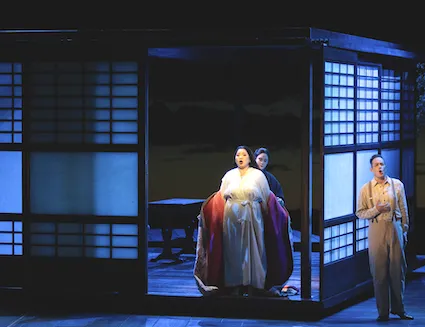
In the second act, we observe the Nagasaki neighborhood in which Cio-Cio-San’s is located, with its electrical poles (see above) and stark appearance.
Recommendation
There are many admirable features of the Santa Fe Opera’s 2026 revival. The vocal performances of the four principal artists were strong.
The opera’s Brescia version includes many lines of conversation that illuminate the opera’s backstory. One can appreciate the logic of Puccini’s “cuts” for the opera’s final version, while still enjoying the additional words and music of Puccini’s Brescia version.
This was an excellent performance of one of Puccini’s masterpieces.