
The opening performance of the Santa Fe Opera’s 2025 season was a James Robinson’s co-production (with Seattle Opera, of which Robinson is General and Artistic Director) of Puccini’s “La Boheme”. This performance review is of the fifth of ten scheduled performances.
Sylvia d’Eramo’s Mimi
[Photo: Sylvia d’Eramo as Mimi; edited image, based on a Curtis Brown photograph, courtesy of the Santa Fe Opera.]
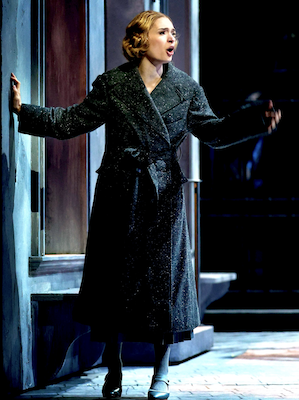
Texas sopsrano Sylvia d’Eramo returns to the Santa Fe Opera three seasons after her arresting performance as Micaela [Review: Strong Vocal Performances by Isabel Leonard, Michael Fabiano, Sylvia d’Eramo and Michael Sumuel for Director Miriame Clement’s Idiosyncratic Production -“Carmen”, Santa Fe Opera, August 2, 2022].
As Mimii, D’Eramo successfully navigated both the vocal and dramatic demands of the role, beautifully performing the first act’s great aria ‘Mi chiamano Mimi’.
D’Eramo’s vocal power was used to great effect in Mimi’s third act duets with Marcello and Rodolfo. Her soft, tightly controlled vibrato underlined the poignancy of the Mimi-Rodolfo interactions in the opera’s last two scenes.
D’Eramo drew applause during the third scene’s “breakup duet” with Rodolfo, responding to d’Eramo’s communication of Mimi’s intimacy as she describes the few possessions that remain in Rodolfo’s apartment. D’Eramo was dramaically persuasive in the final scene, when, in a burst of energy, she sat upright for her last words to Rodolfo.
Long Long’s Rodolfo
[Photo: Long Long as Rodolfo, communicating with his roommates that he will not be alone when he joins them; ediited image, bsed on a Curtis Brown photograph, courtesy of the Santa Fe Opera.]
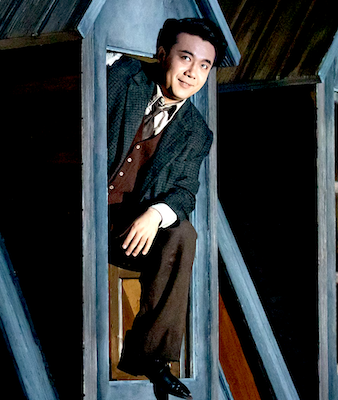
In his debut season with the Santa Fe Opera, Chinese tenor Long Long exhibited a lyric voice with spinto power, perfectly suited for the role of Rodolfo.
Long, a 2019 first place winner in Germany’s international ‘Neue Stimmen’ competition, was artistically impressive in Rodolfo’s first act aria ‘Che gelida manina’. His spinto voice was passionate during Rodolfo’s heart-wrenching duets with d’Eramo’s Mimi.
Long also showed the comedic skills needed to hold his own in the hilarious interactions with Rodolfo’s three roommates, in the ensemble horseplay that takes place at the beginning of the first and last scenes.
Szymon Mechlinski’s Marcello and Emma Marhefka’s Musetta
[Photo: Marcello (Szymon Mechlinski, left) comforts his former and likely future lover, Musetta (Emma Marhefka, right); edited image, based on a Curtis Brown photograph, courtesy of the Santa Fe Opera.]
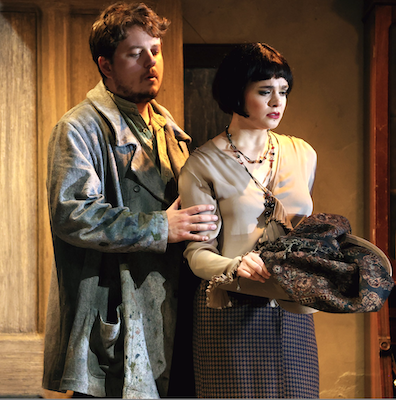
Two of the most interesting casting choices was the pairing of Polish baritone Szymonn Mechlinski with Pennsylvania soprano Emma Marhefka for the off-again, on-again, love affair between Marcello and Musetta.
Both artists are early in their careers. Each shows great promise of future recognition of first rank international opera stars.
Michlinski exhibited a rich, powerful baritone that seems ready for the full array of roles in the dramatic baritone range.
Mechlinski’s warm baritone sounded beautifully throughout the evening, and was especially pleasing in his third scene duet with D’Eramo’s Mimi.
As Musetta, Marhefka demonstrates both the ebullient vocal presence and comic timing essential for a role that dominates the opera’s second scene. Yet Marhefka is still a “young artist in training” – serving as a 2025 Santa Fe Opera Apprentice and as a member of the Metropolitan Opera’s Lindemann program.
Marhefka delivered Musetta’s second scene anthem, the waltz-themed “Quando me’n vo’, with passion. She was a comic delight in her frenzied interactions with Kevin Burdette’s henpecked Alcindoro. In contrast, in the opera’s somber final scene, she showed focused dramatic intensity.
Soloman Howard’s Colline and
[Photo: Soloman Howard as Colline; edited image, based on a Curtis Brown photograph, courtesy of the Santa Fe Opera.]
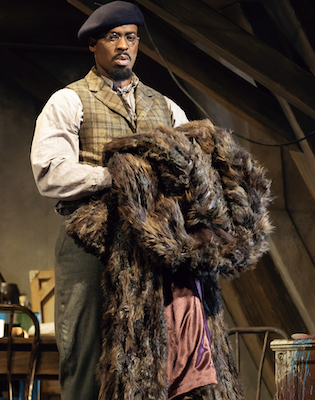
Six years ago, I praised the performance District of Columbia bass Soloman Howard as Colline [Review: A Magnificent Mimi Leads a Youthful “Boheme” Cast – Santa Fe Opera, June 28, 2019]. In this season’s return to this role, Howard’s physical presence is even more commanding, and his sonorous bass voice sounds even richer – a voice superbly tuned for Colline’s plaintive aria ‘Vecchia zimarra, senti’ on sacrificing his “philosopher’s coat” for Mimi’s medical care.
I have followed Howard’s career over the past dozen years, both in comprimario and principal roles. Perhaps his most memorable of his performances I reviewed was his final curtain call for the role of Angelotti, during which he proposed marriage to the Tosca, Ailyn Perez. [Review: Ailyn Pérez , Michael Fabiano, Alfred Walker, Soloman Howard Excel in a Memorable “Tosca” (with a Post-Finale Surprise) – San Francisco Opera, September 5, 2021.]
Efrain Solis’ Schaunard
[Photo: Efrain Solis as Schaunard; edited image, based on a Curtis Brown photograph, courtesy of the Santa Fe Opera.]
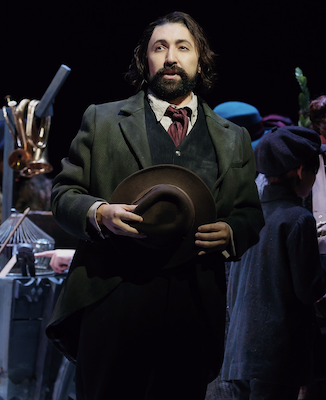
The fourth member of the Bohemian roommates ensemble is California baritone Efrain Solis, whose career I have followed with interest [Rising Stars: An Interview with Efraín Solís].
Solis is a gifted performer of such comic operatic roles as Mozart’s Papageno [Review: The Jun Kaneko “Magic Flute” Revived – San Francisco Opera, October 20, 2015] and Rossini’s Dandini [Review: “Cenerentola” – San Francisco Opera’s Splendidly Sung, Sumptuously Staged Cinderella Story, November 9, 2014]. He also has shown an affinity for dramatically intense, contemporary opera [Streamed Performance Review: Susan Graham, Efrain Solis, Maya Kherani Shine in Heggie’s and Scheer’s “Three Decembers”, Opera San Jose, December 3, 2020.]
Appearing in three of the opera’s four scenes, Solis’ Schaunard engages in well-grounded, well-timed interactions with the other principals, especially the comic banter and horseplay with his three roommates, Rodolfo, Marcello and Colline. Near the opera’s end, it is Schaunard who realizes that Mimi has died, and has the sobering task of so informing his mates. In all its dimensions, Solis performed the role with humor, passion and grace.
Kevin Burdette’s Alcindoro & Benoit and Other Cast Members
[Photo: Alcindoro [Kevin Burdette, seated, center right] reacts to the bizarre antics of his date, Musetta [Emma Marhefka, left]; edited image, based on a Curtis Brown photograph, courtesy of the Santa Fe Opera.]
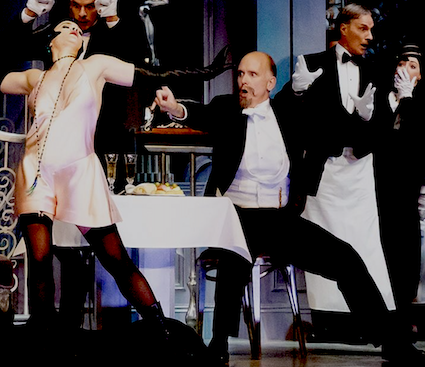
Few Santa Fe Opera debuts were as impactful as Tennessee bass-baritone Kevin Burdette’s as Scattergood in a seldomly performed Menotti comic opera [Review: Loving “The Last Savage”: Over the Top Menotti Charms at Santa Fe Opera – August 5, 2011].
Burdette’s string of triumphs has included his General Boum [Review: Susan Graham’s Star Glows in Offenbach’s Sexy, Witty “Grand Duchess of Gerolstein” – Santa Fe Opera, June 28, 2013] and Voltaire [Review: Bernstein’s “Candide” Opens 2018 Santa Fe Opera Season – June 29, 2018]. Burdette has also shown dramatic intensity in the role of Britten’s villainous John Claggart [Review: Hopkins, Norman and Burdette in a Beauty of a “Billy Budd”- Central City Opera, July 21, 2019].
Burdette’s expertise in “character” roles and the extraordinary physical stamina he has displayed in previous assignments has made him a natural to perform the comic roles of the Bohemians’ landlord Benoit and Musetta’s rich patron Alcindoro. In both roles director James Robinson has entrusted Burdette with comic routines that transcend most interpretations of these important comprimario parts, both examples of Burdette’s operatic vocal and acting skills.
The opera has three smaller roles, each sung by 2025 Santa Fe Opera Apprentices. Appearing in the second scene is the toy-seller Parpignol (portrayed by Puerto Rican tenor Angel Vargas. New Hampshire. In the third scene, bass-baritone Evan Landowski was the Sergeant and Missouri baritone Randell McGee was the Custom House Officer.
Maestro Iván López Reynoso and the Santa Fe Opera Orchestra and Chorus
[Photo: Maestro Iván López Reynoso; edited image of a Curtis Brown photograph, courtesy of the Santa Fe Opera.]
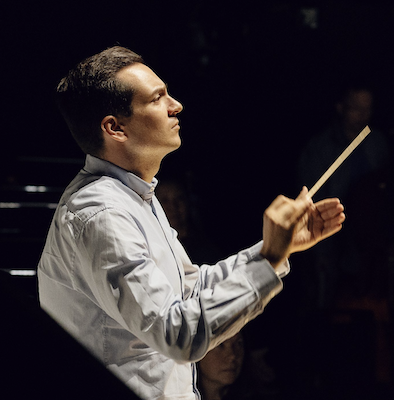
Mexican Maestro Iván López Reynoso led the Santa Fe Opera Orchestra in a passionate performance of Puccini’s beloved operatic score.
The Santa Fe Opera Apprentices form the chorus for company performances, under the directorship of Utah chorus master Suzanne Sheston.
The chorus was onstage during much of the second scene, representing the Christmas Eve crowds of Parisians.
They were offstage voices in the third scene on Paris’ Barriere.
Director James Robinson
Director Robinson notes that the source of Puccini’s opera “La Boheme” is the 1851 collection of stories about Parisian Bohemians, published by Henri Murger. Although acknowledging Murger’s published work as Puccini’s inspiration for his opera, Robinson argues that Puccini’s music tends to be more modern than the time period of Murger’s writings. In Robinson’s view, the opera can be time-shifted to the 1920s, rather that the early 19th century Paris described in Murger’s work
The most obvious consequence of such a time-shift is in the costuming of California designer Constance Hoffman, particularly the flapper outfit worn by Musetta in her first appearance. I concur with Robinson that there is virtually no dissonance between Pucciini’s musical palette and Moyer’s scenic design.
Scenic Designer Alan Moyer
[Photo: the Bohemian roommates and guests share a table in elegant restaurant surroundings (from left to right, Schaunard (Efrain Solis). Rodolfo (Long Long), Mimi (Sylvia d’Eramo), Colline (Soloman Howard) and Marcello (Szymon Mechlinski); edited image, based on a Curtis Brown photograph, courtesy of the Santa Fe Opera.]

The production was created by Oklahoma director James Robinson. The sets were created by Pennsylvania designer Alan Moyer. The costumes were by New York designer Constance Hoffman
Moyer’s scenic second act “Momus” scene is divided into two parts The first is the bustling energy of the Parisian masses, including the children and their guardians who surround the toyseller Parpignol. The second is an interior restaurant scene in which the Bohemians and Mimi encounter Musetta and Musetta’s rich new flame, Alcindoro.
The division of the Momus scene into exterior and interior parts does allow for the Bohemians, Musetta and Alcindoro to be front and center for most of the act, rather than, as in many productions, off to the side with other activities taking place around them. Some may prefer the traditional way of presenting the act.
Recommendation
I strongly recommend the cast and production.