
This performance review discusses the third of seven performances of San Francisco Opera’s mounting of Giuseppe Verdi’s middle-period opera of 1859, “Un Ballo in Maschera”. The opera, which opened the company’s 2024-25 season, its 102nd, was staged by Italian director Leo Muscato, in an insightful production.
Director Leo Muscato’s Staging of Verdi’s “Ballo in Maschera”
The opera that Verdi intended to write (the historical assassination of Sweden’s Gustavus III at a masked ball) was a remake of Daniel Auber’s French opera Gustave III that premiered in 1833, a decade and a half earlier.
Verdi’s opera was composed during a period of revolutionary movements against several European monarchies. The reactionary Hapsburg Empire’s Italian and Austrian censors were not about to allow an opera about the killing of a reigning European monarch to be staged. Ultimately, Verdi agreed to move the opera’s location from Sweden to the non-royal, fictional court of a potentate in Puritan Boston.
Over the past century, most new productions of “Ballo” have returned the opera’s action to the court of the historical Swedish king. In Muscato’s production, tenor Michael Fabiano plays Gustavus, rather than the Massachusetts official Riccardo (neither Verdi nor the censors had any problem with giving the Bostonians Italian names), but others in the cast retain their Italianized Bostonian names – Renato, Ulrica, Samuele, Tom – rather than their Swedish names. (The opera program helpfully lists all of the dual-named characters aliases.)
[Photo: Director Leo Muscato; edited image, based on a Paolo Aquaro photograph, from leomuscato.com.
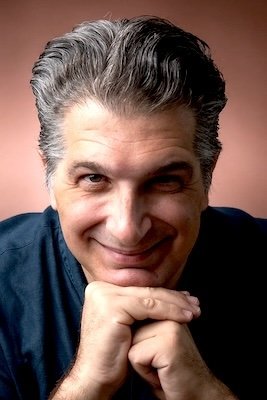
Over the decades there been alternate explanations of this or that event presented in a production of the opera. Director Muscato has enunciated some illuminating and persuasive ideas about the characters, often “connecting dots” between one idea and another.
Muscato presents the trio of Gustavus, Renato and Amelia as a three-way friendship that began in their youths. Long before the opera begins, the non-royals – Renato and Amelia – had married and had a child together. Yet Amelia and Gustavus both harbored deeply repressed romantic feelings for one another, that recently had risen to their consciousness. The married Amelia was determined to rid herself of those feelings. The king was much less willing to do so.
The opera begins with a pantomime in which Gustavus and Renato engage in a mock sword fight. That fight is the subject matter for a painting by Amelia that will hang in Renato’s and Amelia’s home. (It is to that painting that Renato will sing one of Verdi’s greatest baritone arias).
The assistant director was Argentine-born Jose Maria Condemi.
The cast and musical performance
The cast, led by American tenor Michael Fabiano and Armenian soprano Lianna Haroutounian, was uniformly excellent throughout the opera’s seven principal and comprimario roles, as well as the several smaller role.
Michael Fabiano’s King Gustavus
[Photo: Michael Fabiano as King Gustavus; edited image, based on a Cory Weaver photograph courtesy of the San Francisco Opera.]

New Jersey tenor Michael Fabiano was an attractive presence – in superb voice from his lead in the opening chorus through a series of scenes over three acts.
Some of the scenes were light-hearted, some deeply emotional, some tragic. Fabiano’s vocal expressiveness was inherent in every carefully expressed phrase. Especially notable were Fabiano’s later contributions to the Ulrica scene – Gustavus’ cheerful barcarolle ‘Di’ tu se fedele il flutto m’aspetta’ and Gustavus’ amused lead role in the quintet ‘E scherzo od e follia’.
The opera’s tragic finale consists of the dying King Gustavus pardoning those who plotted his death, and Gustavus assuring Renato of Amelia’s innocence.
Fabiano, since his San Francisco Opera debut in the bel canto role of Gennaro [Review: Fleming, Fabiano, Frizza Fuel San Francisco Opera’s Flaming, Fulfilling First “Lucrezia Borgia” – September 23, 2011 ] has been an audience favorite at the War Memorial Opera House.
He has displayed stylistic mastery in performing French opera.[Review: An Exquisitely Sung “Manon” with Ellie Dehn and Michael Fabiano – San Francisco Opera, November 4, 2017]. Additionally, he has excelled in the operas of Verdi [e.g., Review: A Legendary Performance of “Don Carlo” at the San Francisco Opera, June 12, 2016] and of Puccini [e.g., Review: Karah Son, Michael Fabiano Lead Brilliant Cast in Amon Miyamoto’s Fascinating Production of “Madama Butterfly” – San Francisco Opera, June 3, 2023].
See also my interview: Rising Stars: An Interview with Michael Fabian
Lianns Haroutounian’s Amelia
[Photo: (Lianna Haroutounian) seeks an herb in a desolate place; edited image, based on a Cory Weaver photograph, courtesy of the San Francisco Opera.]
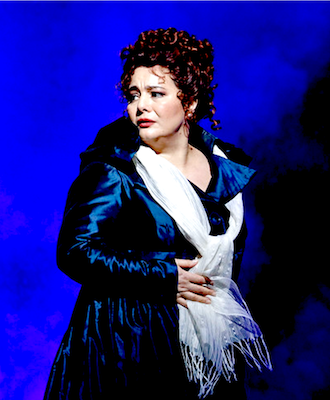
Armenian soprano Lianna Haroutounian returned to the War Memorial Opera House as Amelia. She first sings during a secret meeting with the fortune teller Ulrica (whose abode is simultaneously being visited by Gustavus and members of his court, all in disguise).
Amelia, consumed by the awakening of her repressed romantic feelings for Gustavus and seeking Ulrica’s advice on how to dispel them, is advised to harvest an herb that grows near a gallows at midnight. Musically, that advice results in a terzetto between Amelia and Ulrica (discreetly joined by the hidden Gustavus), one of the many vocally glorious ensembles of this performance.
In retrospect, we understand that Ulrica’s prescription on how and where to gather a particular herb is the first of a series of events, all involving Amelia, that results in Gustavus’ death. It directly sets up, at the beginning of the second act, one of the supreme scenes for a Verdian dramatic soprano, Amelia’s appearance in the desolate surroundings of a hangman’s gallows.
Haroutounian, framed by Italian designer Federica Padolini’s smoky sets, delivered Amelia’s plaintive aria Ma dall’arido stelo divulsa flawlessly. Her ensuing duet with Fabiano’s Gustavus was one of the performance’s many high points.
Over the past decade, Haroutounian has appeared at the San Francisco Opera in four different Italian verismo roles: as Tosca [Review: Lianna Haroutounian Triumphs as Tosca – San Francisco Opera, October 23, 2014], as Cio-Cio-San [Review: A Transcendent “Madama Butterfly”, San Francisco Opera, November 6, 2016], as Nedda [Review: Thrilling Performances in San Francisco Opera Season Opening “Cavalleria Rusticana/Pagliacci” Part II, September 7, 2018] and as Manon Lescaut [Review: A Passionate “Manon Lescaut” Led by Luisotti, Haroutounian and Jagde – San Francisco Opera, November 8, 2019].
Her Amelia suggests she is equally at home in the Verdian soprano repertory.
Amartuvshin Enkhbat’s Renato
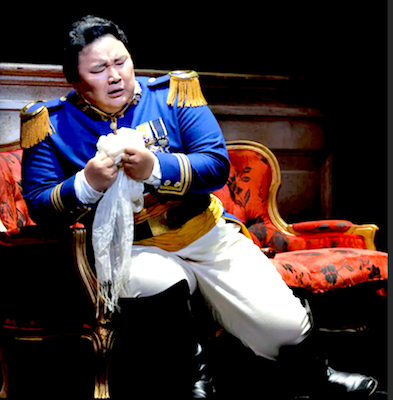
[Photo: Renato (Amartuvshin Enkhbat] iis is emotionally distraught from the appearance of his wife’s infidelity; edited image of a screenshot from a San Francisco Opera performance livestream.]
 s
s
Mongolian baritone Amartuvshin Enkhbat made his San Francisco Opera debut as Gustavus’ long-time best friend, Renato.
He first appears soon after the opera begins to perform the aria ‘Alla vita che t’arride’. That aria introduces two themes, how beneficial Gustavus’ reign is to the people of Sweden and the dangers to Gustavus’ reign from a group of conspirators who are plotting to kill him. Enkhbat performed the aria admirably, his sonorous baritone employed to praise and to try to protect his friend.
In the third act, Enkhbat’s Renato, blindsided by his wife Amelia’s apparent sexual liaison with Gustavus, impactfully performed one of the grandest of Italian baritone arias, ‘Eri tu, che machiavi quell’anima’
The 38-year old baritone was first prize winner at Placido Domingo’s 2012 Operalia Contest in Beijing, China (sharing first place with two San Francisco Opera favorites, countertenor Anthony Roth Costanzo and soprano Janai Brugger). In 2015 he took home the Joan Sutherland Audience Prize at the 2015 BBC Cardiff Singer of the World competition.
Mei Gui Zhang’s Oscar
[Photo: Oscar (Mei Gui Zhang) is tasked with delivering invitations to a masked ball; edited image, based on a Cory Weaver photographm courtesy of the San Francisco Opera.]
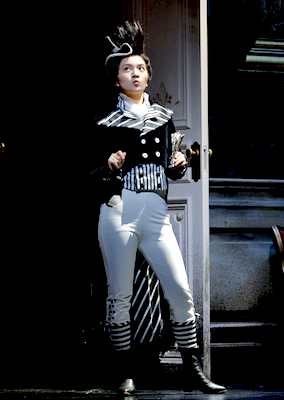
Playing the role of the page Oscar is Chinese soprano Mei Gui Zhang. Oscar is one of Verdi’s most exotic creations, and the exception to the composer’s rule of avoiding assigning male characters to female artists.
As the adolescent companion to the Gustavus/Riccardo lead role, Oscar appears in every scene in which the lead tenor appears and in the scene in Renato and Amelia’s household, in which the lead tenor is not present.
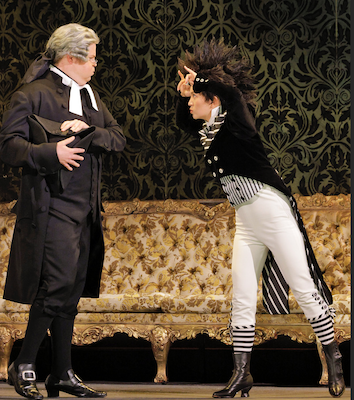
Zhang’s Oscar, taunting Sweden’s chief justice and inspiring Gustavus to visit a fortune teller’s abode to judge for himself whether she deserves banishment, comes across as a socially aware youth with street smarts. Vocally, Zhang performed in each of the five scenes in which the character appears, admirably exhibiting a bright-sounding coloratura, often embellished with fluttery hand movements.
This is the third Mei Gui Zhang perfomance review I have conducted, preceded by her performances as Dai Yu [Review: A Pleasing Revival of “Dream of the Red Chamber” at San Francisco Opera, June 14, 2022] and by her Euridice [Review: Orlinski’s Astounding, Acrobatic Orfeo: “Orfeo ed Euridice”, San Francisco Opera, November 20, 2022].
Judit Katasi’s Ulrica
[Photo: Ulrica (Judit Kutasi, left) disturbs King Gustavus (Michael Fabiano, right) by predicting his death at the hand of a friend; edited image, based on a Cory Weaver photograph, courtesy of the San Francisco Opera.]
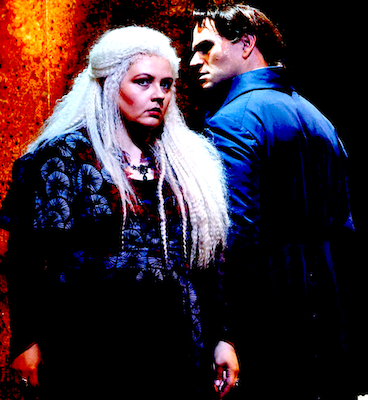
Less than a year before this performance, Romanian mezzo-soprano Judit Kutasi madeher San Francisco Opera American debut as Ortrud [Review: A Musically, Visually Satisfying “Lohengrin” – San Francisco Opera, October 15, 2023].
Kutasi returned to the War Memorial Opera House as the fortune-teller Ulrica.
Kutasi’s luxurious, warm mezzo was fully in evidence in her ‘invocazione’, the mysterious ‘Re dell’abisso affrettati.’
Adam Lau’s Samuele and Jongwon Han’s Tom
[Photo: the conspirators Tom (Jongwon Han, left) and Samuele (Adam Lau, center) are suspicious of the entreaty of Renato (Amartuvshin Enkhbat, right) to let him join their conspriracy to assassinate the king; edited image, based on a Cory Weaver photograph, courtesy of the San Francisco Opera.]
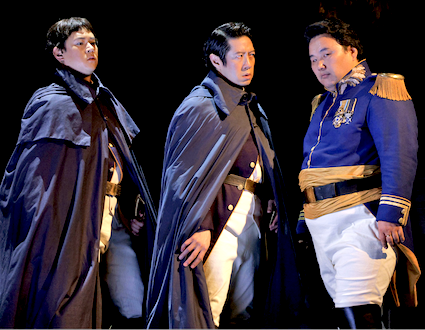
The two conspirators Samuele and Tom were performed respectively by California bass Adam Lau and Korean bass-baritone Jongwon Han. Both were impressive in their roles of would-be regicides and were vocally strong, convincing actors,
On the occasion of Lau’s San Francisco Opera debut as Dr. Grenvil [Review: “La Traviata” Delightful New Production, Well-Received Debuts by Yende, Tetelman and Piazzola – San Francisco Opera, November 22, 2022] I made reference to previous reviews of Lau operatic performaces at Florida Grand Opera in 2013 and at the Seattle Opera in 2019.
A current Adler Fellow, Han has previously performed two important comprimario roles, the Bonze [Review: Karah Son, Michael Fabiano Lead Brilliant Cast in Amon Miyamoto’s Fascinating Production of “Madama Butterfly” – San Francisco Opera, June 3, 2023] and the Speaker i[Review: Barrie Kosky’s Production of Mozart’s “The Magic Flute” – San Francisco Opera, June 2, 2024]
Samuel Kidd’s Cristiano and Other Cast Members
[Photo: Samuel Kidd as Christiano; edited image, based on a Cory Weaver photograph, courtesy of the San Francisco Opera.]
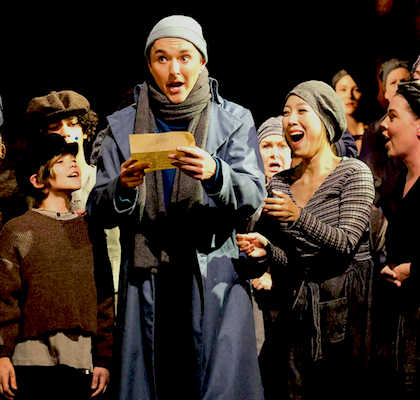
Michigan baritone Samuel Kidd, a current Adler Fellow, brought passion to the sailor Christiano’s aria that praised Gustavus.
Georgia tenor Christopher Ogelsby was amusing in,the role of the Chief Magistrate, who finds himself mocked by Gustavus’ companion, Oscar.
Oglesby is developing the diverse repertory of a character tenor.
Welsh tenor Thomas Kinch was Amelia’s servant.
[Photo: an impudent Oscar (Mei GUi Zhang, right) taunts Sweden’s Chief Magistrate (Christopher Oglesby, edited image, based on a Cory Weaver photograph, courtesy of the San Francisco Opera.]
Maestra Eun Sun Kim and the San Francisco Opera Orchestra and Chorus
For this production of “Ballo in Maschera” San Francisco Opera’s music director, Maestra Eun Sun Kim, repositioned key members of the San Francisco Opera Orchestra.
The resulting changes created a spectacular sound, particularly noticeable in the cello solos of Evan Kahn and the harp accompaniment of the impassioned Act II duet between Fabiano’s Gustavus and Haroutounian’s Amelia. The resulting orchestral performance was resplendant.
The San Francisco Opera Chorus, under the direction of Pennsylvania chorus master John Keene, produced the brilliant sound for which it is renowned.
Dance Master Colm Seery’s Choreography
[Photo: A dance and musical interlude takes place priot to the final scenes of Verdi’s “Un Ballo in Maschera”; edited image based on a Cory Weaver photogtraph, courtesy of the San Francisco Opera.]
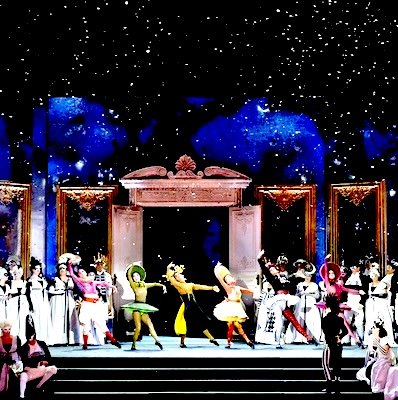
Although Muscato’s production originated at the Teatro dell’opera di Roma, Irish dance master Colm Seery was given the opportunity to create new dances for the final act’s masked ball.
Seery devised elaborate dance regimens, in which elegantly-costumed solo dancers were engaged in eye-catching performances on a raised portion of the stage.
At other points in the ball scene, members of the opera’s chorus were paired in dances.
The dances provided the cover through which Amelia, Oscar and Gustavus could surreptitiously communicate and the conspirators Renato, Tom and Samuele could hide.
Seery’s choreography provided one of the most elegant masked balls in memory.
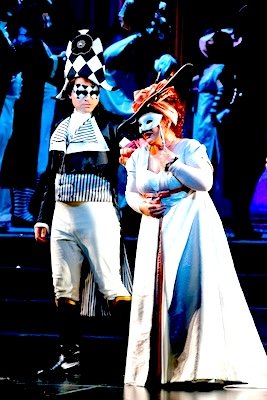
[Photo: Amelia (Lianna Haroutounian right), having learned which costume Gustavus (Michael Fabiano, left) is wearing, warns him of the assassination plot; edited image, based on a Cory Weaver photograph, courtesy of the San Francisco Opera.]
Designers Federica Parolini’s Sets and Alessandro Verrazzi’s Costumes
The “Ballo” sets, created by designer Federica Parolini, were mounted on a turntable that accommodated each of the scenes and provided a spacious area for the final scene’s masked ball.
Alessandro Verrazzi’s costumes were beautifully conceived, befitting an Enlightenment era royal court.
The domino-themed masked ball costumes were especially attractive.
[Photo: the back wall of the final scene of “Ballo in Maschera”; edited image, based on a Cory Weaver photographm courtesy of the San Francisco Opera.]

Recommendation
I enthusiastically recommend San Francisco Opera’s Leo Muscato production of “Un Ballo in Maschera” to both the veteran opera goer and to persons new to opera.