Note from William: This post continues my series of observances of historic performances that I attended at San Francisco Opera during the general directorship of Kurt Herbert Adler. This is the second of sixteen such observances of performances from the company’s 1965 Fall season.
My Saturday series at the San Francisco Opera had three performances scheduled for September 1965. I’ve already described the first [Historical Performances: Jess Thomas’ Victorious “Die Meistersinger” – San Francisco Opera, September 11, 1965].
The next Saturday night would be my first Johann Strauss’ “Die Fledermaus”. Later on my series I would be able to see the legendary soprano Renata Tebaldi’s return to the San Francisco Opera in Giordano’s “Andrea Chénier”.
“Chénier”, one of my favorite operas going back to early teenage years, had opened the season on September 10th, but only three performances were scheduled.
Although Tebaldi was in all three performances, the title role on my Saturday night series (on October 2) was to be the Brazilian tenor Joao Gibin, while the first two performances were assigned to American tenor Richard Tucker.
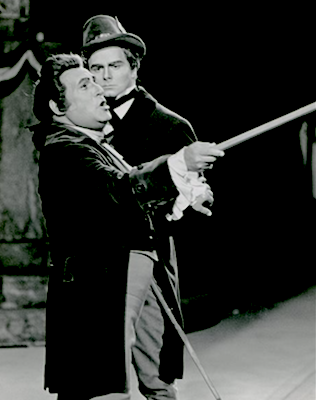
[Photo: The poet Andrea Chénier IRichard Tucker, front) is observed by the revolutionary Carlo Gerard (Ettore Bastianini, behind); edited image, based on a Carolyn Mason Jones photograph, courtesy of the San Francisco Opera Archives.]
Since I had experienced disappointment in the past holding a Tebaldi performance ticket when she withdrew for one of the illnesses that plagued her, and had seen her perform only once, I thought it would be prudent to attend a couple of scheduled Tebaldi performances not on my series.
I purchased a seat for a Tebaldi-Konya “Boheme”. Then, on the day of the second “Andrea Chénier” I decided to get a standing room ticket for that evening’s performance. That “Chénier” would also be my only chance that season to see Richard Tucker perform in opera. As it turned out, it was the only opera in which I ever saw Tucker.
In order to see Tucker and Tebaldi together, I did all my college homework due the next day and left for the War Memorial Opera House.
Richard Tucker’s Andrea Chénier
[Below: Richard Tucker as Andrea Chénier in the 1965 production of Giordano’s “Andrea Chénier”; resized image of a production photograph for the San Francisco Opera.]

In March of 1965, the San Francisco Opera announced its Fall 1965 season, which was to include a trio of superstar Italian artists in the lead “Andrea Chénier” roles – tenor Franco Corelli, (in what was to be his San Francisco Opera debut season), Tebaldi as Maddalena, and baritone Ettore Bastianini as Gerard.
However, a foot injury sidelined Corelli for most of the season, including his announced assignments as Dick Johnson in Puccini’s “”La Fanciulla del West”. He arrived in November for a performance as Mario Cavaradossi in “Tosca”, which he repeated on the Southern California tour to Los Angeles (his only two San Francisco Opera performances ever).
Replacing Corelli for the first two of his three scheduled performances, was Tucker, Tebaldi’s Chénier of a decade earlier. Two years after their first San Francisco Opera appearance together, I had seen Tebaldi perform with Tucker on NBC’s ‘The Ed Sullivan Show’ singing Chénier’a and Maddalena’s glorious final duet ‘Vicina a te s’acquesta’.
Tucker and his RCA Victor recording colleagues
Among the RCA Victor stars were several male artists, based in New York City and associated with the New York Metropolitan Opera. I had seen three major recording artists,
The three were tenor Jan Peerce, whom I had seen opposite soprano Licia Albanese in my first opera [Historical Performances: Peerce, Albanese, Siepi and MacNeil in “Faust”, San Francisco Opera Fall Tour, San Diego, November 3, 1955], baritone Leonard Warren, who was Boccanegra opposite Tebaldi in my first Italian opera ever [[Historical Performances: “Simon Boccanegra” with Warren, Tebaldi and Christoff, San Francisco Opera in Los Angeles – October 20, 1956] and baritone Robert Merrill, who was Gemont to the Violetta of soprano Leyla Gencer [Historical Performances: San Francisco Opera’s “La Traviata” in San Diego Stars Leyla Gencer, Robert Merrill – October 31, 1957].
Each the artists I had seen only once, and each, by 1965, had completed their career association with the San Francisco Opera.
Tucker and each of the other three artists had descended from Jewish families who settled in New York City. Peerce, Tucker and Merrill had received training in the vocally rich cantorial tradition.
Tebaldi previously had sung the role of Maddalena di Coigny for San Francisco Opera in 1955, when her colleagues were Tucker in the title role and Leonard Warren as Carlo Gerard, unambiguously a superstar trio.
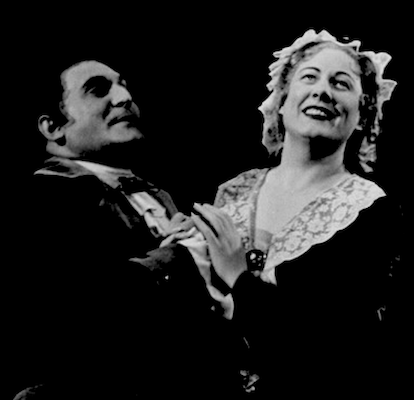
[Below: Andrea Chénier (Richard Tucker,left) and Maddalena di Coigny (Renata Tebaldi, right) in the San Francisco Opera’s 1955 mounting of Giordano’a “Andrea Chénier”; edited image of a historical photograph.]
Chénier sings a big aria in every one of the four acts and hearing Tucker’s ‘Come un bel dì di maggio’ and final duet with Tebaldi is one of that season’s great memories.
(I was fortunate to be offered an upfront orchestra seat for the final two acts by a patron who apparently thought that Tucker, Tebaldi and Bastianini were not sufficiently interesting for him to stay until the end.)
This evening was to be Richard Tucker’s final performance with the San Francisco Opera. He had appeared only in San Francisco Opera’s 1954, 1955 adn 1965 seasons, six times at the War Memorial Opera House, twice on tour at the Los Angeles Shrine Auditorium. Four of these eight performances were as Chénier.in 1955 and 1965.
Renata Tebaldi’s Maddalena di Coigny
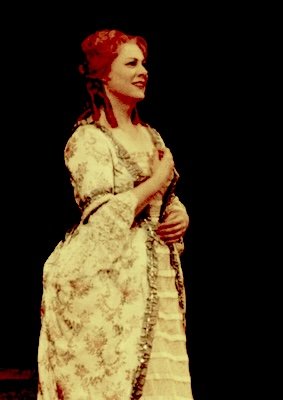
[Photo: Maddalena di Coigny (Renata Tebaldi); edited image of a Robert Cahen photograph, courtesy of the San Francisco Opera.]
My personal journey as an opera goer dates back to my elementary school days in the early 1950s, a time in which the “operatic scene” was quite different from the present.
My earliest experiences with opera had been through the long-playing vinyl operatic recordings that appeared in the early 1950s, including those of RCA Victor, Tucker’s label, and Decca, for whom Tebaldi recorded.
It was a time when operas originally recorded on albums of bulky ’78 records were being rerecorded on the relatively new 33 1/3 vinyl records, The standard operatic repertory was receiving new recordings with the major operatic stars of the time, with most of those “complete” operas observing the “standard performance cuts” that were observed in virtually all operatic live performances.
By the time I was in sixth grade I had begun collecting “long-playing” symphonic records. Soon, as a junior high school student, my father bought me my first operatic recording – Tebaldi’s first Decca recording of Puccini’s “La Boheme” and found myself entranced by her large, creamy vocal delivery.
I began frequenting the classical departments of record stores located on San Diego’s Broadway Avenue, with a fellow classmate, Stephen, who had already assembeld a sizable operatic record collection. Although even then I had eclectic operatic tastes, I considered myself a ‘tebaldiano’ and assembled an impressive collection of Tebaldi’s vinyl recordings – which I retain to the present day.
My dedication to Tebaldi as a recording artist was a driving force in my determination to see her in live performance at San Francisco Opera’s War Memorial Opera House, which, though large by European opera house standards, was only half the size of the only venue (the Los Angeles Shrine Auditorium) in which I had seen her perform previously.
[Photo: A revolutionary scene from director Lotfi Mansouri’s 1965 San Francisco Opera mounting of “Andrea Chénier”; edited image, based on a Carolyn Mason Jones photograph, courtesy of the San Francisco Opera Archives.]
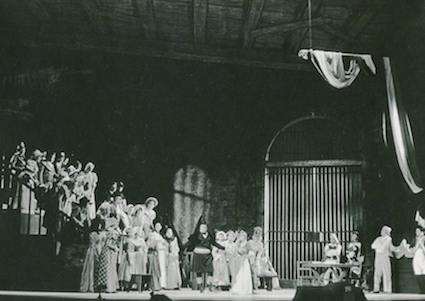
Already, I had experienced performances at the War Memorial Opera House by other world famous operatic recording artists, such as Tito Gobbi, Victoria de los Angeles, Elizabeth Schwarzkopf, Birgit Nilsson and Jon Vickers.
Seeing and gearing Tebaldi, with Tucker and Bastianini, in the first half of the opera as a standee at the opera house was a thrilling experience, made memorable by a gentleman with orchestra tickets, who, for whatever reason decided to leave the performance early and offered me, a standee, his orchestra ticket.
Thus, I was able to see Tebaldi and Tucker seated in the War Memorial’s acoustically rich orchestra section. Here I was viewing director Lotfi M<ansouri’s dramatic presentation of Giordano’s opera up close. I was experiencing Tebaldi’s superb third act “La Mamma Marta” and enjoying the lush music of the Andrea’s and Maddalena’s final duet.
Ettore Bastianini’s Carlo Gérard
[Below: Ettore Bastianini as Carlo Gérard; edited image of a Carolyn Mason Jones photograph, courtesy of the San Francisco Opera Archives.]
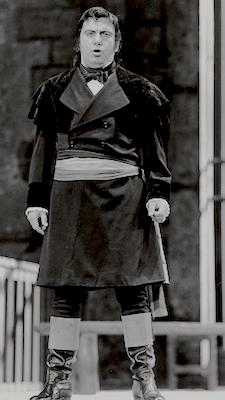
The third member of the trio of principals was Italian baritone Ettore Bastianini, whose performance of Gérard’s sinister aria ‘Nemico della patria’ was one of the evening’s highlights.
Bastianini’s appearances in the two performances of the opera I attended proved to be poignant. Although Bastianini was only 42, he was suffering from an incurable throat cancer.
Within the next few weeks, he would sing the final performances of his career., retiring in December, 1965. By early 1966, he was dead.
I will have more to say about Bastianini in my observance of the October 2 performance. However, both of the performances that I heard and saw that year were extraordinary, confirming that he was one of the most impressive Italian baritones of the 20th century.
Two nights later, I would be back at the opera house for Johann Strauss’ “Die Fledermaus”.