
The first performance of “Die “Walküre” in Santa Fe Opera history took place on July 26, 2025. This is a review of the second of five scheduled performances of Santa Fe Opera’s 2025 season.
Tamara Wilson’s Brünnhilde
[Photo: Tamara Wilson as Brünnhilde; edited image, based on a Curtis Brown photograph, courtesy of the Santa Fe Opera.]
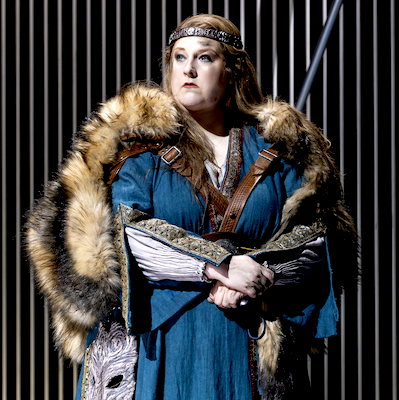
IIn her debut season, Illinois soprano Tamara Wilson was the first artist in Santa Fe Opera history to sing the Wagnerian dramatic soprano role of Isolde [Review: A Praiseworthy New Mexico “Tristan und Isolde” – Santa Fe Opera, August 5, 2022]. She now adds the first performance of the “Walküre” Brünnhilde to this prestigious achievement
Wilson performed the role of the valkyrie Brünnhilde, favorite daughter of Wotan, ruler of the gods. Brünnhilde first appears in the second act of “Walküre”, the second opera of Wagner’s “Ring of the Nibelung”. The character’s emotional journey is a major theme of Wagner’s epic “Ring”.
Wilson possesses the powerful dramatic soprano voice required for the role, and has the important quality of conveying to an audience the emotional turmoil that so often faces this iconic character. Brünnhilde is the daughter, confidante and enabler of the king of the gods. She wrestles with what she understands is her obligation to obey his every command. Simultaneously, she advocates for what she believes Wotan really desires, rather than what Wotan feels compelled to require.
Wilson projected Brünnhilde’s emotional journey in a beautifully sung, persuasively acted, performance, She sang the role’s showpiece passages authoritatively. Her ‘Todesverkundig’ aria informs Wotan’s son Siegmund that, instead of being victorious in a battle with Hunding, that he would die. Another highlight of the evening was her heart-wrenching final duet with Wotan. She persuades him to alter her punishment for disobeying his orders.
My first opportunity to attend a Wilson performance was 18 years ago in the Verdian dramatic soprano role of Amelia [Review: Vargas, Podles Brilliant in Puzzle Box “Ballo” – Houston Grand Opera, November 2, 2007] and later as Verdi’s Elisabetta di Valois [Review: Brandon Jovanovich Triumphant in Historic “Don Carlos” Production – Houston Grand Opera, April 13, 2012]. I also saw her performances as the ghostly Miss Jessel in Houston [ Review: Houston’s Haunting, Inscrutable “Turn of the Screw” – January 29, 2010] and Los Angeles [Review: Countdown to Britten Centennial – Conlon, Racette and Burden Impress in Enigmatic “Turn of the Screw” – Los Angeles Opera, March 12, 2011 ]
Ryan Speedo Green’s Wotan
[Photo: Ryan Speedo Green as Wotan; edited image, based on a Curtis Brown photograph, courtesy of the Santa Fe Opera.]
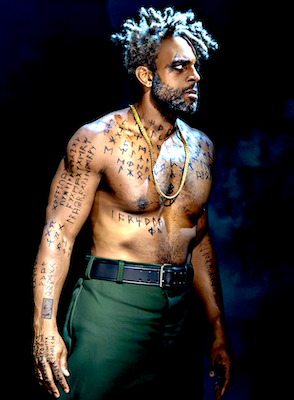
Virginia bass-baritone Ryan Speedo Green, whose role debut as the chief god Wotan took place four days earlier, demonstrated a mastery of this central role in Wagner’s ‘heldenbariton’ repertory. Green conveys power, not just vocally, but by his physical presence.
Wagner’s libretto and music set up the complex situations that the artists performing the “Ring” must interpret for the audiences. In the two “Walküre” acts in which Wotan appears, his master-plan for effecting the world’s future, utilizing his offspring, the Wälsungs (Siegmund and Sieglinde) crumbles. It is destroyed by Wotan’s wife, Fricka, who demonstrates that Wotan’s master plan contradicts his godly responsibilities. When his daughter Brünnhilde seeks to salvage Wotan’s plan against her father’s instructions, Wotan sees it as defiance to his authority, punishable by death.
Like Shakespeare’s plays, Wagner’s words and music require artists of great sensitivity to each character’s motives and emotions. Green performed the music as Wagner intended. Importantly, he was a convincing actor in portraying Wotan’s original motivations and the anger his character felt when forced to abandon what had been Wotan’s central purpose.
This was my second opportunity to attend a Green performance. In the previous Santa Fe Opera season, he showed his bel canto skills as Don Giovanni [Review: Stephen Barlow Creates an Elegant New “Don Giovanni” Production – Santa Fe Opera, June 29, 2024.] Praiseworthy performances of both Don GIovanni and Wotan by this internationally sought-after artist.demonstrate Green’s vocal flexibility that enables him to engage in such a wide-ranging repertory.
Jamez McCorkle’s Siegmund
[Photo: Janez McCorkle as Siegmund; edited image, based on a Curtis Brown photograph, courtesy of the Santa Fe Opera.]
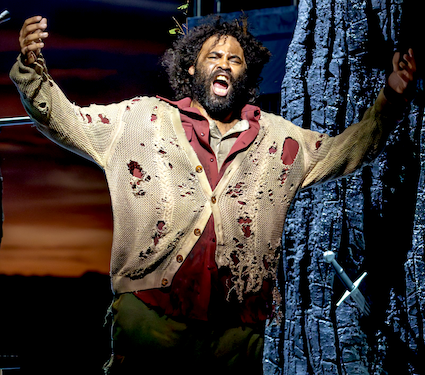
Louisiana tenor Jamez McCorkle portrayed Siegmund, the Wälsung son on whom Wotan had pinned his hope for a heroic agent to further his long-term objectives.
McCorkle embodied the emotional highs and lows of this conflicted character. McCorkle’s Siegmund was full of joy at finding his long-lost sister Sieglinde, who guides him to victory in wresting a magic sword from a tree. McCorkle excelled at Siegmund’s aria ‘Winterstürme wichen dem Wonnemont’ in which the male Wälsung makes clear his incestuous intentions regarding his Wälsung sister, Sieglinde. Siegmund goes where no other operatic character goes, with full knowledge that higher powers are pinning their hopes on him and his sister.
The tenor portraying Siegmund’s joy must also be convincing in the disaster that is to occur to him. His joy is dashed by his immortal half-sister Brünnhilde’s revelation that he would perish in his fight with Sieglinde’s cruel husband, Hunding. Siegmund’s pleading convinces Brünnhilde to disobey Wotan’s command, with fateful consequences. McCorkle (and Wilson) vocally and dramatically achieve what Wagner intended – believability.
Like Ryan Speedo Green, McCorkle’s repertory spans a diverse operatic repertory. McCorkle’s assignments include such tenor roles besides Wagner’s Siegmund as Tamino in Mozart’s “The Magic Flute”. As an example of McCorkle’s contemporary repertory, I had first observed McCorkle’s vocal and acting skills in the opera “Omar”, in whose title role he excelled [See: Review: Ovations for “Omar”, Giddens’ and Abels’ Remarkable Opera – San Francisco Opera, November 5, 2023/]
Vida Mikneviciute’s Sieglinde
[Photo: Vida Mikneviciute as Sieglinde; edited image, based on a Curtis Brown photograph, courtesy of the Santa Fe Opera.]
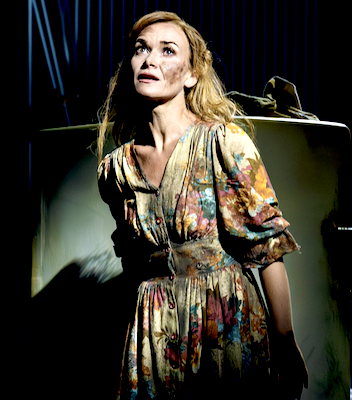
Lithuanian soprano Vida Mikneviciute performed the role of Sieglinde. This was my first opportunity to hear her. She had made her North American debut only four days earlier.
Mikneviciute is petite in height, a feature especially noticeable when standing next to McCorkle or Howard, the artists performing the roles of Siegmund and Hunding. So it was a pleasant surprise when she produced a voluminous sound that confirmed a Wagnerian soprano of the first rank.
Mikneviciute proved to be an engaging actor as well. Her passionate physicality was obvious, especially in her interactions with McCorkle’s Siegmund, who would lift her off the floor while embracing her.
The only member of the cast to appear in all three acts, Mikneviciute drew audience synpathy, first as Hunding’s battered spouse and second as a refugee pregnant with the hero whom we will come to know as Siegfried.
Sarah Saturnino’s Fricka
[Photo: Sarah Saturnino as Fricka; edited image, based on a Curtis Brown photograph, courtesy of the Santa Fe Opera.]
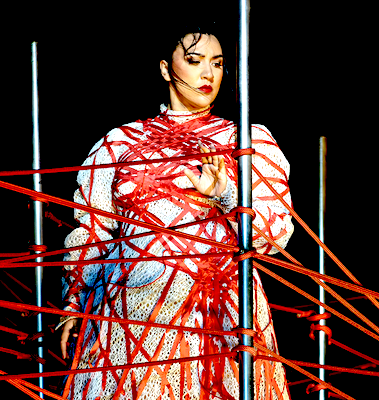
California mezzo-soprano Sarah Saturnino, in the role of Wotan’s wife, Fricka, displayed yet another voice of power and beauty. As the god protecting marriage, Fricka was deeply offended by Siegmund and Sieglinde’s incestuous lovemaking, and Sieglinde’s simultaneous infidelity to Hunding.
The confrontation between Saturnino’s Fricka and Green’s Wotan was one of the evening’s many highlights. A turning point in the opera’s plot, Fricka’s fury dislodges Wotan from his decades-old strategic plan. Fricka’s clever tactic, insisting that anything that dishonors Wotan’s wife, dishonors Wotan as well, creates a schism between Wotan and his most trusted ally, Brünnhilde.
Saturnino, a Metroplitan Opera National Auditions winner, received training both as a Santa Fe Opera Apprentice and a member os Los Angeles Opera’s young artists’ program.
Soloman Howard’s Hunding
[Photo: Soloman Boward as Hunding; edited image, based on a Curtis Brown photograph, courtesy of the Santa Fe Opera.]
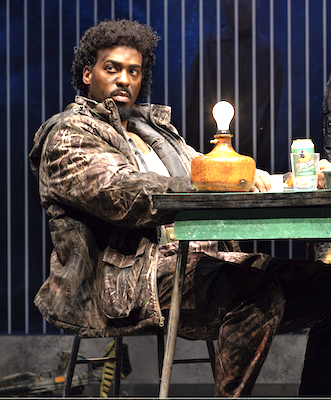
District of Columbia bass Soloman Howard’s majestic voice proved to be most appropriate for a Wagnerian villain. Howard gave a masterful performance as an abusive husband. His characterization of the brooding Hunding was sufficiently treacherous to win audience sympathy for Sieglinde’s turmoil.
My review of Howard’s Colline, his other role in the current Santa Fe Opera season [Review: Memorable “La Boheme” Led by Sylvia D’Eramo, Long Long, Szymon Mechlinski and Emma Marhefka, Santa Fe Opera, July 28, 2025], listed several of his performance credits.
Since I have noted that the cast’s two other male principals have borh Mozart and Wagner roles in their repertories, it is appropriate also to cite an excellent appearance by Howard as Mozart’s Sarastro [Review: Sean Panikkar, So Young Park Brilliant in Madeline Sayet’s “Magic Flute” – Glimmerglass Festival, July 20, 2015].
The Eight Valkyrie Sisters
[Photo: first row, left to right, Waltraute (Gretchen Krupp), Helmwige (Jessica Faselt), Rossweisse (Deanna Ray Eberhart) and Siegrune (Aubrey Odie); second row, between Waltraute and Helmwige, Gerhilde
(Jasmin Ward); between Helmwige and Rossweise, Grimgerde (Lauren Randolph) and Ortlinde (Wendy Bryn Harmer); between Rossweise and Siegrune, Schwertleite (Jennifer Johnson Cano); edited image, based on a Curtis Brown photograph, courtesy of the Santa Fe Opera.]
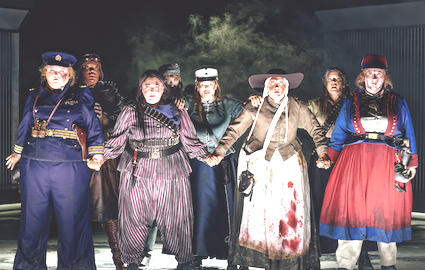
The costuming of the individual valkyries, the production creator (Melly Still) explains, is meant to represent the time and place that each valkyrie was born (in this production, the earliest in Celtic times, the latest at a time Wagner was still alive). The activities in which the valyrkies engage when they assemble at the beginning of the third act are both frantic and mostly remote from view, so there is little chance to absorb the significance of the individiual dress styles.
Visiting artists who performed valkyrie sisters were Iowa soprano Jessica Faselt (Santa Fe Opera debut) as Grimgerde; California soprano Wendy Bryn Harmer as Ortlinde; Missouri mezzo-soprano Jennifer Johnson Cano as Schwertleite and Virginia mezzo-soprano Gretchen Krupp as Waltraute.
2025 Santa Fe Apprentice artists performing valkyries were, as Gerhilde, Virginia soprano Jasmin Ward; as Grimgerde, Illinois mezzo-soprano Lauren Randolph; as Rossweisse, Missouri mezzo-soprano Deanna Ray Eberhart, and, as Siegrune, Oregon mezzo-soprano Aubrey Cole.
Maestro James Gaffigan and the Santa Fe Opera Orchestra
New York conductor James Gaffigan led the Santa Fe Opera Orchestra in an authoritative reading of Wagner’s score, in which the the Santa Fe Opera Orchestra sounded brilliantly. This is my third Santa Fe Opera performance review of Gaffigan’s strong presence in the German opera repertory, preceded by a masterwork of Richard Strauss [Review: Santa Fe Opera’s Delectable New “Ariadne auf Naxos” – Santa Fe Opera, July 28, 2018] and the 2022 season’s “Tristan und Isolde”, referenced above.
Melly Still’s Production and Leslie Travers’ Scenic Desig
[Photo: Wotan (Ryan Speedo Green) creates a barrier of magic fire to shield his sleeping daughter from being awakened by anyone other than the bravest hero; edited image, based on a Curtis Brown photograph, courtesy of the Santa Fe Opera.]

This production of “Walküre” is English director Melly Still’s Santa Fe Opera debut, although I have reviewed her work elsewhere [See Review: Powerful Performances by Martinez, Jagde in “Rusalka” – Houston Grand Opera, January 29, 2016]. Still has explained her general philosophy on this work, that the story itself can be appreciated not only by the Wagner opera aficionado, but also by a person seeing the work for the first time. I concur with her statement and believe she succeeded in producing a clearly understandable presentation of the story line.
Still’s production incorporated the physical sets created by the brilliant English designer Leslie Travers, whose past work that I have admired includes operas of Richard Strauss, [Review: Penda, McKinny, Brubaker, Jagde Impress in Daniel Slater’s Psychiatrically Searing “Salome” – Santa Fe Opera, July 31, 2015 and Mozart [Review: A Captivating “Marriage of Figaro” Opens San Diego Opera’s 54th Season – October 20, 2018] as well as the 2016 Houston Grand Opera “Rusalka” with Melly Still referenced above.
Some details did not work for me. Still explains why Hunding’s house has early 20th century kitchen appliances. (She says it makes us feel the humanity of the first act’s three mortals – the Walsung twins and Hunding). I’ve previoussly mentioned the incongruity of the valkyrie costumes. Notably, neither Sieglinde’s kitchen appliances nor the valkyrie costumes are visible for very long.
Leslie Travers sets have three main parts. The first is ithe central stage floor. The second is a permeable backwall that separates the world of the gods from the world of humans. The backwall is made of strands of a material through which the gods can pass into the mortal world. We in the audience can see and sometimes identify characters going about their business. The third part is an upper balcony. From the latter, Fricka can determine whether mortals are correctly observing her rules of marriage. “Ring” experts might have a great time guessing what each image behind the backwall or on the balcony they see is meant to represent. But none of the backwall or balcony activities or dark shadowy shapes one sees from time to time slows down or detracts from the presentation of the story.
Recommendation
I strongly recommend this cast and production both to the veteran opera-goer and the person new to opera.