
A Weekend of Schuller’s “The Visitation” and Donizetti’s “L’Elisir d’Amore”
During a three-day mid-October 1967 weekend in San Francisco, I experienced my first ever performances of Charpentier’s “Louise” and Puccini’s “Manon Lescaut”, followed by a stellar performance of “Der Rosenkavalier”.
Two weeks later, I returned for a Saturday evening-Sunday matinee weekend consisting of the American premiere performance of Gunther Schuller’s “The Visitation” and the third performance of a new Lotfi Mansouri production of Donizetti’s “The Elixir of Love”.
“The Visitation” was the first new operatic work I had seen performed by the main company. (In the previous year, I had attended the world premiere of Douglas Moore’s “Carry Nation” performed by the company’s budget-priced Spring Opera Theater [SPOT]).
Schuller’s work, whose world premiere took place at the Hamburg Staatsoper the previous October, was a reimagining of Kafka’s posthumous novel “The Trial” (published in 1925). The novel’s plot, which, if not spawning, certainly reinforced the application of the adjective “Kafkaesque” to an individual finding himself battling a mysterious indictment, hurled at him by a bureaucratic state. In Schuller’s’ opera, that plot was transformed to the United States, where an African-American, Carter Jones, a civil rights activist, becomes such a victim of a vengeful bureaucratic state.
I found myself at issue with both the opera’s libretto and its musical style. I personally had supported, with money and marching, the goals of the pro-integration Student Nonviolent Coordinating Committee. Thus, I found it hard to fathom that Schuller, the opera’s librettist as well as composer, would associate the lead character of “The Trial” (himself oppressed by the society of which he was part) with an pro-integration activist. Carter Jones was fighting for societal change that would permit members of his race to become equals in what apparently would be Schuller’s imagined Kafkaesque society.
Schuller’s music was generally atonal, interspersed by a combo of eight jazz musicians. The idea of incorporating seemingly improvisational jazz into contemporary opera was worthy of attention, but, overall, I found myself unpersuaded that “The Visitation” would secure a place in opera’s standard performance repertory.
The 44-member cast included such luminaries as bass Simon Estes, making his San Francisco Opera main company debut as Carter Jones, as did Swedish tenor Ragnar Ulfung in the role of Chuck. Although Swedish baritone Ingvar Wixell had already made his San Franciso Opera debut as Sergeant Belcore in the opening performance of “L’Elisir d”Amore”, my first time seeing him perform was as the scurrilous lawyer Chad in this Saturday evening “Visitation”.
San Francisco Opera and the Elixir of Love
The next afternoon, the matinee of the season’s third and final performance of “L’Elisir d’Amore” was a very different experience. This was my first opporutnity to see this second most famous opera for which the Knight Tristan’s and Queen Isolde’s act pf drinking a love potion is a central feature of its plot.
Curiously, until the 1967 season, San Francisco audiences had experienced a total of only four company performances of “L’Elisir d’Amore (one in 1929, one in 1948 and two in 1956), but each of those four performances enlisted one or more reigning stars of the first five decades of the 2oth century.
The Adinas included Bidu Sayao (1948) and Patrice Munsel (1956). The Nemorinos included Tito Schipa (1929) and Ferruccio Tagliavini (1948) The Belcores included Tito Gobbi (1948) and Louis Quilico (1956). Salvatore Baccaloni (1948) and Italo Tajo (1955) both performed as the charlatan Doctor Dulcamara.
Like the Gunther Rennert “Barbiere of Siviglia” of the 1963 season, an important new production was created that would be revived in multiple succeeding seasons. Lotfi Mansouri’s “L’Elisir” production would return five times in the next 33 seasons.
Reri Grist’s Adina
[Photo: Reri Grist as Adina; edited image, based on a production photograph, courtesy of the San Fransico Opera Archives.]

New York soprano Reri Grist, one of mid-20th century artists familiar with both the Broadway and operatic stages, was enlisted for the role of Adina. This was Grist’s 11th San Francisco Opera role since her career-advancing role as Rosina [see Historical Performances: Grist, Valletti, Prey in “Barbiere di Siviglia” – San Francisco Opera, September 28, 1963].
I was fortunate to see Grist, the company’s leading lyric-coloratura soprano during the five seasons of 1963 and 1967, perform in ten of the 11 roles she sang during those five seasons, (all except for that the Burgundian Lady in Orff’s “Carmina Burana”, which she peformed only once in 1964.)
I saw six of Grist’s major roles in two different seasons – Rosina (1963 and 1965), Susanna (1964 and 1966), Sophie (1964 and 1967), Oscar (1965 and 1967), Zerbinetta (1965 and 1969) and Adina (1967 and 1969), as well as Despina and “Dialogues of the Carmelites” Sister Constance in 1963. If forced to choose my favorite of all of her roles, I would choose her Zerbinetta [Historical Performances: “Ariadne auf Naxos” with Hillebrecht, Thomas, Grist, Vanni – San Francisco Opera, October 23, 1965], with her Adina a close second.
Grist would return to San Francisco Opera after a season’s absence in 1969 to perform both of these favorite roles of mine. After the 1969 season, Grist would be absent from the company until the Fall 1981 season, when she was one of the many opera stars on hand to celebrate the farewell season of General Director Kurt Herbert Adler, who was so important to her operatic career. That season she performed the title role of Massenet’s “Manon”. In 1990, she would return again to sing the Italian Soprano role in Richard Strauss’ “Capriccio”.
Alfredo Kraus’ Nemorino
[Photo: Nemorino (Alfredo Kraus, right) pleads his case to Adina (Reri Grist, left); edited image, based on a Carolyn Mason Jones photograph, courtesy of the San Francisco Opera.]
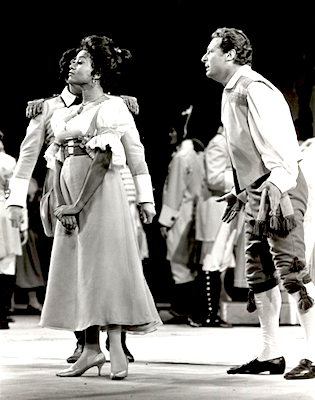
The Nemorino was Canary Island Spaniard Alfredo Kraus in his third San Francisco Opera role, following his Arturo [Historical Performances: Sutherland, Kraus Introduce “I Puritani” to San Francisco Opera – September 20, 1966] and Duke of Mantua [Historical Performances – “Rigoletto” with Glossop, Kraus, Grist and Kreppel – San Francisco Opera, October 16, 1966].
In discussing Kraus, several commentators have referred to Kraus’ care for his voice, enabling him to perform onstage into his 70s. However, I feel fortunate to have seen his 1966 and 1967 performances, while he was still in his late 30s. (I would attend two more Kraus performances in this 1967 season, both of the title role of Gounod’s “Faust”. The second of these occurred six days before Kraus’ 40th birthday.)
Each of the operas I saw Kraus perform during the mid-1960s gave him abundant opportunity to display his beautifully-crafted lyric tenor voice. Few roles are like Nemorino, who sings the beautifiul aria “Una furtiva lagrmia”, often proving an opportunity for a lyric tenor to steal the show from even the most formidable of cast colleagues As expected, Kraus’ perfromance remains a vivid memory.
Ingvar Wixell’s Belcore
Swedish baritone Ingvar Wixell was Sergeant Belcore, repeating the role of his San Francisco Opera debut eight days earlier. As mentioned above, I had seen him perform for the first time, in the role of Held in the previous evening’s “Visitation”. I also would see him in two other roles during the next three weeks.
[Photo: Swedish tenor Ingvar Wixell; edited image, based on a production photograph (here San Francisco Opera’s 1969 mounting of the production; courtesy of the San Francisco Opera Archives.]
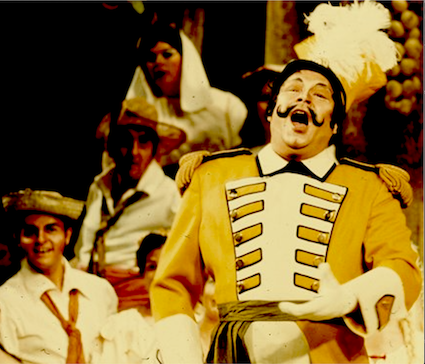
Wixell would soon emerge as a lead baritone with the San Francisco Opera, appearing in 17 different roles in ten seasons over an 18 year period. As Belcore, Wixell proved his skill at comedy and a stylish mastery of Donizetti’s melodious music. As a bel canto artist, Wixell would appear in the lead baritone roles in the most famous operas of Mozart (Count Almaviva) and Rossini (Figaro).
Over the next two decades, San Francisco Opera audiences would see Wixell perform the dramatic Verdi baritone roles of Rigoletto, the Conte di Luna, Giorgio Germont, Simon Boccanegra, Don Carlo di Vargas, Amonasro and Falstaff, as well as Puccini’s Marcello, Baron Scarpia and Sharpless and Richard Strauss’ Mandryka.
Sesto Bruscantini’s Doctor Dulcamara
Like Wixell, Italian bass-baritone Sesto Bruscantini made his San Francisco Opera debut in the first of the three scheduled performances of “L’Elisir d’Amore” that took place the previous weekend. Skilled in the patter-singing with which any artist performing Dulcamara must display, Bruscantini was a hilarious presence.
[Photo: Italian bass-baritone Sesto Bruscantini; edited image based on an historical photograph.]

Mezzo-soprano Marija Kova sang the role of Giannetta.
Maestro Giuseppe Patanè and the San Francisco Opera Orchestra and Chorus
In his third conducting assignment in his debut San Francisco Opera season (preceded by “La Gioconda” and “Macbeth”), Maestro Giuseppe Patanè led the San Francisco Opera Orchestra and Chorus in an energetic performance of Donizetti’s delightful score.
Director Lofti Mansouri, Designer Robert Darling and Other Crew Members
The production was one of the most successful San Francisco Opera productions to date. The production was credited to Iranian-born director Lotfi Mansouri, who had been listed as director on several San Francisco Opera productions since the company’s 1963 season. “L’Elisir”, though, was the first opera for which the production itself was listed as Mansouri’s.
[Photo: the principal Robert Darling set for Lotfi Mansouri’s San Francisco Opera production of “L’Elisir d’Amore”; edited image,based on a Ken Friedman photograph, here of the production’s 2000 season revival, courtesy of the San Francisco Opera Archives.]
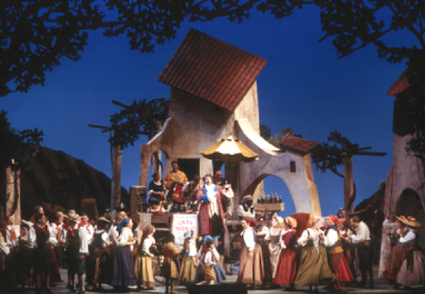
The attractive scenic design was created by Californian Robert Darling, the first of three main season productions attributed to him. (For the 1968 San Francisco Opera season, Darling would create productions of Auber’s “Fra Diavolo” and Richard Strauss’ “Salome” Darling would for several years contribute scenic designs for the Spring Opera Theater [SPOT] offerings, and would refurbish the main company’s 1964 production of Wagner’s “Parsifal”, but unquestionably the often-revived production of “L’Elisir d’Amore” was Darling’s most enduring legacy with the San Francsico Opera.