
The evening after my very first ever live performance of Charpentier’s “Louise” in a San Francisco Opera performance at the War Memorial Opera House [Maestro Jean Périsson Leads Arlene Saunders, John Alexander, Nicola Rossi-Lemeni and Sona Cervena in Impressive Performance of Charpentier’s “Louise” – San Francisco Opera, October 13, 1967], I returned for my first ever live performance of Puccini’s “Manon Lescaut”. This was the first of three “Manon Lescaut” performances that season..
The opera is Puccini’s earliest composed opera that has established a secure place in the international opera performance repertory.
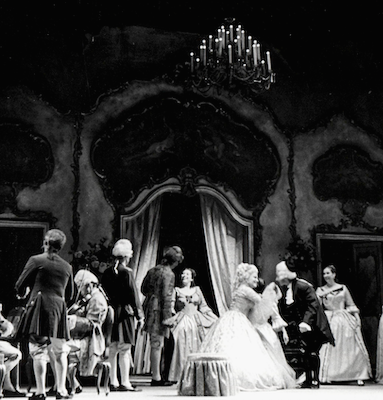
[Below: a gathering in the apartments of Geronte with Manon Lescaut (Dorothy Kirsten, third from right in white dress) greeting guests; edited image of a production photograph, courtesy of the San Francisco Opera.]
Puccini’s Principal Lead Soprano Roles
I regard “Manon Lescaut’s” title character as the first of Puccini’s six major lead soprano roles, to be followed by Mimi, Tosca, Cio-Cio-San, Minnie and Turandot. (I am leaving out of this list Puccini’s pre-Manon Lescaut operas. I am also leaving out the “Trittico” operas and “La Rondine”, even though I have very much liked performances of this latter group).
I probably am not the only opera goer that gives great importance to the first artist I experienced in a role. I saw performances of five of the six “Puccini lead soprano roles” I mentioned above in San Francisco and the sixth on a San Francisco Opera tour performance in San Diego..
Three of these six “lead soprano roles” were performed by Kirsten. My first Manon Lescaut was preceded by my first Cio-Cio-San [Historical Performances: “Madama Butterfly” with Kirsten, Campora, Quilico, Roggero – San Francisco Opera in San Diego, November 1, 1956 ] and my first Minnie [Historical Performances: Dorothy Kirsten Rides High in “Girl of the Golden West” – San Francisco Opera, October 1, 1960].
The other three leading soprano “firsts” were my first Mimi, Victoria de los Angeles [Historical Performances: de los Angeles, Cioni, Horne, Baccaloni in “La Boheme” – San Francisco Opera, October 22, 1962], my first Tosca, Leontyne Price [Historical Performances: Leontyne Price, Konya, Shaw in “Tosca” – San Francisco Opera, October 3, 1963] and my first Turandot, Birgit Nilsson [Historical Performances: “Turandot” with Birgit Nilsson, Franco Tagliavini, Lorengar, Tozzi – San Francisco Opera, October 22, 1964]. I’m confident that few opera goers have six “first time” experiences that surpass this illustrious list – Kirsten (Manon Lescaut), de los Angeles (Mimi), Leontyne Price (Tosca), Kirsten (Butterfly) Kirsten (Minnie), Nilsson (Turandot).
For additional context, I could affix a couple of the ‘seconda donnas’ to the above list of roles. My first Musetta (performing with de los Angeles as Mimi) was Marilyn Horne (whose association with San Francisco Opera began in soprano roles). My first Liu (performing with Nilsson as Turandot) was the esteemed Spanish soprano Pilar Lorengar.
There were non-Puccini operas, where my “first ever live performance” starred Kirsten in a major soprano role – that of Lisa [Historical Performances: “Queen of Spades” with McCracken, Kirsten, Resnik – San Francisco Opera, October 5, 1963] and Fiora [Historical Performances: Kirsten, Campora, Wolansky, Ghiuselev in San Francisco Opera’s Last 20th Century Performance of Montemezzi’s “L’Amore dei Tre Re” – October 15, 1966].
I was later to see Kirsten in historic performances of two other Puccini roles – in 1969 as Mimi opposite the Rodolfo of Luciano Pavarotti, and in 1970 as Tosca to the Cavaradossi of Placido Domingo. At the end of the latter performance, Kirsten became the first artist to receive the newly created San Francisco Opera Medal.
Soprano Grace Moore’s Mentorship of Dorothy Kirsten
Although Kirsten was an impressive vocal performer in any role (her reputation included her endless supply of “on-pitch” high C’s), one of her principal claims to fame was her convincing acting.
During the 1950s, the decade I first became interested in opera (while still in junior high school), the opera world (Europe, the Americas and elsewhere) was impacted by the presence of Greek operatic superstar Maria Callas, who was justifiably promoted as an operatic actress who challenged anachronistic attitudes towards presenting opera.
What I did not appreciate at the time, was that, in the years before Callas became an international sensation, another operatic superstar, Tennessee-born soprano Grace Moore, had been a transformative force on operatic acting and staging, especially in the United States. Recognition of Moore’s acting savvy included her nomination for the 1934 Oscar for Best Actress in a Motion Picture and a receiving a star on the Hollywood (California) Walk of Fame (as did Kirsten at a later date).
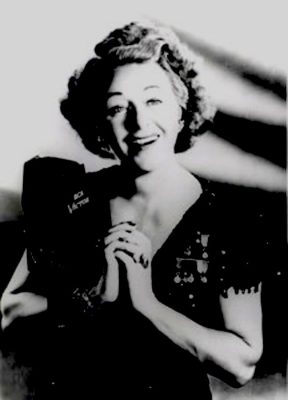
[Below: Tennessee born soprano Grace Moore; edited image of a publicity photograph.]
Moore, less than nine years Kirsten’s senior, had been an observer of the early years of Kirsten’s career, which encompassed such non-operatic pursuits as Broadway theater and radio shows featuring celebrity singers. Moore’s mentoring included encouraging Kirsten to pursue operatic training, arranging for Kirsten to become a student of the voice teacher of the eminent Italian operatic tenor, Beniamino Gigli.
The careers of Moore and Kirsten career covered decades when, traditionally, directors of mid-20th century operatic performance bowed to the will of singers as to how they moved onstage. their stsage movements were directed. Operatic staging, more often than not, sought to position each artist in the most advantageous place onstage to “stand and sing” in relation to the acoustics of the opera house in which the performance was taking place.
Moore’s mentoring was not limited to encouraging Kirsten’s vocal training and dramatic instincts. Her mentoring included recommending Kirsten to the management of several opera companies, including the Chicago Opera Company (one of the predecessor companies of the present day Lyric Opera of Chicago), the San Francisco Opera and the New York Metropolitan Opera. In 1941, Moore and Kirsten performed together in a Chicago Opera “La Boheme”, respectively as Mimi and Musetta.
In 1947, Moore died tragically in an airplane crash, but her mentorship of Kirsten, was a lasting force on Kirsten’s career.
Dorothy Kirsten’s Manon Lescaut
Kirsten possessed a beautiful lyric soprano voice, comprising a soft, appealing vibrato and spinto power for the “big moments”, such as those passages written by Puccini to be sung over the full orchestra.
In this “Manon Lescaut” performance, Kirsten was resplendent in each of the Puccini’s four acts, excelling vocally in Manon’s most famous arias, the second act In quelle trine morbide and the dramatic final act aria Sola, perduta, abbandonata.
[Below: Dorothy Kirsten as Manon Lescaut; edited image, based on a Margaret Norton photograph, courtesy of the San Francisco Opera Archives.]
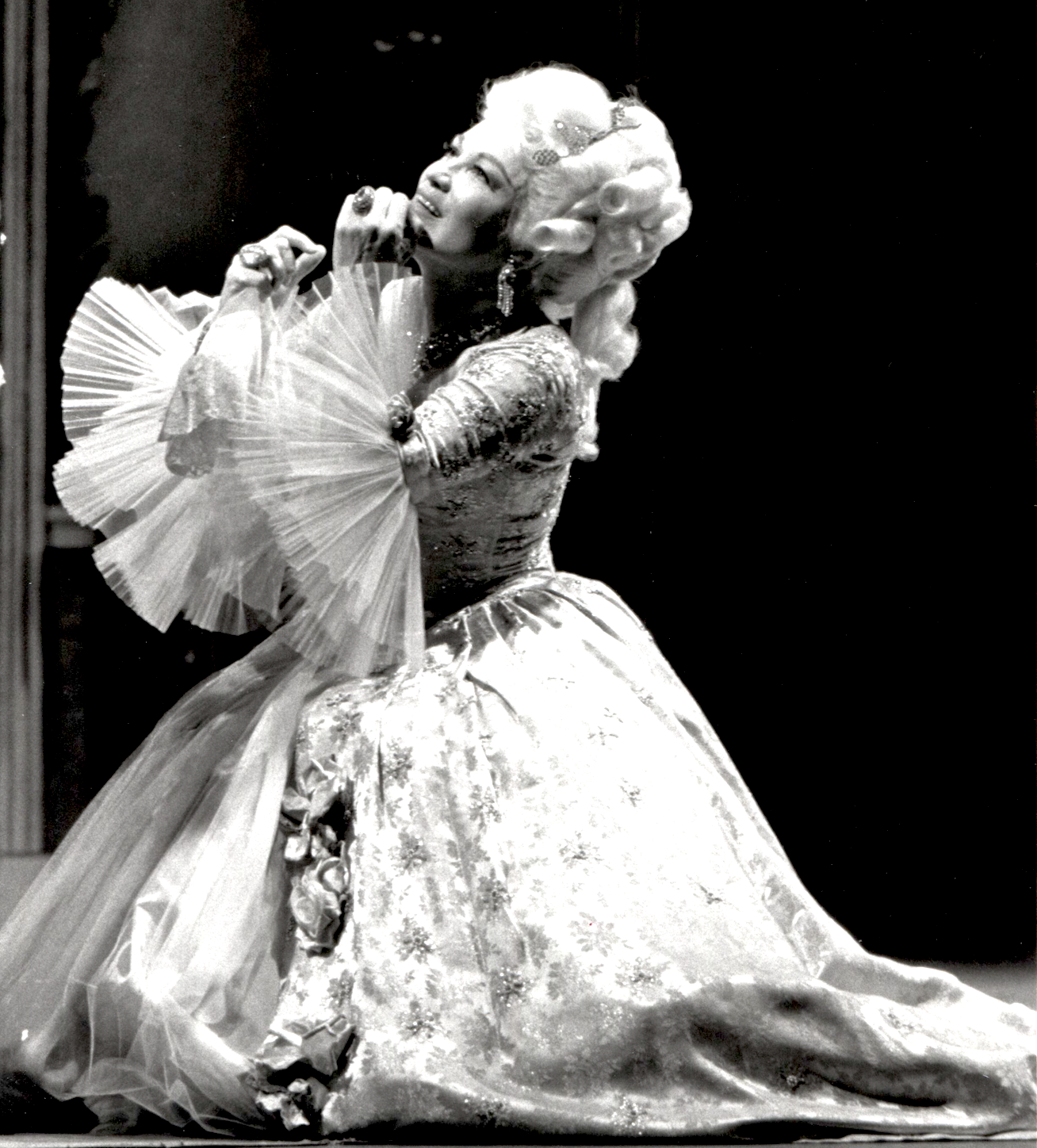
Especially noteworthy was Kirsten’s beautiful costume for the Act II scene in the apartments of Geronte de Revoir, Manon’s wealthy lover at that time.
[Below: The Chevalier des Grieux (Robert Ilosfalvy, front center left) consoles the prisoner Manon Lescaut (Dorothy Kirsten, front center) who is among the women sentenced to deportation to Louisiana; edited image, based on a Margaret Norton photograph, courtesy of the San Francisco Opera Archives.]
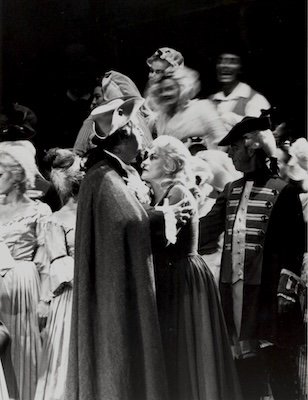
The second act is the height of Manon’s fortunes. Manon’s social ascendancy is followed by arrest for theft by the end of that act. The arrest led to Manon’s her increasingly desparate situation in the final two acts.
Below: the Chevalier des Grieux (Robert Ilosfalvy, embraces Manon Lescaut (Dorothy Kirsten, right), who is dying of thirst in a desert outside of New Orleans; edited image, based on a Robert Cahen photograph, courtesy of the San Francisco Opera Archives.]
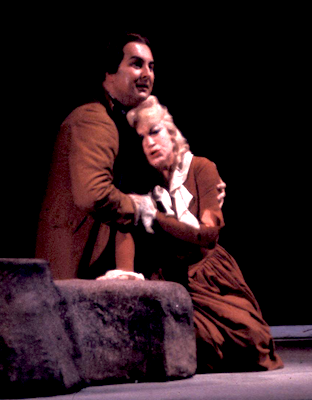
Robert Ilosfalvy’s Chevalier des Grieux
Huigarian tenor Robert Ilosfalvy brought to the role of the scion of nobility, the Chevalier des Grieux, a beautifully expressive spinto voice. Ilosfalvy proved to have the vocal heft for both the first act aria Donna non vidi mai, one of Puccini’s supreme gifts to operatic tenors, and des Grieux’ aria Non v’avviciente!, his third act plea to the ship’s officers to allow him join Manon on her exile to Louisiana.
[Below: Hungarian tenor Robert Ilosfalvy; edited image of a Margaret Norton photograph, courtesy of the San Francisco Opera Archives.]
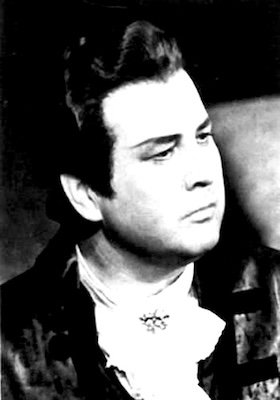
This was the second Ilosfalvy performance at which I was present, preceded by his Aflredo to the Violetta of Joan Sutherland two seasons prior [Historical Performances: Joan Sutherland, Ilosfalvy, Waechter in “La Traviata” – San Francisco Opera, November 5, 1964]. I sould see him again the next afternoon as the Italian tenor in Richard Strauss’ “Der Rosenkavalier”.
[Below: Robert Ilosfalvy as the Cheavlier des Grieux; edited image, based on a Margaret Norton photograph, courtesy of the San Francisco Opera Archives.]
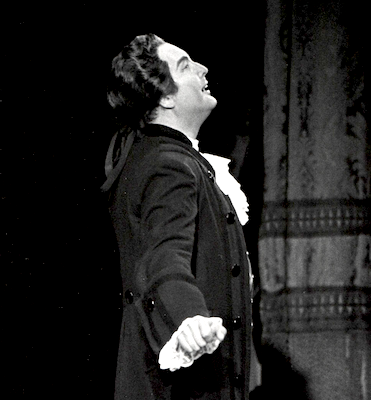
Stuart Burrows’ Edmondo and Delme Bryn-Jones’ Lescaut Stuart Burrows’ Edmondo
Performing the first act role the student Edmondo was Wlsh tenor Stuart Burrows, who had made his San Francisco Opera debut as Tamino to the Papageno of fellow Welshman Geraint Evans [[Historical Performances: Geraint Evans, Stuart Burrows, Jane Marsh Welcome “The Magic Flute” into the San Francisco Opera repertory – September 23, 1967 and October 8, 1967.]
[Below: Stuart Burrows as Edmondo; edited image of a publicity photograph.]
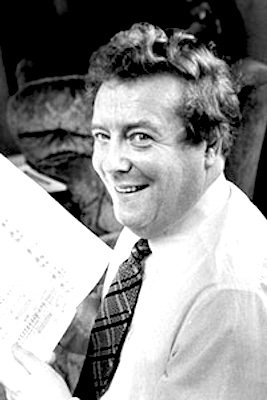
Although Burrows is more closely associated with Mozartian roles, Burrows’ lyric tenor proved as felicitous for Puccini’s Edmondo as it did for Mozart’s Tamino. (A year later, Burrows’ Edmondo and Iosfalvy’s des Grieux would be heard, to the Manon Lescaut of San Francisco Opera favorite, Marie Collier, at the Royal Opera House, Covent Garden.)
[Below: Edmondo (Stuart Burrows, right) warns the Chevalier des Grieux (Robert Ilosfalvy, left) that his adversaries plan to kidnap the woman he desires; edited image, based on a production photograph, courtesy of the San Francisco Opera.]
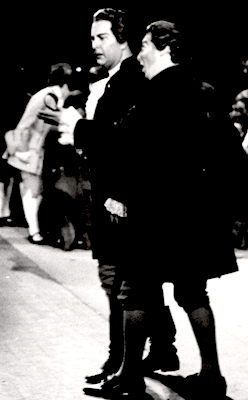
Geraint Evans and Stuart Burrows were not the only Welshmen to be performing in the San Francisco Opera’s 1967 fall season. A third, Delme Bryn-Jones, sang the role of Manon’s wily brother, Lescaut. Bryn-Jones displayed a likable lyric baritone in his second act arioso, Sei splendida e lucente.
[Below: Lescaut (Welsh baritone Delme Bryn-Jones front), right joins in a conversation at the place of embarkation for banishing French prostitutes to Louisiana; edited image, based on a Margaret Norton photograph, courtesy of the San Francisco Opera Archives.]

Federico Davia and Other Cast Members
Italian bass Federico Davia was an authoritative Geronte. In the company’s 1966 season, Davia had distinguished himself in three significant comprimario roles, Zuniga in “Carmen”, and, most notably, Sparafucile [Historical Performances: A Pleasing “Rigoletto” From Chester Ludgin, Lee Venora, Ottavio Garaventa and Janis Martin, San Francisco Opera, November 5, 1966] and Pistola [Historical Performances: Ramon Vinay, Raina Kabaivanska Lead Memorable “Falstaff” – San Francisco Opera, November 20, 1966].
Colin Harvey was An Innkeeper. Marija Kova was A Musician. L. D. Clements was A Dancing Master. Raymond Manton was A Lamplighter. Clifford Grant was A Sea Captain and Allan James Monk was A Sergeant.
The conductor was Maestro Herbert Grossman. Lotfi Manouri directed. Vincenzo Giannini was chorus director. The costumes were provided by Goldstein & Company.
Fifteen hours later I would return to the War Memorial Opera House for my third performance of the weekend, a matinee of Richard Strauss’ “Der Rosenkavlier”.