Note from William: This post continues my series of observances of historic performances that I attended at San Francisco Opera during the general directorship of Kurt Herbert Adler. This is the first of 13 such observances of performances from the company’s 1964 Fall season.
In the late summer of 1964, I had my Saturday night subscription seats to the San Francisco Opera’s season, but as late as 15 days before the season’s opening night, the contract with the musician’s union was in doubt, and the season seemed like it would be canceled, until the Mayor of San Francisco himself proposed the compromises that saved the opera season.
The first performance on my 1964 San Francisco Opera Saturday night series was a new production of Wagner’s “Parsifal”, starring Hungarian heldentenor Sandor Konya as Parsifal, American mezzo-soprano Irene Dalis as Kundry, Austrian baritone Eberhard Waechter as Amfortas and American basso Giorgio Tozzi as Gurnemanz.
Sandor Konya’s Parsifal
[Photo: Sandor Konya (left) as Parsifal and Irene Dalis (right) as Kundry in the 1964 San Francisco production; edited image, based on a Pete Peters photograph courtesy of the San Francisco Opera Archives.]
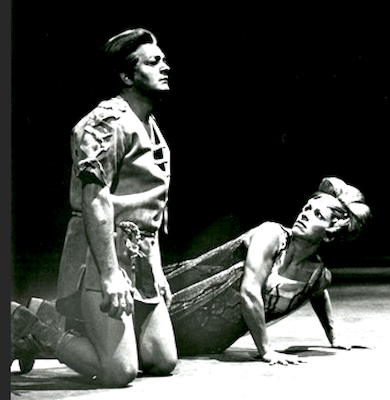
I had first attended performances of Hungarian tenor Sandor Konya in 1960, the year before I entered college. I saw him in two San Francisco Opera productions – as Dick Johnson in my first-ever performance of Puccini’s “La Fanciulla del West” [See Historical Performances: Dorothy Kirsten Rides High in “Girl of the Golden West” – San Francisco Opera, October 1, 1960].
Later that season, I saw him in the title role of my first-ever performance of Wagner’s “Lohengrin”. [Historical Performances: Sandor Konya, Irene Dalis in “Lohengrin” – San Francisco Opera, October 27, 1960.
Very much in demand for the title roles of “Parsifal” and “Lohengrin” Konya proved an excellent choice for both of these ‘jugendlicher’ tenor roles. As Parsifal, Konya displayed a smooth legato and an expressive tone, which was an example of what I was later to call “bel canto Wagnerian singing”.
I considered Konya to be the leading tenor of the San Francisco Opera for the six seasons from 1960 through 1965, singing 13 different roles. Parsifal was the seventh of nine roles that I saw him perform (all at San Francisco Opera’s War Memorial Opera House
In addition to his being my first-ever Dick Johnson, Lohengrin and Parsifal, he was my first Don Carlo in Verdi’s opera of that name. In the “Don Carlo” performance he was joined by his colleagues of this”Parsifal” performance – Irene Dalis as as the Princess Eboli,and Giorgio Tozzi, as King Philip II.
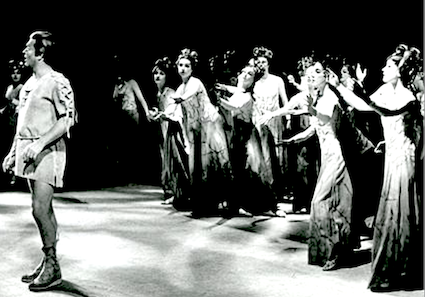
[Photo: Parsifal (Sandor Konya, left) is unmoved by the seductive songs of the Flower Maidens in the 1964 San Francisco Opera production of “Parsifal”; edited image, based on a Pete Peters photograph, courtesy of the San Francisco Opera Archives.]
Konya was also my first-ever Mario Cavaradossi in Puccini’s “Tosca” and my first-ever Don Alvaro in Verdi’s “La Forza del Destino”, both opposite Leontyne Price. (I also saw his Pinkerton in Puccini’s “Madama Butterfly” to Price’s Cio-Cio San, his Radames in Verdi’s “Aida” to Price’s Aida and his Riccardo in Verdi’s “Ballo in Maschera” to Price’s Amelia.
Konya also appeared with another mid-20th century superstar, Renata Tebaldi, as Mimi in “La Boheme”, opposite his Rodolfo, in one of the four occasions that I was present at a Tebaldi operatic performance..
After the 1965 season, Konya returned to the San Francisco Opera only for a single performance of Pinkerton in Puccini’s “Madama Butterfly”, substituting for another tenor in a performance that I was fortunate to attend.
Eberhard Waechter’s Amfortas
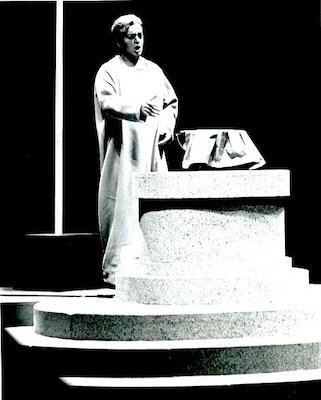
[Phoro: Amfortas (Eberhard Waechter) is granted th ecare of Montsalvat’s most holy relics; edited image, based on a Pete Peters photograph, courtesy of the San Francisco Opera Archives.]
1964 was the occasion of the San Francisco Opera debut of Austrian baritone Eberhard Waechter, who sang four different roles – two German, two Italian. He
For his German opera assignments – Amfortas in “Parsifal and Barak in “Die Frau ohne Schatten [Historical Performances: Ella Lee, Dalis, Kuchta, Waechter, Martell in “Frau ohne Schatten” – San Francisco Opera, September 26, 1964], Waechter displayed a dramatic ‘heldenbariton’.
He was equally adept at perfomring iconic baritone roles in the differeing styles of Mozart and Verdi. Waechter’s Italian opera performances at San Francisco Opera.were the Count Almaviva in Mozart’s “Le Nozze di Figaro” [See Historical Performances: “Nozze di Figaro” with Geraint Evans, Grist, Lorengar, Waechter – San Francisco Opera, October 3, 1964 ] and the Elder Germont in Verdi’s “La Traviata” [See Historical Performances: Joan Sutherland, Ilosfalvy, Waechter in “La Traviata” – San Francisco Opera, November 5, 1964.]
Although I saw Waechter perform each of his four roles, I never saw him again after 1964.
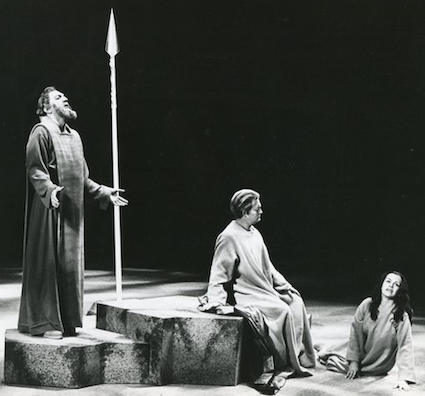
[Photo: Amfortas (Eberhard Waechter, center, sitting on the bench) is observed by Gurnemanz (Giorgio Tozzi, standing left) and Kundry (Irene Dalis, right); edited image, based on a Pete Peters photograph, courtesy of the San Francisco Opera Archives.]
Irene Dalis’ Kundry
[Photo: California mezzo-soprano Irene Dalis as Kundry in the 1964 San Francisco Opera production of “Parsifal”; edited image, based on a Pete Peters photograph, courtesy of the San Francisco Opera.]
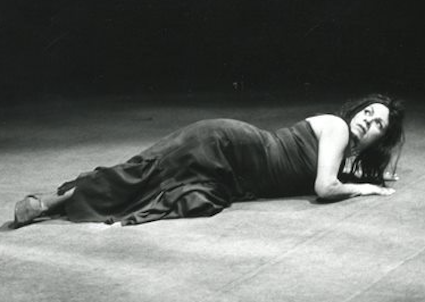
California mezzo-soprano Irene Dalis possessed a dramatic mezzo-soprano voice of\with extraodinary range and power.
Four seasons prior, attending my first performance ever at the War Memorial Opera Hosue, I experienced my first performance by Dalis She played the Empress’ evil Nurse in my first-ever performance of Richard Strauss’ “Die Frau” [Historical Performances: The Woman Without an Equal: Leonie Rysanek in “Frau ohne Schatten”: San Francisco Opera, September 24, 1960 From that performance on, over the decades that followed, War Memorial Opera House would nr my operatic home base.
A month later I would return for my first-ever “Lohengrin”‘ in which Dalis performed Ortrud to Sandor Konya’s Lohengrin. Four years later Dals returned as the Nurse in “Die Frau’s revival Historical Performances: Ella Lee, Dalis, Kuchta, Waechter, Martell in “Frau ohne Schatten” – San Francisco Opera, September 26, 1964,.
The roles I saw Dalis perform druing the seasons between 1960 and 1964 – the Empress’ Nurse, Ortrud, Princess Eboli, Kundry – were among the most demanding (some wold say treacherous) roles in the mezzo-soprano repertory.
The confidence of San Francisco Opera’s General Manager Kurt Herbert Adler in Dalis’ abilities allowed him to approve a casting choice thatl likely would not have been imagined at other opera houses throughout the world.
Three seasons later, Irene Dalis would become my first-ever Fricka in Wagner’s “Das Rheingold”.
She also was chosen to take part in a new production of Wagner’s “Tristan und Isolde” with the superstar South Dakota tenor Jess Thomas as my first-ever Tristan. Ther artist announced for the soprano role of Thomas’ Isolde was the mezzo-soprano Irene Dalis.
Dalis was one of the few artists from the decade of the 1960s or before to receive the San Francisco Opera medal, created in 1970 with Dorothy Kirsten as its first honoree. Others whom I had seen in the 1960s in San Francisco – Thomas Stewart, Sir Geraint Evans, Leontyne Price, Birgit Nilsson, Leonie Rysanek -= were to join her, The decisions to honor certain artists with the San Francisco Opera medal is a subject I will return to at a later time.
Giorgio Tozzi’s Gurnemanz
[Photo: Illinois basso Giorgio Tozzi as Gurnemanz in Wolfram Skalicki’s costume for the 1964 San Francisco Opera production; edited image, based on a Pete Peters photograph, courtesy of the San Francisco Opera.]

Tozzi’s Gurnemanz showcased Tozzi’s powerful bass voice. His character masterfully sang the opera’s intoxicating music, joining the superb singing of Konya, Dalis and Waechter.
Giorgio Tozzi was a major operatic recording artist during the 1950 and 1960s, when he sang for several seasons, beginning in 1955.
Like Konya and Dalis , I had several “first-ever” roles with him.
Tozzi was my first-ever Boris in Mussorgskky’s “Boris Godunov”, Zaccaria in Verdi’s “Nabucco”, Don GIovanni in Mozart’s opera of that name and Timur in Puccini’s “Turandot”.
1964 marked the end of Tozzi performing in seven consecutive San Francisco seasons begginning in 1958. He would return in seven of the next 14 seasons.
I was fortunate to have been at his final operatic appearance ever with the San Franisco Opera, on Saturday night, November 25, 1978. He was Scarpia (to the Cavaradossi of Juan Lloveras) in a performance of “Tosca”, in which the title role was sung by the legendary Italian soprano, Magda Olivero, still vocally strong despite her advanced age.
This was one of two Satureday nights at the War Memorial Opera House etched in my momory, when the reaction of the audience at final curtain call was a boisterous long-lasting foot-stomping ovation. (The only other time that occurred was a Saturday evening performance of Puccini’s “Manon Lescaut” starring Mirella Freni and Ermanno Mauro.)
Oilivero’s two performances as Tosca in 1978 and five performances as Elle in Poulenc’s “La Voix Humaine” the subsequent season constituted her total lifetime performances with the San Franciso OPera.
Maestro Georges Prêtre and the San Francisco Opera Orchestra
[Photo: Maestro Goerges Prêtre; edited image of anhistorical photograph.]
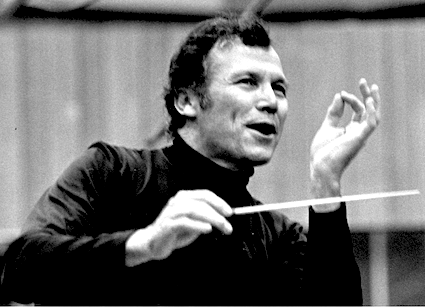
In his second and final season perfomring with the San Francisco Opera Orchestra, French Maestro Georges Prêtre was “Parsifal’s” conductor.
He was the conductor, who, in addition to “Parsifal”, introduced me to my first-ever performances of “Samson et Dalila” with James McCracken and Sandra Warfield, of “Tosca” (with Konya and Leontyne Price) and “Carmen” with Regeina Resnik and Jon Vickers.
After those two seasons, he never returned to the San Francisco Opera.
The Hager-Skalicki Production
It was the first night of a new production by Paul Hager, with sets and costumes by Wolfram Skalicki. If there was any political (or religious) message intended, it eluded me completely.
Nearly two decades after the end of World War II, productions of the mystical “Parsifal” remained the least performed of Wagner’s ten major works, either in Nazi Germany, which had glorified Wagnerian opera, or in postwar Europe.
Except for two performances in 1950 and a single one in 1951 (the only three previous performances in San Francisco Opera history), “Parsifal” had been absent from the San Francisco stage.
San Francisco Opera’s general director, Kurt Herbert Adler, an Austrian emigre with impeccable anti-Nazi credentials, had proved to be a major figure in the postwar rehabilitation of artists who found themselves on the losing side in the Second World War.
A new production of “Parsifal”, staged by German director Paul Hager (the pre-eminent director at San Francisco Opera during the first decades of the Adler era) and the Austrian set and costume designer Wolfram Skalicki, was an affair of more than local significance. In what was then still an innovative device, scrims and projections were extensively used.
Some operas work out to be once in a decade experiences. I was present at the San Francisco Opera a decade later for the revival (with modifications) of the Hager-Skalicki production in 1974 withJess Thomas, Eva Randova, Thomas Stewart and Kurt Moll.
In 1988, I was present for a new Nicolas Joel production Rene Kollo, Waltraud Meier, Jorma Hyninnen, Kurt Moll, with Walter Berry as Klingsor).
For the new millenium San Francisco Opera mounted a Nicholas Lehnhoff production in 2000 with Christopher Ventris, Catherine Malfitano, Franz Grundheber and Kurt Moll.. I
also traveled to the Los Angeles Opera, for the Robert Wilson production with Placido Domingo, Linda Watson, Albert Dohmen and Matti Salminen).
“Parsifal”, to which a series of conventions and legends had become attached, has attracted a series of unconventional productions. Even though the Hager/Skalicki production was considered a substantive departure from the “Parsifal” traditions of old, it would seem conservative when compared to the productions of Joel, Lehnhoff and Wilson.
[For my extended remarks on the Wilson production (which was my first Wagner review on this website), see Domingo is the Redeemer of L.A.’s spellbound “Parsifal”: December 8, 2005 and “Robert Wilson’s Parsifal” in L A: Whose Spell is it Anyway?