
In its 2026 season, the Santa Fe Opera presented “Rodelinda”, the eighth opera by George Frideric Handel performed in the company’s history.
Lucy Crowe’s Rodelinda
[Photo: Rodelinda (Lucy Crowe, right) sits with her son, Flavio (Maximilian Moore left); edited image, based on a Bronwen Sharp photograph, courtesy of the Santa Fe Opera.]
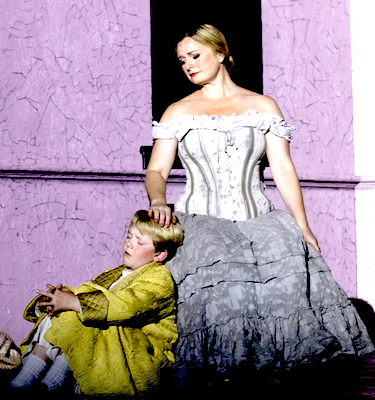
British soprano Lucy Crowe brought vocal brilliance and coloratura agility to Rodelinda, considered one of her signature roles. Among the many highlights of her performance were her first aria, the soulful ‘Ho perduto il caro sposo’ and her defiant response to the marriage proposals from Grimoaldo, ‘L’empio rigor del fato’.
A 2004 alumna of the Royal Academy of Music, Crowe received an OBE (Officer, Order of the British Empire) at the 2023 King’s Honors.
My first opportunity to review a Lucy Crowe performance was 15 years ago, when she sang the role of Iole in Handel’s “Hercules”, her debut role at the Lyric Opera of Chicago [Review: Strong Cast for Peter Sellars’ Reconceptualization of Handel’s “Hercules” – Lyric Opera of Chicago, March 16, 2011].
In that review I praised Crowe’s coloratura singing and the purity of her voice. Seeing her perform the title role in Handel’s “Rodelinda” is further evidence of her extraordinary talent for baroque opera.
Iestyn Davies’ Bertarido
[Photo: Iestyn Davies as Bertarido; edited image based on a Bronwen Sharp photograph, courtesy of the Santa Fe Opera.]
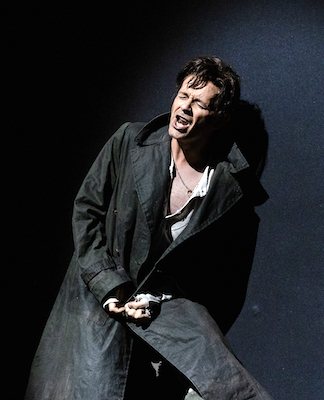
English countertenor Iestyn Davies portrayed Bertarido, the deposed ruler of Milan, who is believed to be dead. The opera’s plot concerns the efforts of the usurper Grimoaldo to consolidate power, not realizing that Bertarido is alive and will ultimately regain his throne.
Davies, one of the great countertenors of his generation, beautifully sang Bertarido’s famous aria ‘Dove sei, amato bene’. He was also an excellent actor, showing a range of emotions.
A graduate of the Royal Academy of Music, in 2017 Davies received Queen’s Honors, being appointed an MBE (Member, Order of the British Empire.)
The first Davies performance I reviewed was his Oberon in Britten’s “Midsummer Night’s Dream” in Houston [Review: Incandescent “Midsummer Night’s Dream” – Houston Grand Opera, January 25, 2009]. Three years later I reviewed his Eustazio in Chicago [Review: Handel’s “Rinaldo” in Chicago – Francisco Negrin’s Finely Sung, Fun-filled Fantasy – Lyric Opera, March 16, 2012] in which I referred to Davies as a “world-class countertenor”.
Anthony Gregory’s Grimoaldo
[Photo: Anthony Gregory as Grimoalso; edited image, based on a Bronwen Sharp photograph, courtesy of the Santa Fe Opera.]
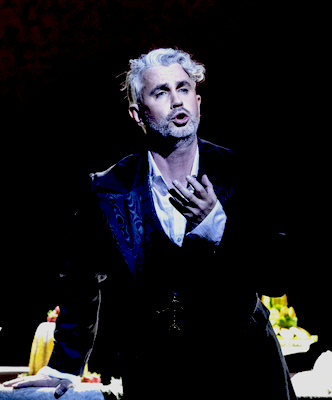
British tenor Anthony Gregory sang the role of Grimoaldo, the usurper of the Milanese throne.
Gregory displayed an attractive lyric tenor voice, well-suited to Handel’s baroque style. He is also identified with the Mozart tenor category and in such 20th century operatic parts as Peter Quint in Britten’s “The Turn of the Screw” and the title role of Bernstein’s “Candide”.
In 2014 he received the “Breakthrough Opera Artist” award by United Kingdom’s “WhatsOnStage” theater audience organization.
A graduate of the National Opera Studio and Royal College of Music, Gregory participated in Young Artists’ programs at the Glyndebourne Festival.
William Guanbo Su’s Garibaldo
[Photo: William Guanbo Su as Garibaldo; edited image, based on a Bronwen Sharp photograph, courtesy of the Santa Fe Opera.]
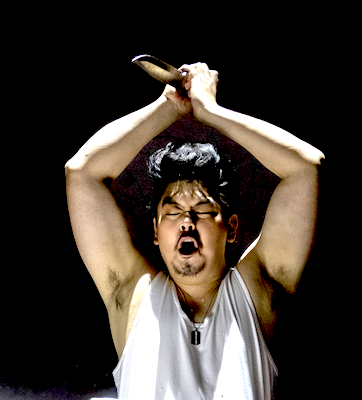
Chinese bass William Guano Su returned to the Santa Fe Opera as the villain Garibaldo, counselor to the usurper Grimoaldo. Although Garibaldo pretends to work to strengthen Grimoaldo’s grip on his ill-gotten power, Garibaldo plans ultimately to seize the throne himself.
As Su’s Garbaldo villainous plans proceed, the staging was augmented by massive shadows reaching to the stage ceiling as he moves about the stage. Garibaldo’s plans are foiled when Bertarido unexpectedly appears at a critical moment and slays Garibaldo. Su, stretched out on the stage floor, represents the dead body of Garibaldo for a long stretch of time.
Su’s sonorous bass voice, commanding stage presence and impactful acting make him a solid choice for character roles.
Two Santa Fe Opera seasons ago, Su performed the role of Masetto in Mozart’s “Don Giovanni” under the baton of Maestro Harry Bicket [Review: Stephen Barlow Creates an Elegant New “Don Giovanni” Production – Santa Fe Opera, June 29, 2024]. Next year’s Santa Fe Opera season will give him a chance to display his comic talents – as Don Basilio in Rossini’s “Barber of Seville”.
Su, who is from Beijing, China, where his birth family still lives, enrolled in a Massachusetts School for the Arts when he was 14 and afterwards attended and graduated from the Manhattan School of Music in New York City.
Merdian Prall’s Eduige
[Photo: Meridian Prall as Eduige; edited image, based on a Bronwen Sharp photograph, courtesy of the Santa Fe Opera.]
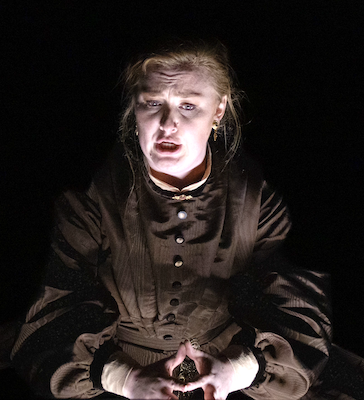
Michigan mezzo-soprano Meridian Prall was stalwart in the role of Bertarido’s sister Eduige.
Prall made a strong positive impression, showing her character’s resilience, singing Eduige’s aria ‘Quanto più fiera tempesta freme’, which was well-applauded by the Santa Fe Opera audience.
Eduige is the second of two roles Prall is singing in Santa Fe Opera’s 2026 season, the other being Filipyevna [Review: A Pushkin-Centered “Eugene Onegin” – Santa Fe Opera, August 6, 2026].
Hugh Cutting’s Enulfo
[Photo: Hugh Cutting as Enulfo; edited image, based on a Bronwen Sharp photograph, courtesy of the Santa Fe Opera.]
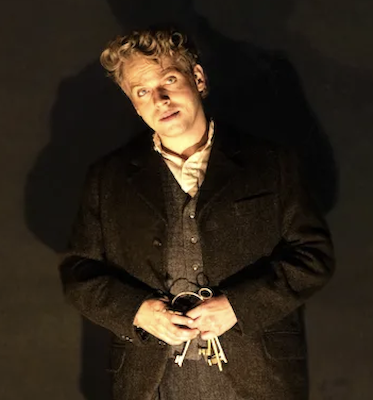
English countertenor Hugh Cutting portrays Unulfo, a friend and counselor to Bertarido. Unulfo is in contact with both the iimprisoned Bertarido, and with Bertarido’s wife Rodelinda and sister Eduige. He coordinates the actions that free Bertarido, who defeats his enemies and regains his throne.
Cutting was an impressive vocalist and a engaging actor. He is currently one of the most sought after of countertenors internationally. He was the first countertenor to win the prestigious Kathleen Ferrier Prize. and was designated a 2022-24 BBC New Generation Artist.
His childhood included being a Choral Scholar at Saint John’s College, Cambridge. Afterward, he was an alumnus of the Royal College of Music.
Maestro Harry Bicket and the Santa Fe Opera Orchestra
[Photo: Maestro Harry Bicket; edited image, based on a Bronwen Sharp photograph, courtesy of the Santa Fe Opera.]
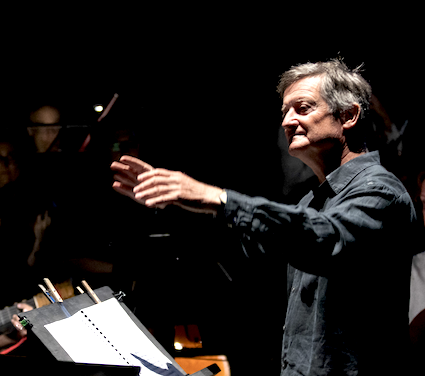
Santa Fe Opera’s Music Director, Mestro Harry Bicket, led the Santa Fe Opera in an authoritative performance, in which he also played the harpsichord accompaniment.
Bicket has a long history with “Rodelinda”, having conducted it at the New York Metropolitan Opera in three seasons – 2004 and 2011, with Renée Fleming in the title role and in 2022, for Elza van den Heever’s role debut.
He has recorded the opera on Scottish-based Linn Records, in a performance with Lucy Crowe as Rodelinda and Iestyn Davies as Bertarido
This season, he is reunited with Director R. B. Schlather at the Santa Fe Opera, whose 2019 production of Mozart’s “Cosi fan Tutte” he conducted.
R. B. Schlather’s Production, Doey Luthi’s Costume Design and Masha Trimming’s Lighting Design
[Director R. B. Schlather; edited image of a Tobin Del Cuore photograph, accompanying an interview for the American Composers Forum’s ‘I CARE IF YOU LISTEN‘].

New York Director R. B. Schlather returns to the Santa Fe Opera for his second assignment, following his 2019 production of “Cosi fan Tutte” [Review: “Cosi Fan Tutte” – World Class Singing, Deconstructed Staging – Santa Fe Opera, July 26, 2019].
Schlather is noted for productions which minimize the opera’s scenic design and concentrates on the motivations of the opera’s individual characters.
For “Rodelinda” he designed a blank wall room on which a phrase was written and later erased. I regarded his scenic design as the least effective aspect of the production.
[Photo: Doey Luthi’s costumes for the victors in the power struggle, from left to right, Eduige (Meridian Prall), Unulfo (Michael Cutting, Rodelinda (Lucy Crowe), Bertarido (Iestyn Davies) and Flavio (Maximilian Moore); edited image, based on a Bronwen Sharp photograph, courtesy of the Santa Fe Opera. ]

The costumes were created by Swiss designer Doey Luthi. The costumes did not appear to represent any particular historical period, nor to have any special significance.
Tne lighting design was created by California Lighting Director Mascha Trimming, who emphasized contrasts of light and darkness.
Trimminf’a work was especially notable for the large shadows associated with the characters, especially Garibaldo, as referenced above.
The Historical Background and Handel’s Opera
[Photo: Photo: Paulus Diaconus; edited image, from a medieval manuscript.]
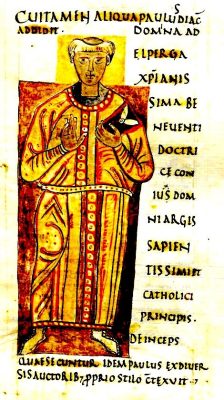
In 782, the young Frankish Emperor Charlemagne, determined to assemble a court of scholars, became acquainted with a Benedictine monk, Paul the Deacon. The monk’s writings later included a history of the Lombards (a name that in the eighth century meant “long-beards”).
Paul’s history centered on the the families who governed Milan, Lombardy’s principal city, during the “Dark Ages” of the sixth and seventh centuries.
That history discusses power struggles to control the throne of Milan. Included were accounts of the usurpation of the Milan throne in the year 662 by Grimoaldo.from the ruler we know (from the opera) as Bertarido. After Grimoaldo’s usurpation, Bertarido’s wife Rodelinda remained as Queen, faithful to her husband. Bertarido regained his throne in 671 (the year of Grimoaldo’s death). Garibaldo, in those days the Duke of Turin, is a villainous presence in the opera.
The theatrical possibilities of these late 7th century Lombardian events inspired a play by French playwright Pierre Corneille in 1652, which subsequently inspired multiple opera libretti. 73 years after Corneille’s play, the subject matter became Handel’s 1725 opera, “Rodelinda”. I attended this Santa Fe Opera performance three centuries and a year later.
Recommendation
I recommend the Santa Fe Opera’s R. B. Schlather production of “Rodelinda”, borth for the veteran opera-goer and the person new to opera.