
In 2021, the Santa Fe Opera presented Italian director Alessandro Talevi’s new production of Tchaikovsky’s opera “Eugene Onegin”. Although the company had reopened following the darkened months of 2020 resulting from the Covid-19 pandemic, many compromises had to be made to meet government-imposed limitations on the numbers of persons onstage at the same time.
[Photo: Alexander Pushkin at age 28; edited image of an Orest Kiprensky painting ]
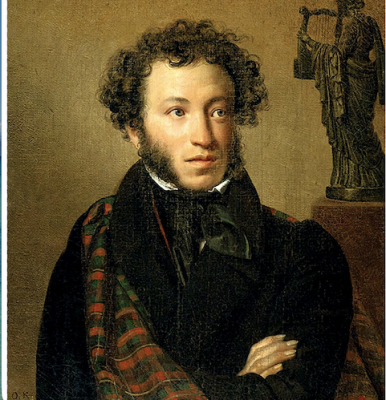
In 2026, Talevi and his associates were able to produce the opera as they had originally intended. Talevi delves into the source material of Tchaikovksy’s opera, Alexander Pushkin’s ten-chapter poem “Eugene Onegin”,
Key ideas of the production were inspired by Chapter Five of Puskhkin’s poem, which containes plot elements that Tchaikovsky and his librettists did not use. In that chapter, Pushkin’s describes the remarkable dreams and nightmares of frightful beasts experienced by the opera’s heroine, Tatyana.
Mattia Olivieri’s Eugene Onegin
[Photo: Eugene Onegin (baritone Mattia Olivieri) dressed for Prince Gremin’s Saint Petersburg party; edited image, based on a Bronwen Sharp photograph courtesy of the Santa Fe Opera.]
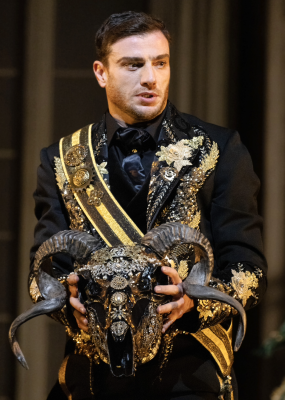
Performing the opera’s title role was Italian baritone Mattia Olivieri in his Santa Fe Opera debut season. In his early 40s, the handsome baritone is a graduate of Bologna’s Music Conservatory G.B. Martini.
Onegin is a character who is rich and socially connected and who uses his wealth and power, at key points in the opera, in destructive ways.
Onegin is residing in the Russian countryside to tend to the final days of a rich relative whose heir he is. He befriends Vladimir Lensky, who is engaged to Olga Larina.
Through Lensky, Onegin spends an afternoon with Olga’s sister Tatyana and charms her. When Tatyana indiscreetly writes him a love letter proposing, in effect, a lifetime relationship, Onegin responds as a gentleman would to such an unexpected proposal, but Tatyana regarded his rejection as an humiliation.
Olivieri performed Onegin’s principal aria ‘Kogda bï zhizn domashnim krugom’ beautirully. The message of the aria devastates the teenage Tatyana.
Olga Kutchynska’s Tatyana Larinski
[Photo: Tatyana Larina (soprano Olga Kulchynska) is srrounded by horned-beast party-goers; edited image based on a Bronwen Sharp photograph, courtesy of the Santa Fe Opera.]
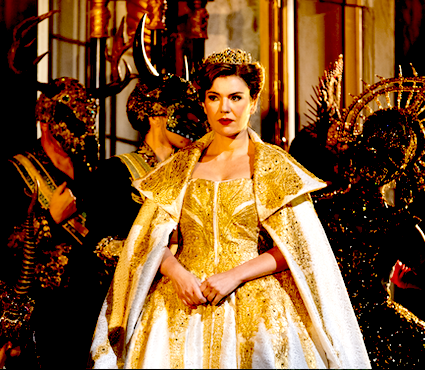
Ukrainian soprano Olga Kutchynska, in her Santa Fe Opera debut season, brilliantly performed the role of Tatyana. Her gleaming voice was enlisted for the “second tableau” in Tatyana’s bedroom, where she performs the Letter Scene, the greatest set of arias for a soprano in Russian opera, Her performance was magnificent, and enthusiastically applauded by the Santa Fe Opera audience.
A graduate of the R. Glier Kyiv Institute of Music, Kutchynska was a master class student with the late Dmitri Hvorostovsky.
Talevi’s production incorporates many ideas from the mysterious Chapter Five of Pushkin’s poem, “Eugene Onegin”. Tatyana dreams she is traveling by foot on a snowy path when a bear begins to chase her. She seeks refuge in a hut. On entering the hut, she finds Onegin who is adorned with a horned monster’s head. (see photo below) The room is filled with horned beasts and many other kinds of frightening animals.
In only rwo years from the time of these dreams, Tatyana will become the beloved wife of an important Russian prince.
Tatyana’s dreams inspire the costumes of many of the participants in the dance sequences that take place throughout the opera.
Ivan Ayon-Rivas’ Vladimir Lensky
[Photo: Vladimir Lensky (tenor Ivan Ayon-Rivas); edited image, based on a Bronwen Sharp photograph, courtesy of the Santa Fe Opera.]

Peruvian tenor Ivan Ayon-Rivas performed the role of Vladimir Lensky, Olga’s ill-fated fiance.
Ayon-Rivas gave a soulful performance of the aria ‘Kuda, kuda vï udalili’. Lensky sings the aria just before his death in a duel that was the result of his own impulsive challenge to his friend, Onegin. It is the best-known tenor aria from a Russian opera, for which the opera’s, composer, Pyotr Tchaikovsky, personally composed the aria’s lyrics. The audience expressed its appreciation with shouits of “bravo” and sustained applause.
Aron-Rivas is a graduate of Lima’s Conservatorio Nacional de Música, and a voice student of Italian baritone Roberto Servile. Rivas was a 2021 winner of Placido Domingo’s Operalia singing contest.
Alexander Kopeczi’s Prince Gremin
[Photo: Prince Gremin; Alexander Kopeczi); edited image, bassed on a Bronwen Sharp photograph courtesy of the Santa Fe Opera.]
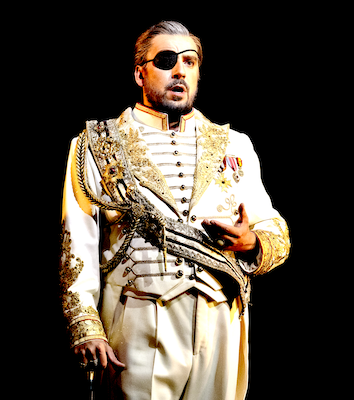
Romanian bass Alexander Kopeczi gave a sturdy performance as Prince Gremin, who, in the interim between Lensky’s death in a duel with Onegin, has married Tatyana.
Kopeczi sang Gremin’s famous aria ‘Lyubvi vse vozrasty pokorny’ elegantly, and received a well-deserved audience ovation.
Kopeczi, in his Santa Fe Opera debut season, is singing two roles, the other being Sarastro in Mozart’s “The Magic Flute”.
He was trained both in piano and voice at Romania’s Gheorghe Dima Music Academy. Kopeczi’s operatic debut took place in 2014. He was a member of the Salzburg (Austria) Festiival’s Young Artists’ program and a 2023 recipient of the Herbert von Karajan prize for promising young opera singers.
Lindsay Ammann’s Olga Larinski
Photo: Olga Larinski (Lindsay Ammann, center) is surrounded by dancers at her sister Tatyana’s birthday celebration; edited image based on a Bronwen Sharp photograph, courtesy of the Santa Fe Opera.]
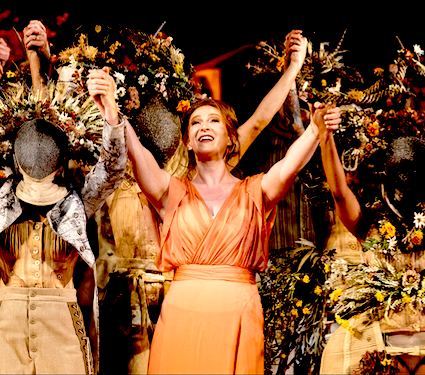
South Dakota mezzo-soprano and contralto Lindsay Ammann portrayed the role of Tatyana’s sister Olga. She was the center of the lively scenes of dancing at her sister Tatyana’s “name day” celebration. Flattered by Onegin’s attention, she allowed him to be her dance partner throughout the evening, infuriating her fiance, Lensky.
I first saw Ammann perform the role of one of the valkyrie sisters in Wagner’s “Die Walkure” in 2017 at Lyric Opera of Chicago. Most recently I saw her performane as Serena Joy in San Francisco [Review: A Cautionary “Handmaid’s Tale” , San Francisco Opera, September 14, 2024].
Susan Graham’s Madame Larina, Meridian Prall’s Filipyevna and Other Cast Members
[Photo: Madama Larina (Susan Graham, left) confers with Filipyevna (Meridian Prall, right); edited image based on a Branwen Sharp photograph, courtesy of the Santa Fe Opera.]
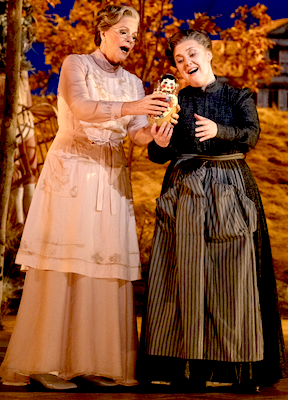
This is Susan Graham’s 13th Santa Fe Opera season. In 2026, she is performing the role of the head of the Larinski family, supervising her daughters Olga and Tatyana. Graham created an image of a strong-willed presence in this rural community.
I have posted performance reviews from her last four roles sung here, the Duchess [Review: Susan Graham’s Star Glows in Offenbach’s Sexy, Witty “Grand Duchess of Gerolstein” – Santa Fe Opera, June 28, 2013], Clairon [Review: Santa Fe Opera Makes the Case for “Capriccio”- July 27, 2016], Prince Orlofsky [Review: “Fledermaus” Opens 2017 Santa Fe Opera Festival – June 30, 2017] and Genevieve [Review: Passionately Sung, “Pelléas et Mélisande” in Netia Jones’ Attractive, Introspective Production – Santa Fe Opera, July 28, 2023].. For my interview with her, see: Return to New Mexico: An Interview with Susan Graham
Michigan mezzo-soprano Meridian Prall was sympathetic in the role of the Larina household’s long-time servant, Filepyevna. An affecting scene takes place in Tatyana’s bedroom, when the two women converse about love and marriage. Later, Tatyana writes her fateful letter to Onegin.
Prall made her Santa Fe Opera debut in 2023, singing a wood-sprite in Dvorak’s “Rusalka”. This season, in addition to the role of Filipyevna, Prall is Eduige in Handel’s “Rodelinda”.
Taiwanese tenor Ya-Chung Huang, who also performed the role of Goro [Review: “Madama Butterfly”, Brescia Version with Karen Chia-Ling Ho, Stephen Costello, Jarrett Ott and Maestro John Fiore – Santa Fe Opera, August 3, 2026] was a convincing Monsieur Triquet.
Santa Fe Opera Apprentices performing roles were California tenor Dominic Salvati as a Peasant. Tennessee bass Will Ryan as Captain Petrovich, and New Mexico bass-baritone Tzvi Bat Ashram as Zaretsky.
Maestra Keri-Lynn Wilson and the Santa Fe Opera Orchestra and Chorus
[Photo: Maestra Keri-Lynn Wilson; resized photograph from IMG.artists]
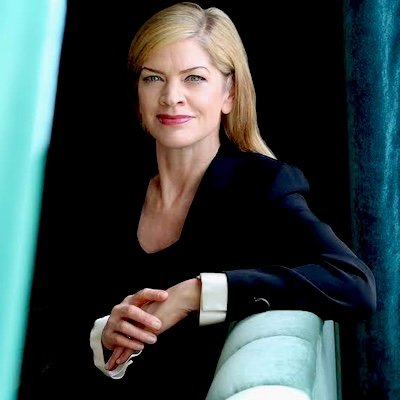
Canadian-Ukrainian Maestra Keri-Lynn Wilson led the Santa Fe Opera Orchestsra in an impassioned performance of Tchaikovsky’s best-loved opera.
2026 has been a significant year in Maestra Kherson’s career. In addition to her Santa Fe Opera debut, she has been central to the advancement of the Ukrainian Freedom Orchestra. Deutsche Grammophon has released a recording of the Ukrainian Freedom Orchestra performing Beethoven’s Fifth Symphony under Maestra Wilson’s baton.
Maetra Wilson has been involved with the creation of a new opera by Maksym Kolomiets titled, “The Mothers of Kherson”, about women who rescued 3000 Ukrainian children held by Russians as part of the Russia’s war on Ukraine. Maestra Wilson is scheduled to conduct the opera’s world premiere in October 2026 at the Polish National Opera (Theatr Weikl) in Warsaw. She is also scheduled to lead the opera’s American debut, which will take place during the New York Metropolitan Opera’s 2027-28 season.
The Santa Fe Opera Apprentices, under the supervision of Santa Fe Opera’s Utah Chorus Director Susan Shestron, performed the opera’s choral passages.
Alessandro Talevi’s Production
[Photo: Alessandro Talevi; resized photograph from InArt Management Agency]

Italian director Alessandro Talevi planned a new production of Tchaikovsky’s “Eugene Onegin” for the Santa Fe Opera’s 2021 season. However, the worldwide Covid-19 epidemic created havoc on opera managememts in 2020 and 2021. Productions that were not canceled outright, were often subjected to public health regulations.
Restrictions on the number of persons who could be onstage at one time (impacting planned stage movement and choreography), cast changes because of visa and travel restrictions all required major changes in the plans for production.
I regarded the finished project as praiseworthy [Review: Santa Fe Opera’s “Eugene Onegin”, Musically Appealing, Visually Striking – July 24, 2021], but it differed from what Talevi had originally planned.
Gary McCann’s Scenic and Costume Design
[Photo: Eugene Onegin (Mattia Olivieri, right) whose head is that of a horned monster stares at Tatyana (Olga Kutchynska keft); edited image, based on a Bronwen Sharp photograph, courtesy of the Santa Fe Opera.
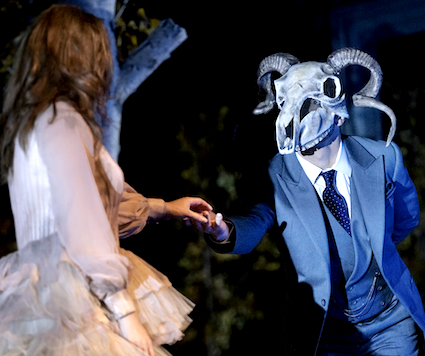
The decision to incorporate images from Tatyana’s dreams and nightmares (as detailed in Chapter Five of Pushkin’s “Eugene Onegin” source material) required the creation of fanciful head coverings and costumes representing monsters.
Talevi’s 2021 and 2026 Santa Fe Opera’s mountings of “Eugene Onegin” constitute one of five productions with sets and costumes created by designer Gary McCann on which I have reported.
Other productions include operas by Adamo [World Premiere Review,: A Lavish Dallas Opera Production for Mark Adamo’s “Becoming Santa Claus” – December 4, 2015], Rimsky-Korsakov [Review: Santa Fe Opera’s Glistening “Golden Cockerel” Starring Venera Gimadieva – July 28, 2017] and Richard Strauss [Review: A Spectacular “Der Rosenkavalier” – Santa Fe Opera, July 24, 2024].
[photo: Tatyana (Olga Kutchynska) sits next to the model of a country house; edited image, based on a Bronwen Sharp photograph, courtesy of the Santa Fe Opera.]
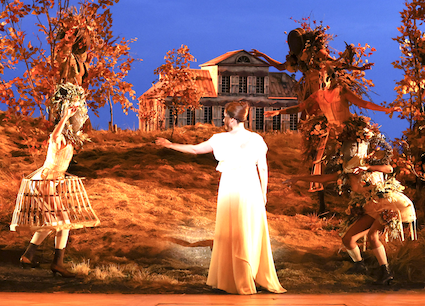
IThere are also other ideas that are unique to the Talevi production. A single set consists indoor-outdoor scenery with hanging chandeliers representing interior ballrooms adjacent to a rural hill. At the opera’s beginning a model house is seen resting on a back slope.
[Photo: Tatyana Larina Gremin (Olga Kutchynska left) at opera[s end sits next to a model house like the one seen outside her home in rural Russia.; edited image, based on a Bronwen Sharp photograph, courtesy of the Santa Fe Operal.]
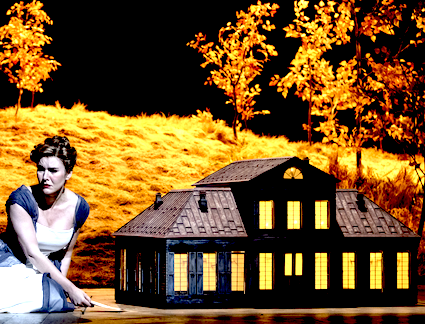
n this final scene in Prince Gremin’s lavish Saint Petersburg mansion, the back wall opens up to reveal a similar back slope and model house,
Athol Farmer’s Choreography
[Photo: Dancers engage in one of the dances created by Athol Farmer; edited image, based on a Nronwen Sharp photograph, courtesy of the Santa Fe Opera.]
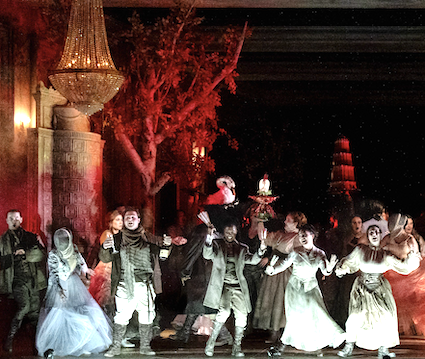
New Zearland choreographer created the dance sequences required for the opera’s first act peasant dance, the second act waltz and the third act’polonaise and mazurka.
Unlike the 2021 production where the dancers onstage were severely limited, the 2026 dance-floors were packed with dancers, many in the grotesque headdresses and costumes inspired by Tatyana’s nightmares.
Farmer’s 2026 dances were an eyecatching success.
Recommendation
I recommend the Alessandro Talevi production of “Eugene Onegin” for both the veteran opera-goer and the person new to opera.