
This review is of the fourth of seven Santa Fe Opera 2025 performances of the Julien Chavaz production of Verdi’s “Rigoletto”, a co-production with Irish National Opera (Dublin, Ireland) and Oper Zuid (Maastricht, Netherlands)
Michael Chioldi’s Rigoletto
[Phoro: Rigoletto (Michael Chioldi, center) is surrounded by the Duke of Mantua’s courtiers; edited image, based on a Curtis Brown photograph, courtesy of the Santa Fe Opera.]

Cast in the title role is New York baritone Michael Chioldi, who had performed the role in the Irish National Opera’s mounting of Chavaz’ production. When the artist originally scheduled as Rigoletto withdrew, Chioldi replaced him for all seven performances.
Chioldi possesses the full-bodied dramatic baritone voice that is needed for this iconic role. For most of the opera costumed as if he was a toy clown, Chioldi transcended his surroundings. His character’s fateful encounter with the assassin Sparafucile, his powerful performance of Rigoletto’s great aria ‘Cortigiani’, his affecting duets with his character’s daughter, Gilda, especially the final scene, were exemplary of a major artist’s approach to the role.
Chioldi received early training in young artists’ programs conducted by the San Francisco Opera and Houston Grand Opera.
I first saw Chioldi at the Kennedy Center 15 years ago, in the title role of French composer Ambroise Thomas’ “Hamlet” [Review: Michael Chioldi, Micaela Oeste Enrich Washington National Opera’s Theatrically Absorbing “Hamlet” – May 22, 2010]. I had praised his vocal power and convincing acting in that role. Seven years later I saw him perform the comprimario role of Abimelech at The Dallas Opera [Review: A Power House Dallas Opera “Samson” with Borodina, Forbis, Fink – October 25, 2017]. Although Chioldi’s appearance was luxury casting, the strong impression he made as the Philistine leader is a lasting memory of that performance.
Elena Villalón’s Gilda
[Photo: Elena Villalón as Gilda; edited image, based on a Curtis Brown photograph, courtesy of the Santa Fe Overall]

Texas soprano Elena Villalón was cast as Rigoletto’s sheltered daughter, Gilda. The role of Gilda is a psychologically complex one, centered on her infatuation with a young man. At first, she is unaware that that man is the womanizing Duke of Mantua, her father’s employer.
As the events of the opera take place, she will have a few romantic moments with a man she believes to be an impoverished student, she will be kidnapped, she will be placed in the Duke of Mantua’s bed for sex, which, importantly, is either consensual or rape, she will stand beside her father as he cries for vengeance, and she will watch the Duke attempt to make love to Sparafucile’s sister.
Verdi provides some clues that suggest Gilda has fallen in love with the Duke. During the part of the opera that Gilda is unenlightened about the identity of the handsome man who is pursuing her, Verdi has provided the artists performing Gilda and the Duke with ardent, melodious duets, beginning with ‘Signor ne principe io lo vorrei’,
As the Duke prepares to leave, he gives her a false name. Gilda’s belief that the Duke is an impoverished student leads to Gilda’s “Caro nome”, one of the greatest arias in the coloratura soprano’s repertory, which Villalón sang superbly.
[Photo: Gilda (Elena Villalón, left) is pursued by a handsome stranger who is in reality, the Duke of Mantua (Duke Kim, right); edited image, based on a Curtis Brown photograph, courtesy of the Santa Fe Opera.]

Even while the aria “Caro nome’ is ending, the Duke’s courtiers are preparing to kidnap Gilda, tricking her father whom they blindfold into believing they are engaged in an action against another courtier. The kidnapped Gilda is brought to the Duke’s bed, who, we assume, rapes her. When Gilda is free, she joins her father in a furious duet ‘Si vendetta, tremenda vendetta’ aimed at revenge against the Duke.
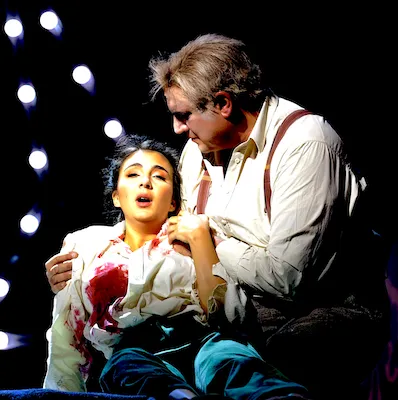
Yet, in the final scenes, that make Verdi’s opera s plot a controversial one, Gilda chooses to sacrifice herself to spare the Duke’s life. In her plaintive final duet with Chioldi’s Rigoletto, the dying Gilda sings the heavenly words ‘Lassu in cielo, vicina alla madre’ in the waning moments of her life. Few would dispute the emotional power that Villalón brought to this heartwrenching finale.
Villalón’s Santa Fe Opera debut in the nicely performed role of Nannetta took place three seasons earlier [Review: Quinn Kelsey Delights in Sir David McVicar’s New “Falstaff” Production – Santa Fe Opera, August 4, 2022] and was followed by her role of Sheila in last season’s world premiere of Gregory Spears; latest work [World Premiere Run Review: Gregory Spears’ “The Righteous”, Santa Fe Opera, July 26, 2024].
Earlier in her career, Villalón was a member of the Houston Grand Opera’s Young Artists’ program
Duke Kim’s Duke of Mantua
[Photo: The Duke of Mantua (Duke Kim) visits the assassin Saprafucile’s Inn; edited image, based on a Curtis Brown photograph, courtesy of the Santa Fe Opera.

Republic of Korea tenor Duke Kim displayed an attractive lyric tenor voice, with which, surrounded by his courtiers, he performed the first scene’s ballata ‘Questa o quella, per me pari sono’.
It is the second scene, that takes place in RIgoletto’s and Gilda’s apartment in which Kim’s special relationship with this role becomes evident. I have seen many tenors perform the role of the Duke (some well into middle age), but have never seen a tenor who appears as young as Kim, who plausibly could pass for an impoverished student. He was an appealing presence in his interactions with Villalón’s Gilda (and her maid Giovanna, who assisted the Duke in gaining access to Rigoletto”s apartment).
The duets between Gilda and the Duke in Rigoletto’s apartment are among Verdi’s finest “middle period” compositions. These include the ‘cantabile’ passage beginning ‘E’ul sol del anima, la vita e amore’, followed soon after with the ‘vivacissimo’ duet “Addio, addio, speranza ed anima’. These are believable duets involving two young lovers, instead of, as sometimes seems the case, a young girl singing with a philandering roué.
Kim also excelled in his perfromances in the last act showstoppers, the aria ‘La donna e mobile’ and the tenor part of the famous Rigoletto Quartet, ‘Bella figlia, dall’amore’, sung with Chioldi’s Rigoletto, Villalón’s Gilda and Marcela Rahal’s Maddalena.
Kim was a Santa Fe Apprentice in the 2019 and 2021 seasons. In his first apprenticenship year, he performed a role in a new opera [See ‘World Premiere Review: Poul Ruders’ “Thirteenth Child” – Santa Fe Opera, July 27, 2019.]
Stephano Park’s Sparafucile and Marcela Rahal’s Maddalena
[Photo: Stephano Park (left) is Sparafucile and Marcela Rahal (right) is Maddalena; edited image, based on a Curtis Brown photograph, courtesy of the Santa Fe Opera.

Republic of Korea bass Stephano Park was cast as the assassin Sparafucile, who not only offers his services to Rigoleltto, but explains why Rigoletto needs those services. Park proved effective in this sinister role, both in the early scene in which he first introduces himself to Rigoletto, then in the later scene at his Inn, where his arguments with Maddalena determine the fate of the Duke (and, indirectly, Gilda).
Brazilian mezzo-soprano Marcela Rahal gave a strong performance as Sparfucile’s sister, Maddalena, who assists her brother in his professional duties as a murderer-for-hire. Maddalena, both vocally and dramatically, is a dominant force in the scene in Sparafucile’s Inn, making the character one of the most important comprimario roles in Verdian opera. Rahal was persuasive in the role.
This season’s performances are the occasion of the Santa Fe Opera debuts of both Park and Raval.
Le Bu’s Monterone and Other Cast Members
[Photo: Le Bu as the Count Monterone, here being led to his execution by the Duke’s men; edited image, based on a Curtis Brown photograph, courtesy of the Santa Fe Opera.]

Chinese tenor Le Bu portrayed the Count Monterone, who hurls a fateful curse at Rigoletto when he mocks Monterone’s denunciation of the Duke’s seduction of the Count’s daughter.
This was my second opporutnity to hear Le Bu, who performed the role of one of the five pastore in Monteverdi’s “Orfeo”. [Review: Luke Sutliff, Replacing Injured Rolando Villazón, Triumphs in Opening Night of Monteverdi’s “Orfeo” – Santa Fe Opera, July 29, 2023.]
Santa Fe Opera Apprentices performing were Texas tenor Ryan Bryce Johnson as Borsa, Colorado mezzo-soprano Kayla Nanto as Countess Ceprano, Illinois baritone Ryan Wolfe as Marullo, Canadian baritone Korin Thomas-Smith as Count Ceprano, Canadian mezzo-soprano Simona Genga as Giovanna, New York mezzo-soprano Mary Beth Nelson Zaros as a Page and New Hampshire bass-baritone Evan Landowski as Count Usher.
[Photo: Rigoletto (Michael Chioldi, right) comforts his dying daughter, Gilda (Elena Villalón, left); edited image, based on a Curtis Brown photograph, courtesy of the Santa Fe Opera.]
Maestro Carlo Montanaro and the Santa Fe Opera Orchestra and Chorus
The Santa Fe Opera Orchestra performed brilliantly under the baton of Italian Maestro Carlo Montanaro in his Santa Fe Opera debut season.
In past seasons, I have appreciated Montanaro’s work elsewhere in the operas of Verdi [See Review: “Attila” in Italy with a Phenomenal Ferruccio Furlanetto – San Francisco Opera, June 12, 2012 and Review: O’Neill, Pérez and Vratogna Impressive in Houston Grand Opera’s “Otello” – November 1, 2014 and Review: Hurt, Bauer, Angeletti, Barton, Thomas in “Nabucco” – Seattle Opera, August 9, 2015
The 2025 Santa Fe Opera Apprentices performed as the Chorus, under the direction of Utah Chorus Director Susanne Sheston. They were a lively presence in the scenes taking place in the Mantuan court.
Julien Chavaz’ Direction and Jamie Vartan’s Scenic Design
[Photo: The opera’s final scene, when a jester’s cap flashes on as Rigoletto (Michael Chioldi, standing) sings the world “maledizione”; edited image, based on a Curtis Brown photograph, courtesy of the Santa Fe Opera.]

Swiss director Julien Chavaz, in collaboration with English designer Jamie Vartan, developed a concept that relied on visual images. Various scenes in the opera took place in odd-shaped blocks. Lamps and candles were a major part of the scenic design, and bright background lights were often present.
The signature idea in Chavaz’ concept was the final scene. Blocs of scenery and panels of light moved into a position in which a multicolored neon lighting illuminates a jester’s cap as Rigoletto intones the opera’s final word, ‘maledizione’.
Although I understood what director Chavaz was attempting to do, I am unconvinced it needed to be done. The odd-shaped surfaces and garish lighting design did nothing to facilitate enjoyment of Verdi’s music and the opera’s story line. The evening was worthwhile because of the participating opera singers, the orchestral performance conducted by Maestro Montanaro and the excellent choral work of the Santa Fe Opera Apprentices.
Recommendation
I recommend performances of this production for the singing of its excellent cast and the support of that cast by the musicians of the oOrchestra and Chorus.