The San Francisco Opera presented Handel’s “Rodelinda” as the second offering of the final fall season of the departing General Director Pamela Rosenberg.
The excellent cast consisted of California soprano Catherine Nauglestad as Rodelinda, South Carolina countertenor David Daniels as Bartarido, Arkansas countertenor Gerald Thompson as Unulfo, British tenor Paul Nilon as Grimoaldo and Italian bass Umberto Chiummo as Garibaldi.
The Origins of Handel’s and Alden’s ‘Rodelinda”
The “Rodelinda” production introduced Director David Alden to San Francisco Opera audiences, although Alden has a substantial reputation from his work in Chicago, Houston, the Met and Europe.
His “Rodelinda” is a co-production with the Bayerische Staatsoper in Munich, which is his principal artistic home.
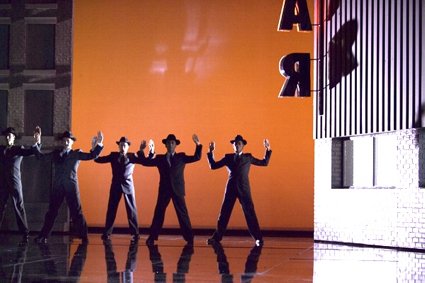
Alden and team decided for the San Francisco/Munich collaboration it should be set as a “film noir” gangster movie from the 1940s.
Catherine Nauglestad’s Rodelinda
[Photo: Rodelinda (Catherine Naglestad) inherits the responsibility to take care of her family; edited image, based on a Terrence McCarthy photograph, courtesy of the San Francisco Opera.]

Alden’s concept envisions Rodelinda as a Mafia wife, who, as Alden expressed in an interview for the San Francisco Opera program:
‘Say a purge has taken place and . . . [Rodelinda is] suddenly the only one left, and whereas she never would have had anything to do with running the family business before, now she must take over the reins and protect those around her.”
One envisions Carmela, the matriarch played by Edie Falco on ‘The Sopranos’, having to take control of the mob’s affairs.
David Daniels’ Bertarido
[Photo: the deposed Bertarido; (David Daniels) sits next to a photograph of his Mafioso family; edited image, based on a Terrence McCarthy photograph, courtesy of the San Francisco Opera.]

Alden surveyed the story line, which is preceded by a King Lear-like division of his realm between two brothers.
One of the brothers has been replaced by a usurper (Grimoaldo) who deposes the other brother Bertarido in an inter-family struggle to bring the realm back to its original state.
The latter’s wife (Rodelinda) and son Flavio are in mortal danger, with the villainous Garibaldo doing Grimoaldo’s strategic thinking.
Paul Nilon’s Grimoaldo
[Photo: Paul Nilon as Grimoaldo; edited image, based on a Terrence McCarthy photograph, courtesy of the San Francisco Opera.]

Alden’s production team includes the set designer, Paul Steinberg (who does have some experience with the San Francisco Opera), and costume designer Buki Shiff.
The story of ‘Rodelinda” derives from the work of an eighth century Italian cleric and later employee of Charlemagne, Paulus Diaconus (Paul the Deacon).
Paulus attempted a history of those ruling families of the Longobard (eventually ‘”Lombard” – the English cognate would be “long-beard”) Goths who were in power between the late sixth and early eighth centuries.
Umberto Chiummo’s Garibaldo
[Photo: Umberto Chiummo as Garibaldo; edited image, based on a Terrence McCarthy photograph, courtesy of the San Francisco Opera.]

Although not a model for contemporary historical research, Paulus’ work provides some illumination of events in what have been called the ‘Dark Ages” of pre-medieval Europe.
Paulus’ work was considered as the historical authority on the early Lombardy for several centuries.
Virtually every character in Rodelinda appears to have an historical counterpart.
Playwright Pierre Corneille’s Play About Bertarido
[Photo: the portrait of Pierre Corneille by an unknown artist; edited image, based on the portrait at the Musee du Chateau, Versailles.]

Almost 800 years later, French dramatist Pierre Corneille created his tragedy ‘Pertharite, roi des Lombards’ from elements of Paulus’ history, altering for dramatic purposes many of the events Paulus described.
Corneille’s dramas, of course, were a prime source for opera libretti, any of which, in those times, might be used by several composers.
Eventually Corneille’s ‘Pertharite’ (re-Italianized as Bertarido) was fashioned into a libretto (now centered on Bertarido’s wife and entitled “Rodelinda, regina de Longobardi.”)
Rather few Langobard families have excited the interest of later centuries, and a millennium passed by before Corneille decided to develop their story line.
[Photo: David Daniels as Bertarido; edited image, based on a Terrence McCarthy photograph, courtesy of the San Francisco Opera.]

With over 350 years separating Corneille’s play and 280 years separating Handel’s opera from the present day, modern production designers need to have a lot of imagination to decide how to stage the opera.
You can create a pre-medieval Lombard village, or locate it in a 17th century Royal Court (in deference to Corneille).
You can create an 18th century Georgian setting (in deference to Handel), or try to find a basis for 20th or 21st century themes for the production.
But in the 21st century how ‘would’ you stage a baroque opera about a lethal power struggle in a large Italian family?
David Alden has shown us how.
[Photo: the men of the San Francisco Opera chorus enact a scene from David Alden’s production of Handel’s “Rodelinda”; edited image, based on a Terrence McCarthy photograph, courtesy of the San Francisco Opera.]

]