
San Francisco Opera launched a new Leni Bauer-Ecsy production of Verdi’s “La Forza del Destino” as a vehicle for Leontyne Price. James McCracken was her Don Alvaro in a stirring performance led by Italian Conductor Francesco Molinari-Pradelli.
[Below: the Leni Bauer-Ecsy sets for the monastery scene in “La Forza del Destino”; edited image, based on a Pete Peters photograph, courtesy of the San Francisco Opera.]

Leontyne Price’s Leonora di Vargas
Mississippi soprano Leontyne Price had previously sung two Verdi roles at San Francisco;s War Memorial Opera House – the title role of Verdi’s “Aida” and the role of Leonora in Verdi’s “Il Trovatore”, This season she also performed the role of Leonora di Vargas in Verdi’s “La Forza del Destino”.
This was my second opportunity to see and hear Price in a Verdi role [see also Historical Performances: “Aida” with Price, Konya, Resnik, Shaw and Tozzi – San Francisco Opera, September 21, 1963.] She met all of an opera-goers expectations of a Verdian soprano of the first rank. Between her Aida and her Leonora di Vargas, she also performed the iconic title role of Puccini’s “Tosca” with great distinction. [See .Historical Performances: Leontyne Price, Konya, Shaw in “Tosca” – San Francisco Opera, October 3, 1963.
I agree fully with the assessment of Arthur Bloomfield, the San Francisco Examiner critic and historian of the San Francisco Opera general directorships of Gaetano Merola and Kurt Herbert Adler years.
Bloomfield’s review of the 1963 “Forza” performance reported that “[w]ith [Leontyne Price’s] soaring line, smooth from a light, sweet top down to those velvety chest tones, she had no trouble establishing the happy inevitablilty of her assignment [as Leonora di Vargas]. McCracken was the heroic, plaintive-voiced Alvaro.”
[Below: Leontyne Price as Leonora di Vargas; edited image, based on a Carolyn Mason Jones photograph, courtesy of the San Francisco Opera Archives.]
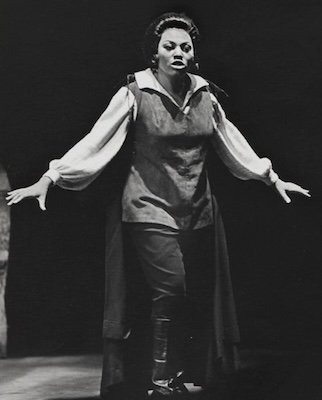
Only two “Forza” performances were scheduled for the 1963 season. Price’s later participation in revivals of the opera “Forza” in 1965, 1969 and 1981 resulted in her achieving 18 total San Francisco appearances as Leonora di Vargas at the War Memorial Opera House, where ultimately she performed 47 Verdi roles. (Her other San Francisco Verdi roles: 12 of Aida, seven of Amelia in “Un Ballo in Maschera”, six of the “Trovatore” Leonora, and four of Leonora role in “Ernani”.
In past articles on Leontyne Price’s appearances in San Francisco (which she often referred to as her “home company”), I have noted the close association between her studio recording schedule and her operas mounted for her by the San Francisco Opera.
Price’s 1963 performances as the “Forza” Leonora in San Francisco pre-dated by a few weeks her 1964 studio recording for RCA conducted by Thomas Schippers, co-starring Richard Tucker, Robert Merrill, Shirley Verrett and Giorgio Tozzi.
James McCracken’s Don Alvaro and Julien Haas’ Don Carlo
The cast surrounding Price was also noteworthy. This was my second opportunity this season to hear the robust spinto tenor of James McCracken, who a month earlier performed the role of Saint-Saens’ Samson [See Historical Perfomances: James McCracken is the Star of “Samson et Dalila” – San Francisco Opera, September 26, 1963.
In the previous season, McCracken tackled what many regard as the most demanding role in the Italian tenor repertory, the title role of Verdi’s “Otello” [Historical Performances: McCracken, de los Angeles and Gobbi in “Otello” – San Francisco Opera, October 9, 1962] .
The role of Don Alvaro includes the aria Tu che im seno agli angeli, one of the Verdi tenor arias that, properly performed, tugs at the heartstrings. McCracken left us, as one would hope, with heartstrings in disarray.
[Below: James McCracken as Don Alvaro in the 1963 San Francisco Opera production of “La Forza del Destino”; edited image, based on a Maria de Monte photograph, courtesy of the San Francisco Opera.

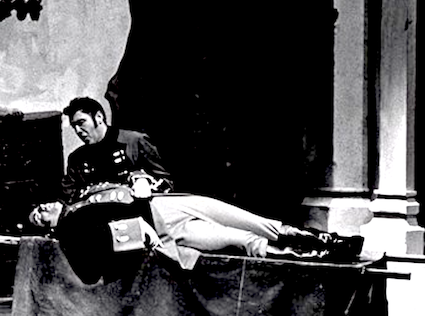
“Foza del Destino” includes important duets between principals, including tow between Leonora’s lover Don Alvaro and her brother Don Carlo. One of the latter is Solenne in quest’ora in which Don Carlo, sung in this performance by 33 year old French tenor Julien Haas, seeks to aide the recovery of his battlefield companion, Don Alvaro.
I was present at Haas’ San Francisco Opera debut as the High Priest in the McCracken led performance of “Samson et Dalila” noted above. Although Haas sang four roles at the War Memorial Opera House, all in 1963, they totalled only six – including single performances of Amonasro and Baron Scarpia (each role sung by John Shaw in performances I attended) After this “Forza”, I never saw Haas perform anywhere again.
[Below: Don Carlo (Uulien Haas, above) tends to the injured Don alvaro (Janes Mc Crackeh, prostrate); edited image, based on a photograph, courtesy of the San Francisoco Opera Archives.]
Walter Kreppel’s Padre Guardiano, Elfego Esparza’s Fra Melitone and Janis Martin’s Presiozilla
German bass Walter Kreppel was Padre Guardiano. Kreppel had been Hunding in “Die Walküre” a few days prior, one of several assignments in principal and comprimario roles he sang during the San Francisco Opera’s 1963 and 1966 seasons.
[Below: Padre Guardiano (Walter Kreppel) welcomes the pilgrim Leonora di Vargas (Leontyne Price, back to camera, into the monastic community; edited image, based on a production photograph, courtesy of the San Francisco Opera Archives.]
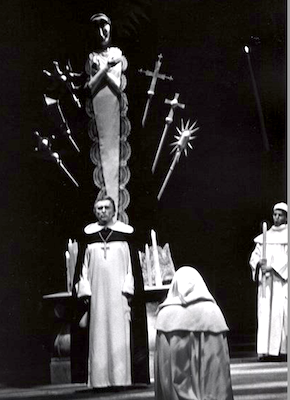
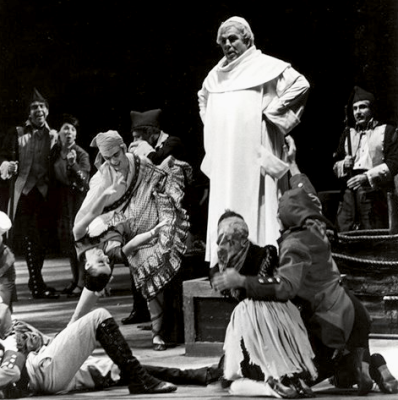
Spanish bass Elfego Esparza showed mastery of the comic role of Fra Melitone.
[Below: Fra Melitone (Elfego Exparza, standing center right in white robe; edited image, based on a Pete Peters photograph, courtesy of the San Francisco Opera.]
Janis Marton, still early in what proved to be an important career with the San Francisco Opera, was a lively Preziosilla.
[Below: Janis Martin as Preziosilla in the 1963 San Francisco Opera production of “La Forza del Destino”; edited image, based on a Maria de Monte photograph, courtesy of the San Francisco Opera.]

Although any performance by Price or McCracken at San Francisco Opera House was an exciting experience, the remainder of the 1963 cast, excepting Martin’s Preziosilla, was, to my taste, more routine than would be the case two seasons later, when Price would return in “Forza” with Sandor Konya, Raymond Wolansky, Ugo Trama and Heinz Blankenburg.
Notes on 1963 and 2013 Performances Attended
This is the tenth of the observations of performances I attended (all at the War Memorial Opera House in San Francisco) in 1963. Interestingly, and, to a degree, coincidentally, nine of the ten operas on which I have reported is one I reviewed at least once somewhere in the United States in 2013: Bellini’s “La Sonnambula”, Mozart’s “Cosi fan Tutte”, Offenbach’s “Tales of Hoffmann”, Puccini’s “Tosca”, Rossini’s “Barber of Seville”, Saint-Saens’ “Samson et Dalila”, Verdi’s “Aida’ and “Forza del Destino” and Wagner’s “Walküre”.
In 2013, I reported on the new “Forza del Destino” production at Washington National Opera and the “Walküre” revival at Seattle Opera as part of the latter company’s “Ring of the Nibelungs”. I attended performances of “Aida” in San Diego and Houston.
For “Sonnambula” (a rarity in the United States in the past half century) I traveled to Miami, for “Samson et Dalila” to San Diego, and for “Tosca” to Los Angeles.
Three of these 1963 offerings were also performed at the War Memorial in 2013 – a new production of “Barbiere di Siviglia”, mounted 50 years after the company’s classic Rennert production. The San Francisco Opera summer season included s a new production of “Tales of Hoffmann” and a revival of “Cosi fan Tutte”.
In reflecting on the 1963 and 2013 performances of each of these nine operas, there is much I would like to say. I will return to this subject in my year-end “Thoughts and Assessments” feature.
There is one additional report from 1963 to be published – my account of the San Francisco Opera revival of Poulenc’s “Dialogues of the Carmelites” (which I have not seen performed in 2013.)